
Revision summary
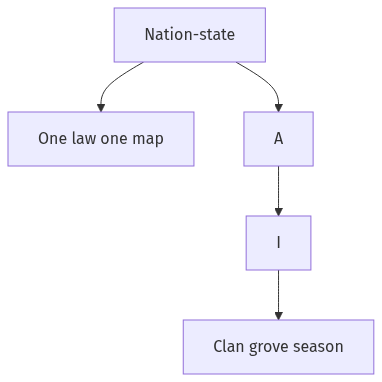
Nation-state: one people, territory, law and citizenship; indigenous life is clan, grove and seasonal land. India is a Union with asymmetric clauses, not a pure nation-state, but still centralising in school, army and mine. Impacts: borders, legal monopoly, standard language, development-security, market. FRA, PESA, 371 and Sixth Schedule are domestic tools of coexistence. India has not ratified ILO 169; consultation remains the unkept promise.
Model answer
Copper italics in this answer — like this — are the key facts. Each one is unpacked in the Facts & figures rail.
Introduction
A nation-state claims one people, one territory, one law, one citizenship. Indigenous societies were historically organised by clan, village and seasonal territory, not by that monopoly. Independent India is a constitutional Union of states, not a textbook France, but it still presses indigenous life into a single map.
Body
The concept
In European political theory (and in Weber’s monopoly of legitimate force) the nation-state replaces empire and tribe. Benedict Anderson’s imagined community is its cultural form. Indigenous here means Adivasi and similar peoples with prior occupancy and a distinct public — the sense used in UNDRIP and, cautiously, in Indian scholarship even though India officially prefers “Scheduled Tribe” to “indigenous people” in some UN forums.
Indian impact
- Cartographic: Inner and international borders cut Naga, Mizo, Khasi and pastoral worlds. Inner Line is a colonial tool reused by the nation-state.
- Legal monopoly: Customary courts survive only as the Constitution allows (371A, Sixth Schedule, tribal customs in personal law). Samata and Niyamgiri are indigenous wins inside that monopoly.
- School and language: The nation teaches a standard language and history. Mother-tongue policy is the concession.
- Development and army: Dams, mines, and AFSPA-bearing regions make the state felt as road and rifle. Elwin already feared this in NEFA.
- Market: Forest becomes timber and carbon; labour becomes circular migration.
- Positive impacts exist: universal franchise, ST reservation, FRA as a national statute that recognises community title, Panchsheel as official ethic. The nation-state can protect a small people against a local king or a company — when it chooses.
Critique
Xaxa and indigenous theorists say the nation-state sees like a list. It cannot easily see a people who live across two districts or two countries. ILO 169 (not ratified by India) would demand consultation as a right. India uses PESA and FRA as domestic analogues.
The remedy inside the Union is asymmetric federalism (371, Sixth Schedule, tribal majority states) plus Gram Sabha consent, not a romantic exit from citizenship. Citizenship without land is a hollow nation for the indigenous household.
Flow diagram
Conclusion
The nation-state wants one law and one map. Indian indigenous societies meet it as list, school, border and project. Asymmetric federalism, FRA and PESA are the working compromise; they fail when the map is drawn before the grove is asked.
Quick related
Students also ask
-
Custodians of natural resources are the tribals, but they are the most deprived. Critically examine how climate change will impact their survival in future.
Next question on this syllabus topic (2024 · Q6(a)). View answer →
-
Does India deny that Adivasis are indigenous?
Officially it often says all Indians are indigenous in a civilisational sense. In practice ST law is the indigenous-rights analogue.
-
Is secession the only indigenous politics?
No. Most Indian indigenous politics asks for autonomy, title and consent inside the Union.
Same topic · past papers
UPSC has asked this before
These previous-year questions sit on the same topic. Open one to practise the earlier ask.
-
2024 · Q5(b) · Anthropology GS 2 · 10 marks
Describe ILO's Convention No. 169 (1989) on Indigenous and Tribal people. Is India a signatory to it?
More from this topic
Q6(b) · UPSC Mains 2026 · Anthropology GS 2 · 15 marks · Solution
Discuss the impact of democratic institutions on the tribal populations of India
Social change and contemporary tribal societies
1. The Indian Constitution and democratic framework have deeply transformed tribal socio-political landscapes. 2. The Fifth and Sixth Schedules provide distinct administrative autonomies to protect tribal land and culture. 3. The PESA Act, 1996, empowers Gram Sabhas with self-governance and resource management in Scheduled Areas. 4. Political reservations ensure nominal legislative representation for Scheduled Tribes in Parliament and Assemblies. 5. High voter turnout and new educated leaders show successful electoral integration and political efficacy. 6. However, structural issues like bureaucratic paternalism and elite capture often turn local bodies into rubber stamps. 7. Major development projects frequently override Gram Sabha dissent, creating a gap between token and substantive democracy. 8. True tribal autonomy requires strengthening local institutions and ensuring informed consent in resource management.
Q7(a) · UPSC Mains 2025 · Anthropology GS 2 · 20 marks · Solution
Identify the contemporary limitations in the process of tribal development. How can anthropological knowledge contribute in this process?
Social change and contemporary tribal societies
Limits: consent deficit, list-area mismatch, livelihood substitution, last-mile services, security overlay, elite capture, blunt data. Xaxa, PESA, FRA and Niyamgiri name the same gap between paper and hamlet. Anthropology contributes field method, ethnoecology, medical and linguistic knowledge, gendered land. Use it in FRA mapping and social impact before clearance, not as decoration in an EIA. PM-JANMAN helps only if PVTG hamlets author the micro-plan.
Q6(b) · UPSC Mains 2025 · Anthropology GS 2 · 15 marks · Solution
Discuss the role of NGOs in the socioeconomic and political development of weaker sections and the manner in which they facilitate other stakeholders
Social change and contemporary tribal societies
NGOs run last-mile services and translate FRA, PESA, scholarships and health camps for ST, SC and minorities. Politically they support Gram Sabha, RTI and PIL; Niyamgiri-type cases show them beside, not above, the village. They broker schemes, banks and CSR. Risks: donor capture, FCRA chill, elite contractors, substitution of the state. Xaxa’s measure is whether the hamlet still decides.