
Revision summary
Limits: consent deficit, list-area mismatch, livelihood substitution, last-mile services, security overlay, elite capture, blunt data. Xaxa, PESA, FRA and Niyamgiri name the same gap between paper and hamlet. Anthropology contributes field method, ethnoecology, medical and linguistic knowledge, gendered land. Use it in FRA mapping and social impact before clearance, not as decoration in an EIA. PM-JANMAN helps only if PVTG hamlets author the micro-plan.
Model answer
Copper italics in this answer — like this — are the key facts. Each one is unpacked in the Facts & figures rail.
Introduction
- Tribal development fails less from a shortage of schemes than from a wrong process: targets without consent, land without record, schools without language, clinics without trust. Anthropology’s contribution is that process — how a hamlet actually lives — not a new slogan.
Body
Contemporary limitations
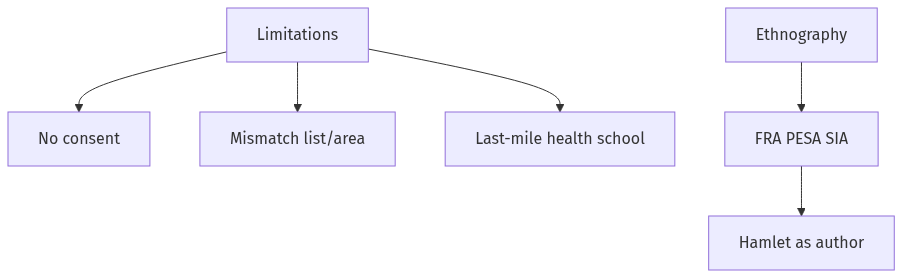
- Consent deficit: Mines, dams, tiger corridors and plantations still arrive as faits accomplis. PESA Gram Sabha and FRA community forest rights exist on paper; Xaxa documented how officers treat them as hurdles. Niyamgiri is the exception that proves the rule.
- List and area mismatch: ST certificates, Fifth Schedule maps and actual hamlets do not coincide. PVTGs inside a “developed” block remain invisible until PM-JANMAN.
- Livelihood substitution: Tendu and mahua cash, then a ban or a contractor; jhum labelled backward without a wet-rice alternative that works at that slope.
- Human development last mile: teacher and ANM vacancies, instruction in a non-mother tongue, sickle-cell and malaria treated as character. Expert Committee on Tribal Health said this.
- Security overlay: In central Indian and some North-Eastern belts, development is routed through camps and roads first. Anthropology of fear is not in the DPR.
- Elite capture: A small ST contractor class takes panchayat and mining liaison; women and PVTGs do not.
- Data: No hamlet-level, season-sensitive food calendar in the MIS.
What anthropology contributes
Participant observation and genealogies show who really holds land and who only has a patta. Ethnoecology maps grove, jhum cycle and women’s collection, which FRA claims need. Medical anthropology explains why a tablet is refused and how a gunia and an ANM could share a protocol. Linguistic respect designs the school that NCF now also asks for in mother tongue. Gendered ethnography stops treating “the tribe” as male hunters.
Anthropologists in Tribal Research Institutes, in Gram Sabha FRA mapping, and in social impact assessment under the 2013 land Act are already the applied form. The limit is when anthropology becomes a rapid appraisal for a clearance file.
- Knowledge contributes if it is upstream: before the dam alignment, not as a chapter in the EIA after the contract is signed. It contributes if the sarpanch and the woman collector of mahua are co-authors of the plan, which is the spirit of PESA and of Elwin’s NEFA caution without Elwin’s romance.
Flow diagram
Conclusion
The limitation is a development process that skips consent, language and season. Anthropological knowledge repairs that process when it is used to write FRA maps, health protocols and school language with the hamlet, before the project, not after the protest.
Quick related
Students also ask
-
Critically evaluate the concept of Nation-State and describe its impact on indigenous societies
Next question on this syllabus topic (2025 · Q7(c)). View answer →
-
Is more money the main missing piece?
Money without Gram Sabha and forest rights repeats the same roads-and-colonies pattern. Process is the constraint.
-
Should every project hire an anthropologist?
An independent hamlet study is useful. A consultant who only fills a form is not anthropological knowledge.
Same topic · past papers
UPSC has asked this before
These previous-year questions sit on the same topic. Open one to practise the earlier ask.
-
2025 · Q4(c) · Anthropology GS 2 · 15 marks
Critically examine the concept of Scheduled Tribe (ST) and mention the limitations of administrator's criteria -
2016 · Q8(c) · Anthropology GS 2 · 15 marks
Describe how anthropological knowledge and methods are useful in rural development -
2015 · Q3(c) · Anthropology GS 2 · 15 marks
Describe the paleoanthropological fossil finds from Siwalik hills. Examine the contribution of Siwalik fossils to paleoanthropological knowledge
More from this topic
Q6(b) · UPSC Mains 2026 · Anthropology GS 2 · 15 marks · Solution
Discuss the impact of democratic institutions on the tribal populations of India
Social change and contemporary tribal societies
1. The Indian Constitution and democratic framework have deeply transformed tribal socio-political landscapes. 2. The Fifth and Sixth Schedules provide distinct administrative autonomies to protect tribal land and culture. 3. The PESA Act, 1996, empowers Gram Sabhas with self-governance and resource management in Scheduled Areas. 4. Political reservations ensure nominal legislative representation for Scheduled Tribes in Parliament and Assemblies. 5. High voter turnout and new educated leaders show successful electoral integration and political efficacy. 6. However, structural issues like bureaucratic paternalism and elite capture often turn local bodies into rubber stamps. 7. Major development projects frequently override Gram Sabha dissent, creating a gap between token and substantive democracy. 8. True tribal autonomy requires strengthening local institutions and ensuring informed consent in resource management.
Q7(c) · UPSC Mains 2025 · Anthropology GS 2 · 15 marks · Solution
Critically evaluate the concept of Nation-State and describe its impact on indigenous societies
Social change and contemporary tribal societies
Nation-state: one people, territory, law and citizenship; indigenous life is clan, grove and seasonal land. India is a Union with asymmetric clauses, not a pure nation-state, but still centralising in school, army and mine. Impacts: borders, legal monopoly, standard language, development-security, market. FRA, PESA, 371 and Sixth Schedule are domestic tools of coexistence. India has not ratified ILO 169; consultation remains the unkept promise.
Q6(b) · UPSC Mains 2025 · Anthropology GS 2 · 15 marks · Solution
Discuss the role of NGOs in the socioeconomic and political development of weaker sections and the manner in which they facilitate other stakeholders
Social change and contemporary tribal societies
NGOs run last-mile services and translate FRA, PESA, scholarships and health camps for ST, SC and minorities. Politically they support Gram Sabha, RTI and PIL; Niyamgiri-type cases show them beside, not above, the village. They broker schemes, banks and CSR. Risks: donor capture, FCRA chill, elite contractors, substitution of the state. Xaxa’s measure is whether the hamlet still decides.