
Revision summary
Tribals have managed forests and uplands but Forest Acts and industry stripped title, leaving deprivation beside custody. Climate change will thin wild food, disturb jhum and wet-rice water, raise coastal and mountain risk, and worsen health. Carbon and fortress conservation can evict as 1878 did. FRA, PESA, PVTG habitat rights and Gram Sabha consent are the survival toolkit. Custody must include livelihood, not a duty to remain poor.
Model answer
Copper italics in this answer — like this — are the key facts. Each one is unpacked in the Facts & figures rail.
Introduction
Tribal communities have long managed forests, hills, coasts and uplands that the rest of India now calls natural resources. They remain among the most land-poor, nutritionally insecure and politically thin groups. Climate change will widen that gap unless rights, not only relief, organise the response.
Body
Custodians who do not own
L. P. Vidyarthi’s nature–man–spirit complex and Elwin’s aboriginal ecology described care of grove, river and jhum cycle. Roy Burman’s buffer zone tried to keep that care spatially intact. Yet Forest Acts 1878 and 1927, mines, dams and parks took title. The custodian became an encroacher. FRA 2006 and PESA are attempts to realign law with that older custody. Deprivation is therefore political, not a failure of tribal intelligence.
How climate change will hit survival
Forests and jhum. Hotter, drier or more erratic monsoon years shorten fallow, raise fire, and collapse millet and sal-seed calendars. PVTGs who still forage (Birhor, some Andaman groups, hill Kharia) face thinner wild food — the same path already seen in stunting notes.
Water and mountains. Himalayan and North-Eastern tribes meet glacial and cloudburst risk, slope failure, and dying springs. Apatani channels and other wet-rice systems need stable stream timing. Central Indian plateau tribes meet drought and falling groundwater beside coal pits that already heat and dust the belt.
Coasts and islands. Nicobarese, coastal fishing Scheduled Tribes, and Sundarban-adjacent groups face sea-level rise and cyclone intensity. Andaman policy must treat climate as a contact and food problem, not a tourism opportunity.
Health. Malaria belts may shift; heat kills outdoor labour; nutrition fails when PDS rice meets a failed forest snack economy. COVID-19 already showed that distant PHCs and migrant return crush tribal households. Climate is another such shock, slower and then sudden.
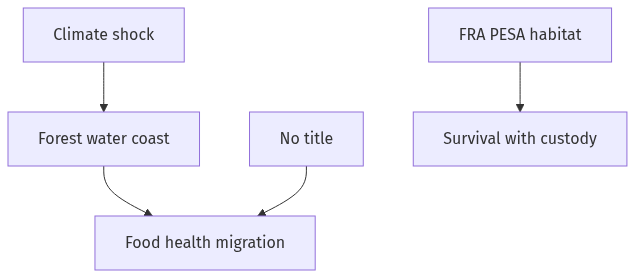
Livelihood. Distress migration will increase. Women who gather MFP lose cash when phenology shifts. Carbon forestry and fortress net-zero projects can repeat 1878: new reserved carbon, old eviction. Xaxa warned against development without consent; climate projects need the same warning.
Critical examination
Tribals are not automatically “closest to nature” in a way that saves them. Landless labourers in a mined block are as exposed as anyone, with less savings. Some tribal elites capture compensation. The paradox is structural: those who stored carbon in standing forest were not paid; those who emit are insured. Survival in future depends on community forest titles, habitat rights for PVTGs, Gram Sabha veto on diversion, public health in hamlets, and climate finance that pays keepers rather than contractors. ILO 169’s consultation standard, which India has not ratified, is the global name for that veto. Domestic FRA is the available tool.
Do not preach that tribals should stay poor to keep the forest. Custody with secure livelihood is the anthropological demand.
Flow diagram
Conclusion
Climate change will strike tribal survival through forest food, water, coasts, heat and health, on top of an older dispossession. Custodianship without title is charity geography. Rights under FRA and PESA, and a refusal of green eviction, are the conditions of future survival.
Quick related
Students also ask
-
Distinguish a 'Theocratic State' from a secular, liberal, democratic state. Illustrate your answer with examples from tribal and contemporary societies.
Next question on this syllabus topic (2024 · Q8(b)). View answer →
-
Will climate change affect all tribals the same way?
No. Island, Himalayan, plateau drought and coastal groups face different hazards. Landless labourers inside a tribe are more exposed than titled cultivators.
-
Is a tiger reserve a climate solution for tribals?
Only if rights and MFP remain. A reserve that evicts the custodian copies colonial forestry in a green vocabulary.
Same topic · past papers
UPSC has asked this before
These previous-year questions sit on the same topic. Open one to practise the earlier ask.
-
2021 · Q3(a) · Anthropology GS 2 · 20 marks
Explain the impact of the concept of nature-man-spirit complex on sustainable use of natural resources with suitable examples -
2016 · Q1(e) · Anthropology GS 2 · 10 marks
Ethno-archaeological evidences for the survival of hunting-gathering traditions in India.
More from this topic
Q6(b) · UPSC Mains 2026 · Anthropology GS 2 · 15 marks · Solution
Discuss the impact of democratic institutions on the tribal populations of India
Social change and contemporary tribal societies
1. The Indian Constitution and democratic framework have deeply transformed tribal socio-political landscapes. 2. The Fifth and Sixth Schedules provide distinct administrative autonomies to protect tribal land and culture. 3. The PESA Act, 1996, empowers Gram Sabhas with self-governance and resource management in Scheduled Areas. 4. Political reservations ensure nominal legislative representation for Scheduled Tribes in Parliament and Assemblies. 5. High voter turnout and new educated leaders show successful electoral integration and political efficacy. 6. However, structural issues like bureaucratic paternalism and elite capture often turn local bodies into rubber stamps. 7. Major development projects frequently override Gram Sabha dissent, creating a gap between token and substantive democracy. 8. True tribal autonomy requires strengthening local institutions and ensuring informed consent in resource management.
Q7(c) · UPSC Mains 2025 · Anthropology GS 2 · 15 marks · Solution
Critically evaluate the concept of Nation-State and describe its impact on indigenous societies
Social change and contemporary tribal societies
Nation-state: one people, territory, law and citizenship; indigenous life is clan, grove and seasonal land. India is a Union with asymmetric clauses, not a pure nation-state, but still centralising in school, army and mine. Impacts: borders, legal monopoly, standard language, development-security, market. FRA, PESA, 371 and Sixth Schedule are domestic tools of coexistence. India has not ratified ILO 169; consultation remains the unkept promise.
Q7(a) · UPSC Mains 2025 · Anthropology GS 2 · 20 marks · Solution
Identify the contemporary limitations in the process of tribal development. How can anthropological knowledge contribute in this process?
Social change and contemporary tribal societies
Limits: consent deficit, list-area mismatch, livelihood substitution, last-mile services, security overlay, elite capture, blunt data. Xaxa, PESA, FRA and Niyamgiri name the same gap between paper and hamlet. Anthropology contributes field method, ethnoecology, medical and linguistic knowledge, gendered land. Use it in FRA mapping and social impact before clearance, not as decoration in an EIA. PM-JANMAN helps only if PVTG hamlets author the micro-plan.