
Revision summary
Redfield’s Great Tradition is textual, specialist and pan-regional; the Little Tradition is local, oral and village or tribal. Marriott’s universalisation and parochialisation, and Srinivas’s Sanskritisation, describe the traffic between them. Vidyarthi’s Gaya sacred complex is a pilgrimage switchboard. Tribal festival-taking and sacred-grove law (FRA, PESA) are living two-way examples. The pair is a civilisation process, not two separate India.
Model answer
Copper italics in this answer — like this — are the key facts. Each one is unpacked in the Facts & figures rail.
Introduction
Robert Redfield distinguished Little and Great Traditions in peasant civilisations. McKim Marriott, Milton Singer and M. N. Srinivas made the pair a working tool for India. Communication between the two is the point of the question, not a static list of traits.
Body
Characteristics
- The Great Tradition is the literate, pan-regional, textual and specialist stream: Vedas and Puranas, shastra, classical Islam of the qazi and madrasa, Buddhist and Jain canons, temple Agamas, court music. It is carried by priests, monks, lawyers and urban elites. It claims universality.
- The Little Tradition is the local, often oral, village and tribal stream: harvest rites, lineage gods, possession, caste panchayat custom, sacred groves, local dargahs. It is carried by households, mediums, bards and elders. It is specific to a place.
Redfield insisted they are dimensions of one civilisation, not two countries. Indian civilisation is the long conversation between them.
How they communicate
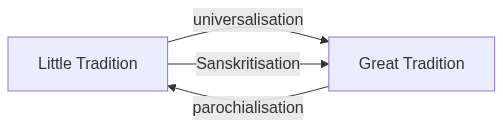
Marriott, in Kishan Garhi, named universalisation (a local goddess or rite is rewritten as a Sanskritic deity or pan-Indian festival) and parochialisation (a Puranic story is pulled down into a village plot, a local name, a local pond). Srinivas’s Sanskritisation is a related mobility strategy: a caste copies the Great Tradition’s ritual style. Islamisation and Christianisation are parallel upward or outward pulls. Tribalisation and revival of sacred groves, or the reclaiming of a village deity against a temple committee, are reverse flows.
L. P. Vidyarthi’s sacred complex of Gaya — sacred geography, sacred performances, sacred specialists — shows a pilgrimage city as a switchboard between village ancestors and a pan-Hindu Gaya-shraddha. N. K. Bose described tribes taking Hindu festivals while keeping clan gods. S. C. Roy’s Oraon and Munda work already showed this two-way traffic.
A living example is Ayyappa at Sabarimala, where forest pilgrimage, tribal hill memory and a Sanskritic vrata meet, later litigated in Indian Young Lawyers Association v. State of Kerala. Another is PESA and FRA recognising Gram Sabha and community forest resource — the Little Tradition of grove and commons — against a Forest Department that once spoke only the Great Tradition of colonial statute.
- Cinema, television and social media now carry both: a televised katha is Great Tradition in a Little living room; a village reel can become a national saint overnight.
Flow diagram
Conclusion
Little and Great Traditions are two circuits of the same civilisation. Universalisation, parochialisation and Sanskritisation are the wires between them. Indian examples run from Gaya and Kishan Garhi to sacred groves now named in forest-rights law.
Quick related
Students also ask
-
What are the ethical concerns in biological and socio-cultural anthropology because of recent advances in AI and genetic research?
Next question on this syllabus topic (2024 · Q4(a)). View answer →
-
Is the Great Tradition only Hindu?
No. Classical Islam, Sikh rahit, Buddhist and Christian liturgies are Great Traditions in the same sense; each has village little forms.
-
Does Sanskritisation destroy the Little Tradition?
It restyles it. Local gods often remain under new names. Reverse flows also occur when a caste or tribe revives a grove or a clan rite.
Same topic · past papers
UPSC has asked this before
These previous-year questions sit on the same topic. Open one to practise the earlier ask.
-
2015 · Q2(a) · Anthropology GS 2 · 20 marks
Examine the social implications of media and communication technology
More from this topic
Q8(a) · UPSC Mains 2026 · Anthropology GS 2 · 20 marks · Solution
Make a critical appraisal of Surajit Sinha's line of argument that tribes and castes may not be isolated social categories, but are a part of the great Indian civilization
Indigenous and exogenous processes of socio-cultural change in Indian society
Surajit Sinha posited that Indian tribes and castes are not isolated phenomena but integral parts of a continuous civilizational framework. Through historical processes of state formation, Hinduization, and agrarian incorporation, tribes were absorbed into the Hindu caste system. However, this civilizational view has been critiqued for masking the forced assimilation, economic exploitation, and loss of indigenous autonomy experienced by tribal communities. Contemporary tribal movements increasingly reject this seamless civilizational continuity in favor of distinct ethnic identities. Thus, Sinha's paradigm remains foundational for understanding Indian social structure while requiring critical re-evaluation.
Q4(a) · UPSC Mains 2024 · Anthropology GS 2 · 20 marks · Solution
What are the ethical concerns in biological and socio-cultural anthropology because of recent advances in AI and genetic research?
Indigenous and exogenous processes of socio-cultural change in Indian society
Genetic ethics: informed and community consent, privacy, no racial misuse of ancestry or aDNA, voluntary medical screening, strict control of heritable genome editing. Artificial intelligence ethics: biased classification, surveillance, loss of ethnographic anonymity, deepfakes and false cultural authority. ICMR, IRB, AAA and Nagoya-type benefit-sharing are the working rules. Do not treat genomes or models as a new Risley. Communities must be able to refuse sampling and recording.
Q3(a) · UPSC Mains 2023 · Anthropology GS 2 · 20 marks · Solution
"Sanskritization is a culture-bound concept." Critically comment to assess the strength and limitation of this concept in developing a theoretical framework to study social change.
Indigenous and exogenous processes of socio-cultural change in Indian society
Srinivas defined Sanskritisation as group copying of a higher caste’s ritual style to claim better rank. Its strength is empirical fit with Indian caste mobility and the little–great tradition traffic. It is culture-bound: it belongs to Hindu caste civilisation, not to all societies. Limits include conversion, non-Brahmin politics, class, and gender costs of new taboos. A theory of Indian social change needs Sanskritisation plus Westernisation, law, and conflict.