
Revision summary
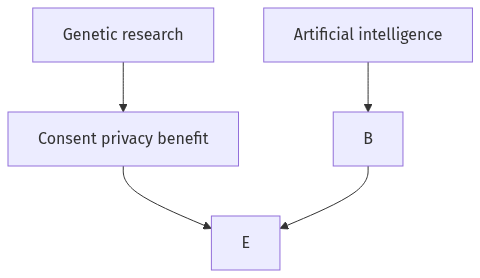
Genetic ethics: informed and community consent, privacy, no racial misuse of ancestry or aDNA, voluntary medical screening, strict control of heritable genome editing. Artificial intelligence ethics: biased classification, surveillance, loss of ethnographic anonymity, deepfakes and false cultural authority. ICMR, IRB, AAA and Nagoya-type benefit-sharing are the working rules. Do not treat genomes or models as a new Risley. Communities must be able to refuse sampling and recording.
Model answer
Copper italics in this answer — like this — are the key facts. Each one is unpacked in the Facts & figures rail.
Introduction
Recent genetic research and artificial intelligence enlarge what anthropologists can know about bodies, faces, voices and social groups. They also enlarge the chance of harm. Ethics here is about consent, stigma, ownership of data and the refusal to revive race science. This answer discusses principles and institutional rules, not laboratory or weapon methods.
Body
Biological anthropology
Human genetics, ancient DNA, and medical genomics need informed consent that a village can actually give. A signed form in English is not consent among a PVTG. Community consent (after Nuu-chah-nulth, Havasupai, and Indian debates on tribal sampling) sits beside individual consent because a genome is never only one person’s secret: relatives and future children are implicated. Benefit-sharing and the spirit of the Nagoya Protocol require that if a community’s genetic or associated traditional knowledge is used, the community is a partner, not a raw-material site.
- Privacy and re-identification: even “anonymised” genomic files can be linked. Databases must limit access. Ancestry tests sold to the public can freeze colonial racial types (Risley, Guha’s older taxonomy) as commercial identity. Anthropologists must not treat a PCA plot as a caste origin certificate. Rakhigarhi aDNA is a scientific result; using it to police who is “indigenous” is a political misuse.
- Medical genetics: counselling, not coercion. Sickle-cell and other screening in tribal belts is ethical when it is voluntary, confidential, and tied to care. It is unethical when it becomes a condition of marriage or of a government benefit. Human genome editing for heritable change is under international moratoria and Indian review (ICMR, Department of Biotechnology, ethics boards) because of uncertain harm to descendants and because enhancement could deepen class inequality. This is a governance issue. It is not a recipe.
- Collections: skeletal and blood archives from colonial and ASI contexts need repatriation or restricted use when communities object. The Helsinki tradition, CIOMS, and ICMR National Ethical Guidelines are the Indian working texts.
Socio-cultural anthropology
Artificial intelligence here means machine systems that classify images, speech, text and behaviour. Ethnographic fieldnotes, photographs and interview recordings, if scraped or donated without permission, can train models that later identify activists, migrants or minorities. Anonymity, a classic field ethic (AAA, ASA, Indian university IRBs), is harder when faces and voices are searchable.
Biased training data reproduce caste, gender and racial stereotype as if they were nature. Predictive policing and welfare-fraud scoring can punish the poor for being poor. Anthropologists who advise such systems share responsibility. Deepfakes of ritual or of a person damage reputation and sacred secrecy (some Australian and Indian communities already restrict images of the dead).
- Authorship and labour: students and informants who clean data for a model must be credited and paid. A chatbot that answers as if it were a tribe’s elder is a representation harm.
Shared duties
Do not collect DNA or digital traces because it is possible. State a research question, a storage limit, a destruction date, and a community veto. Refuse projects whose purpose is covert surveillance or the ranking of peoples. The Ghurye–Elwin lesson still applies: knowledge that only serves the state against a vulnerable group is not autonomous anthropology.
National Digital Health and Aadhaar-linked records raise the same consent problem at population scale. Anthropology’s contribution is to insist that groups, not only individuals, can be harmed.
Flow diagram
Conclusion
Genetic research and artificial intelligence are ethical problems of consent, privacy, stigma and power. Biological anthropology must not revive race; socio-cultural anthropology must not feed surveillance. Codes already exist. The test is whether communities can refuse and still be respected.
Quick related
Students also ask
-
"Sanskritization is a culture-bound concept." Critically comment to assess the strength and limitation of this concept in developing a theoretical framework to study social change.
Next question on this syllabus topic (2023 · Q3(a)). View answer →
-
Is publishing a tribe’s genome always wrong?
Not if consent, governance and benefit-sharing are real, and if the paper cannot reasonably be used to stigmatise the group. Many projects fail that test.
-
Does artificial intelligence replace ethnography?
No. Models summarise patterns in data they are given. They cannot take responsibility for harm or for the meaning of a ritual.
Same topic · past papers
UPSC has asked this before
These previous-year questions sit on the same topic. Open one to practise the earlier ask.
-
2026 · Q5(e) · Anthropology GS 2 · 10 marks
Contribution of L. K. Ananthakrishna Iyer in Anthropology. -
2025 · Q3(c) · Anthropology GS 2 · 15 marks
Highlight the significant contributions of B. S. Guha, Irawati Karve and S. R. K. Chopra to Indian Anthropology -
2024 · Q2(c) · Anthropology GS 2 · 15 marks
Deconstruct the colonial history of Indian Anthropology highlighting the critical role played by the Indian Anthropologists in sustaining its autonomy. -
2023 · Q7(c) · Anthropology GS 2 · 15 marks
Elucidate the role of anthropology in nation building. Illustrate with suitable examples. -
2023 · Q8(b) · Anthropology GS 2 · 15 marks
Critically evaluate the contributions of S.C. Roy to Indian anthropology.
More from this topic
Q8(a) · UPSC Mains 2026 · Anthropology GS 2 · 20 marks · Solution
Make a critical appraisal of Surajit Sinha's line of argument that tribes and castes may not be isolated social categories, but are a part of the great Indian civilization
Indigenous and exogenous processes of socio-cultural change in Indian society
Surajit Sinha posited that Indian tribes and castes are not isolated phenomena but integral parts of a continuous civilizational framework. Through historical processes of state formation, Hinduization, and agrarian incorporation, tribes were absorbed into the Hindu caste system. However, this civilizational view has been critiqued for masking the forced assimilation, economic exploitation, and loss of indigenous autonomy experienced by tribal communities. Contemporary tribal movements increasingly reject this seamless civilizational continuity in favor of distinct ethnic identities. Thus, Sinha's paradigm remains foundational for understanding Indian social structure while requiring critical re-evaluation.
Q1(e) · UPSC Mains 2025 · Anthropology GS 2 · 10 marks · Solution
Characteristics and communication between Little and Great Traditions.
Indigenous and exogenous processes of socio-cultural change in Indian society
Redfield’s Great Tradition is textual, specialist and pan-regional; the Little Tradition is local, oral and village or tribal. Marriott’s universalisation and parochialisation, and Srinivas’s Sanskritisation, describe the traffic between them. Vidyarthi’s Gaya sacred complex is a pilgrimage switchboard. Tribal festival-taking and sacred-grove law (FRA, PESA) are living two-way examples. The pair is a civilisation process, not two separate India.
Q3(a) · UPSC Mains 2023 · Anthropology GS 2 · 20 marks · Solution
"Sanskritization is a culture-bound concept." Critically comment to assess the strength and limitation of this concept in developing a theoretical framework to study social change.
Indigenous and exogenous processes of socio-cultural change in Indian society
Srinivas defined Sanskritisation as group copying of a higher caste’s ritual style to claim better rank. Its strength is empirical fit with Indian caste mobility and the little–great tradition traffic. It is culture-bound: it belongs to Hindu caste civilisation, not to all societies. Limits include conversion, non-Brahmin politics, class, and gender costs of new taboos. A theory of Indian social change needs Sanskritisation plus Westernisation, law, and conflict.