
Revision summary
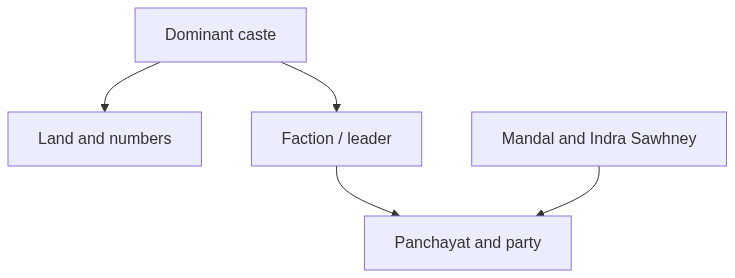
Srinivas’s dominant caste combines numbers, land, rank and an educated elite. Factions are vertical followings around leaders, described by Bailey and others. Village domination scaled into regional parties after adult franchise. Mandal and Indra Sawhney widened OBC claims; panchayat reservation shares some offices. Caste blocs remain, but they now work through parties, cooperatives and social media as well as the village.
Model answer
Copper italics in this answer — like this — are the key facts. Each one is unpacked in the Facts & figures rail.
Introduction
Caste domination, factionalism and political power are three linked ways of reading rural and regional India. M. N. Srinivas named the dominant caste. F. G. Bailey, Ralph Nicholas and later political anthropologists named the faction. Together they explain why numbers, land and office travel together.
Body
Dominant caste
Srinivas, from Rampura and other Mysore villages, said a caste is dominant when it is numerous, owns a large share of local land, ranks fairly high, and has a Western-educated elite. Numerical strength plus economic control plus ritual rank produces local power. Okkaligas in parts of Karnataka, Jats in western Uttar Pradesh and Haryana, Reddys and Kammas in Andhra, and Yadavs in parts of Bihar and UP have played this role at different scales.
Domination is local and historical. A caste that dominates one taluk may be a minority in the next. André Béteille in Tanjore showed how land reform, tenancy and education can split economic power from ritual rank.
Factionalism
A faction is a vertical following around a leader, not a horizontal class. Kin, clients, debtors and caste-fellows gather behind a big man. Bailey’s Bisipara (Odisha) and Nicholas’s Bengal work showed that village politics often splits into two or more such blocs. Elections, panchayat seats and irrigation disputes become the public face of private followings.
Factions cut across a single caste and can join unlike castes. They also reproduce caste, because the leader’s first pool of trust is still kin and jati.
From village to political power
After adult franchise, dominant-caste networks fed state parties. Charan Singh’s Jat base, Lalu Prasad Yadav’s Yadav–Muslim arithmetic, and the Reddy–Kamma contest in Andhra are regional translations of Srinivas’s village fact. The 73rd Amendment and Panchayati Raj put offices into the same arena. Rotating reservation for SC, ST and women, read with K. Krishna Murthy and later panchayat cases, forces some sharing of chairs without ending landed influence.
Mandal (1990) and Indra Sawhney v. Union of India (1992) shifted the grammar from a few landed “dominant” castes to a wider OBC claim on the state. New elites — Yadav, Kurmi, Thevar, Vokkaliga — used both numbers and reservation. Older twice-born domination did not vanish; it moved into education, urban capital and upper-house networks.
The Sachar Committee (2006) and later caste surveys in Bihar showed that political power and census categories still follow community blocs. Factionalism now lives in WhatsApp groups and cooperative societies as much as in the village chaupal.
Flow diagram
Conclusion
Dominant caste explains who owns the village. Faction explains how that ownership is organised as a following. Adult franchise, Mandal and panchayat law turned both into electoral machines without abolishing either.
Quick related
Students also ask
-
Verrier Elwin's philosophy with respect to Arunachal Pradesh
Next question on this syllabus topic (2025 · Q1(d)). View answer →
-
Is a dominant caste the same as a high caste?
No. A numerically strong landed Shudra caste can dominate a village where Brahmins are few and poor.
-
Did Mandal end dominant-caste politics?
It multiplied claimants. Landed OBC groups used the new language of backwardness while still behaving as Srinivas’s dominant castes in many districts.
Same topic · past papers
UPSC has asked this before
These previous-year questions sit on the same topic. Open one to practise the earlier ask.
-
2021 · Q1(e) · Anthropology GS 2 · 10 marks
Factionalism and politics in rural India.
More from this topic
Q6(a) · UPSC Mains 2026 · Anthropology GS 2 · 20 marks · Solution
Make a critical appraisal of the mesolithic culture of Ganga basin with reference to artifacts, faunal and human skeletal remains excavated from different sites
Evolution of the Indian Culture and Civilization
• Ganga basin Mesolithic sites like Sarai Nahar Rai, Mahadaha, and Damd
Q5(e) · UPSC Mains 2026 · Anthropology GS 2 · 10 marks · Solution
Contribution of L. K. Ananthakrishna Iyer in Anthropology.
Evolution of the Indian Culture and Civilization
L. K. Ananthakrishna Iyer is a pioneering figure in Indian anthropology, known for his monumental ethnographic surveys like The Cochin Tribes and Castes and The Mysore Tribes and Castes. Working during the colonial era, he bridged western anthropological methods with indigenous scholarship. His documentation of social stratification, material culture, and folklore laid the empirical foundation for Indian sociology and anthropology. Iyer also established the first department of anthropology in India at the University of Calcutta, shaping institutional teaching and research.
Q5(c) · UPSC Mains 2026 · Anthropology GS 2 · 10 marks · Solution
Article 371A of the Indian Constitution.
Evolution of the Indian Culture and Civilization
Article 371A of the Indian Constitution grants special autonomous status to Nagaland, protecting its traditional socio-religious practices, customary laws, and land ownership rights. Enacted via the 13th Constitutional Amendment Act, 1962, following the 16-point Agreement, it reflects the asymmetrical federal framework of India. The article places a special responsibility on the Governor regarding law and order and regional financial allocations. It balances tribal autonomy with national integration, though it faces implementation challenges in modern governance.