
Revision summary
Guha: 1931 racial types, ASI institution, Harappan osteology; typology is the limit. Karve: kinship organisation, Maharashtra, epics, north–south marriage contrast. Chopra: Siwalik Sivapithecus school at Chandigarh; Ramapithecus later revised. Together they cover living measurement, civilisation-as-kinship, and Miocene fossils. Keep their questions; update their boxes with genetics and ethnography.
Model answer
Copper italics in this answer — like this — are the key facts. Each one is unpacked in the Facts & figures rail.
Introduction
B. S. Guha, Irawati Karve and S. R. K. Chopra stand for three craft rooms of Indian anthropology: census anthropometry, kinship and Maharashtra civilisation, and Siwalik palaeoanthropology. Each left a method that is still taught, and each has a limit that is now clear.
Body
B. S. Guha
Guha led physical anthropology at the Zoological Survey and then the Anthropological Survey of India. For the 1931 Census he offered a racial map of India (Nordic, Graeco-Scythian, Brachycephalic, Mundari, Mongoloid, Negrito traces, and related types in the textbook versions). He measured living people at a national scale and helped institutionalise ASI. He also wrote on the Indus physical type from Harappan skeletons available then.
The limit is typology. His census races, like Risley’s, freeze clines into boxes. His institutional gift is larger than his racial list: a government science of the body that later turned toward People of India ethnography and genetics.
Irawati Karve
Karve, trained with Eugen Fischer in Germany and then firmly Indian in subject, mapped kinship, caste and region. Kinship Organisation in India contrasted Indo-European north (village exogamy, kanyadan hypergamy) with Dravidian south (cross-cousin marriage, different alliance). She wrote on Maharashtra as a cultural region, on the Bhils, on epics as social documents (Yuganta), and on the anthropometry of caste without reducing caste to nose.
She showed that civilisation is kinship geography. Feminists later used her epic readings. Geneticists now find that her north–south marriage contrast still roughly tracks difference in affinity structure. The limit: a strong regional contrast can hide Adivasi and Muslim kinship that are neither “northern Sanskritic” nor “Dravidian textbook”.
S. R. K. Chopra
Chopra, at Panjab University, Chandigarh, made the Indian Siwaliks a world hominoid site. With colleagues he described Sivapithecus material, discussed Ramapithecus, and trained a school that linked geology to jaws. He placed India in Miocene ape phylogeny when many syllabi still jumped from Europe to Africa.
- The limit is the same as the field’s: fragmentary faces, revised taxa, Ramapithecus retired as a hominin. Chopra’s contribution is the laboratory and the locality, not a final family tree.
Together
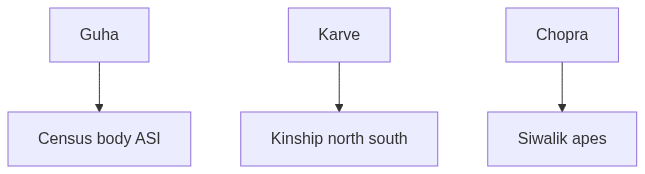
Guha measured living types for the state. Karve measured marriage for civilisation. Chopra measured fossils for deep time. Indian anthropology’s three clocks — census body, kinship region, Siwalik bed — meet in this trio.
Flow diagram
Conclusion
Guha built racial census science and ASI. Karve built kinship regions and a reading of caste and epic. Chopra built Siwalik hominoid palaeontology. Use their methods; do not freeze their first maps as eternal races or eternal ancestors.
Quick related
Students also ask
-
Deconstruct the colonial history of Indian Anthropology highlighting the critical role played by the Indian Anthropologists in sustaining its autonomy.
Next question on this syllabus topic (2024 · Q2(c)). View answer →
-
Should Guha’s races still be taught as fact?
Teach them as history of Indian physical anthropology. Living variation is clinal and social, not seven census types.
-
Is Karve only a kinship writer?
No. She also wrote ethnography, anthropometry and literary anthropology of the Mahabharata.
Same topic · past papers
UPSC has asked this before
These previous-year questions sit on the same topic. Open one to practise the earlier ask.
-
2022 · Q2(a) · Anthropology GS 2 · 20 marks
Illustrate the contribution of Irawati Karve to Indian Anthropology. Make a special mention of her literary contribution
More from this topic
Q3(c) · UPSC Mains 2026 · Anthropology GS 2 · 15 marks · Solution
Discuss with examples, how general comparative analogy has been used for ethnoarchaeological studies in India
Emergence, growth and development of Anthropology in India
1. Ethnoarchaeology uses present-day cultural practices to interpret prehistoric material remains through the principle of uniformitarianism. 2. General comparative analogy applies broad cross-cultural parallels to infer past human behavior when direct historical links are missing. 3. Studies of contemporary stone-knapping among groups like the Birhor help explain prehistoric microlithic manufacturing and campsite use. 4. Traditional rural Indian pottery techniques and vessel distributions offer vital clues for understanding ancient ceramic production and storage. 5. Living megalithic traditions among tribal communities, such as the Munda and Naga, provide models for interpreting Iron Age mortuary architecture. 6. These ethnographic parallels help archaeologists reconstruct dynamic past societies from static artifacts, provided researchers avoid overgeneralizations.
Q5(b) · UPSC Mains 2024 · Anthropology GS 2 · 10 marks · Solution
Describe ILO's Convention No. 169 (1989) on Indigenous and Tribal people. Is India a signatory to it?
Emergence, growth and development of Anthropology in India
ILO Convention 169 (1989) covers indigenous and tribal peoples and stresses self-identification, consultation, land and custom. It replaced the integrationist Convention 107 (1957). India ratified 107 and has not ratified 169. Indian hesitation cites the ST list, sovereignty and land law; PESA and FRA already resemble 169 in parts. Never state that India is a signatory to 169.
Q2(c) · UPSC Mains 2024 · Anthropology GS 2 · 15 marks · Solution
Deconstruct the colonial history of Indian Anthropology highlighting the critical role played by the Indian Anthropologists in sustaining its autonomy.
Emergence, growth and development of Anthropology in India
Colonial anthropology served census, forest and criminal-tribe administration. S. C. Roy professionalised ethnography; ASI and university departments Indianised the job. Ghurye versus Elwin was an Indian debate on assimilation and isolation. Srinivas, Karve, Bose, Majumdar and Vidyarthi supplied Indian concepts and village-tribe fields. Autonomy means an Indian agenda and terms, not a refusal of world methods.