
Revision summary
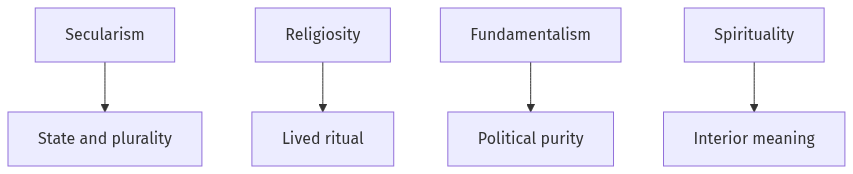
Secularism is a political arrangement of religious equality and principled distance, not simple atheism. Religiosity is lived ritual and shrine practice, as in Srinivas, Vidyarthi and little traditions. Fundamentalism is a modern, organised claim to purify state and society by one inerrant faith. Spirituality is extra-institutional or interior sacred seeking; it must not be used to rank tribes below ‘philosophy’. The four can coexist in one biography; they are not stages of evolution.
Model answer
Copper italics in this answer — like this — are the key facts. Each one is unpacked in the Facts & figures rail.
Introduction
From an anthropological view these four words name different relations between people, power and the sacred. They are not four rungs of one ladder from primitive to modern. Indian fieldwork forces the distinctions because the same person may light a lamp, vote a secular ticket, and reject a call to hate.
Body
Secularism
Secularism is a political arrangement of religious plurality. In India it is not the French emptying of the public square. Nehruvian practice, Articles 25–28, and S. R. Bommai treat the state as even-handed among religions, sometimes intervening against social evil (temple entry, triple talaq litigation, personal-law debate). Anthropology (T. N. Madan, Ashis Nandy, Rajeev Bhargava in a neighbouring discipline) notes that Indian secularism is principled distance, not the absence of religion. A tribal council that hears a marriage dispute under PESA custom is not a theocracy; a state that funds all pilgrimages unequally is a failed secularism.
Religiosity
- Religiosity is lived practice: ritual frequency, shrine use, fasting, possession, and the everyday sacred. M. N. Srinivas’s Coorgs, Vidyarthi’s Gaya sacred complex, Marriott’s little tradition, and Turner’s pilgrimage are studies of religiosity. A Bhil or Santhal household can be highly religious without being fundamentalist. Religiosity can be inclusive (shared village shrines) or ranked (who may enter the inner room). It is a dimension of culture, not a party programme.
Religious fundamentalism
Fundamentalism is a modern political project that claims a purified, inerrant scripture or origin and seeks to discipline state and society by it. It is not “more religiosity”. Marty and Appleby treated it as a twentieth-century formation. In India it appears as organised communalism, anti-minority mobilisation, and sometimes as scriptural reform inside a community. G. S. Ghurye worried about national unity; Elwin worried about tribal absorption into a majoritarian sacred. Anthropology (Tambiah, Veena Das on violence) stresses that fundamentalism needs print, census majorities and youth organisations. A Toda or Apatani ritual revival is usually ethnic revitalisation, not fundamentalism, unless it seeks to punish other faiths through the state.
Spiritualism
Spiritualism in ordinary English can mean séances; in this paper it is better read as spirituality: a personal or philosophical quest for meaning, often de-institutionalised (bhakti interiority, some Buddhist modern, New Age, Sufi affect). Geertz’s mood and motivation, Marriott’s transaction with deities, and tribal singbonga or boonga experience can be spiritual without a church. The risk is elite language that calls Brahmanical philosophy spiritual and tribal ritual superstitious. Anthropology refuses that rank.
Differences in one view
Secularism regulates power among religions. Religiosity is practice. Fundamentalism is authoritarian political religion. Spiritualism/spirituality is interior or extra-institutional sacred experience. A secular state can house intense religiosity. Fundamentalism attacks both liberal secularism and plural religiosity. Spiritual talk can hide from politics or, in Gandhi’s case, feed a public ethic.
- Tribal India complicates all four: sacred groves are religiosity and resource management; conversion debates test secular law; Hindutva or missionary fundamentalisms compete for ST souls; Elwin’s philosophy valued tribal spiritual worlds without making them a national church.
Flow diagram
Conclusion
Secularism is a civic rule of distance and equality. Religiosity is everyday sacred practice. Fundamentalism is a modern project to capture the state for a purified faith. Spirituality is meaning-seeking that may travel light of institutions. Anthropology keeps them apart so that a pilgrim is not named a fundamentalist by default.
Quick related
Students also ask
-
Discuss the contribution of P.K. Bhowmick in decriminalising the status of the Lodha tribe.
Next question on this syllabus topic (2024 · Q6(c)). View answer →
-
Is a religious villager failing secularism?
No. Secularism constrains the state and public power, not private or community ritual as such.
-
Is tribal revival fundamentalism?
Usually it is ethnic or religious revitalisation. It becomes fundamentalist if it seeks coercive monopoly through the state against other groups.
Same topic · past papers
UPSC has asked this before
These previous-year questions sit on the same topic. Open one to practise the earlier ask.
-
2022 · Q8(b) · Anthropology GS 2 · 15 marks
Briefly describe the anthropological perspective on development. How have anthropologists contributed in India's rural development?
More from this topic
Q6(a) · UPSC Mains 2026 · Anthropology GS 2 · 20 marks · Solution
Make a critical appraisal of the mesolithic culture of Ganga basin with reference to artifacts, faunal and human skeletal remains excavated from different sites
Evolution of the Indian Culture and Civilization
• Ganga basin Mesolithic sites like Sarai Nahar Rai, Mahadaha, and Damd
Q5(e) · UPSC Mains 2026 · Anthropology GS 2 · 10 marks · Solution
Contribution of L. K. Ananthakrishna Iyer in Anthropology.
Evolution of the Indian Culture and Civilization
L. K. Ananthakrishna Iyer is a pioneering figure in Indian anthropology, known for his monumental ethnographic surveys like The Cochin Tribes and Castes and The Mysore Tribes and Castes. Working during the colonial era, he bridged western anthropological methods with indigenous scholarship. His documentation of social stratification, material culture, and folklore laid the empirical foundation for Indian sociology and anthropology. Iyer also established the first department of anthropology in India at the University of Calcutta, shaping institutional teaching and research.
Q5(c) · UPSC Mains 2026 · Anthropology GS 2 · 10 marks · Solution
Article 371A of the Indian Constitution.
Evolution of the Indian Culture and Civilization
Article 371A of the Indian Constitution grants special autonomous status to Nagaland, protecting its traditional socio-religious practices, customary laws, and land ownership rights. Enacted via the 13th Constitutional Amendment Act, 1962, following the 16-point Agreement, it reflects the asymmetrical federal framework of India. The article places a special responsibility on the Governor regarding law and order and regional financial allocations. It balances tribal autonomy with national integration, though it faces implementation challenges in modern governance.