
Revision summary
Adult franchise, reserved seats, PESA, and Sixth Schedule councils are the main democratic institutions in tribal India. They created an ST political class and some women sarpanches. Bailey, Xaxa, Niyamgiri, and Naga or Khasi councils show both voice and capture. Inner minorities can lose when a council majority behaves like an ethnic state. Land security still depends on Gram Sabha power, FRA, and cases such as Samata, not on elections alone.
Model answer
Copper italics in this answer — like this — are the key facts. Each one is unpacked in the Facts & figures rail.
Introduction
Modern democratic institutions are adult franchise, political parties, panchayats, autonomous councils, and courts. In tribal India they opened office and law. They also recast clan, chief, and land into electoral blocs. The impact is mixed and must be read from ethnography, not only from the Constitution.
Body
What arrived
- Adult franchise after 1950 made ST voters a national constituency. Reserved Lok Sabha and Assembly seats created a tribal political class.
- The 73rd Amendment and PESA, 1996 (after the Bhuria Committee) put Gram Sabha at the centre of land, minor forest produce, and intoxicants in Fifth Schedule areas.
- Sixth Schedule Autonomous District Councils in parts of Assam, Meghalaya, Tripura, and Mizoram, and Articles 371A and 371G in Nagaland and Mizoram, are democratic devices that also protect custom.
- Parties — Congress, regional tribal parties, BJP, Left — replaced or captured older chiefs and church or sarna networks.
Ethnographic gains
- F. G. Bailey’s highland Odisha already showed elections entering a tribe–caste frontier. Later Jharkhand and Chhattisgarh show ST MLAs using reservation to contest mining and school posts.
- Naga village councils and the Tatar or similar bodies now sit beside elected MLAs; the 16-point agreement and later Framework talks are democratic-national negotiation, not only insurgency.
- Khasi and Garo ADCs give a public form to matrilineal and clan land debates. Women have entered some councils even where clan office remains male.
- Panchayat reservation for ST and women has produced sarpanches among Bhil, Gond, and Santal villages who can sign FRA claims and MGNREGA lists.
Strains
- Xaxa Committee found PESA often paper-thin: Gram Sabha bypassed by mining leases and contractors.
- Factionalism (Bailey, Sachchidananda) maps onto party tickets. Clan ethics become booth ethics.
- Samata (1997) and Niyamgiri (Vedanta, Dongria Kondh) show courts as a democratic resource, but only when activists and Gram Sabha can last the case.
- In the North-East, ethnic majorities inside a council can squeeze inner minorities (Bru in Mizoram, non-Bodo in BTR). Democracy at one scale becomes exclusion at another.
- Customary land and elected office collide when a sarpanch sells what a clan cannot alienate.
Critical judgement
- Democratic institutions ended the colonial fiction that tribes were only subjects of a superintendent.
- They did not automatically deliver land security or gender equality. Capture by contractors, parties, and dominant clans is the living limit.
Flow diagram
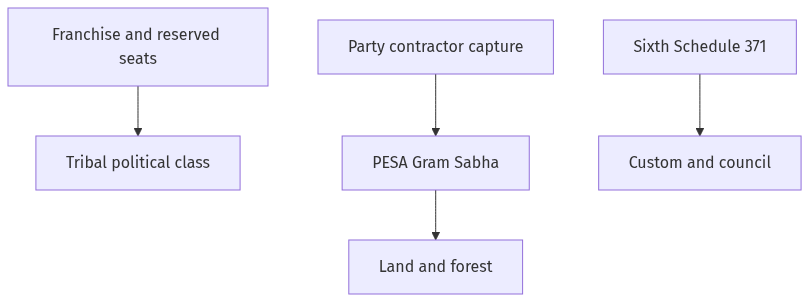
Conclusion
Franchise, PESA, Sixth Schedule, and reserved seats gave tribal societies a voice in the Republic. Ethnography shows new elites, court wins such as Niyamgiri, and also hollow Gram Sabhas and inner minorities. The institutions work where land law and local assembly still bite.
Quick related
Students also ask
-
Urbanization and tribal institutions
Next question on this syllabus topic (2021 · Q5(a)). View answer →
-
Did panchayats replace tribal custom?
They sit beside it. PESA tries to make Gram Sabha the hinge. In practice, parties and departments often bypass both custom and sabha.
-
Are Autonomous District Councils fully democratic?
They are elected, but franchise can still exclude women or inner minorities, and funds may be captured by a single elite.
Same topic · past papers
UPSC has asked this before
These previous-year questions sit on the same topic. Open one to practise the earlier ask.
More from this topic
Q6(b) · UPSC Mains 2026 · Anthropology GS 2 · 15 marks · Solution
Discuss the impact of democratic institutions on the tribal populations of India
Social change and contemporary tribal societies
1. The Indian Constitution and democratic framework have deeply transformed tribal socio-political landscapes. 2. The Fifth and Sixth Schedules provide distinct administrative autonomies to protect tribal land and culture. 3. The PESA Act, 1996, empowers Gram Sabhas with self-governance and resource management in Scheduled Areas. 4. Political reservations ensure nominal legislative representation for Scheduled Tribes in Parliament and Assemblies. 5. High voter turnout and new educated leaders show successful electoral integration and political efficacy. 6. However, structural issues like bureaucratic paternalism and elite capture often turn local bodies into rubber stamps. 7. Major development projects frequently override Gram Sabha dissent, creating a gap between token and substantive democracy. 8. True tribal autonomy requires strengthening local institutions and ensuring informed consent in resource management.
Q7(c) · UPSC Mains 2025 · Anthropology GS 2 · 15 marks · Solution
Critically evaluate the concept of Nation-State and describe its impact on indigenous societies
Social change and contemporary tribal societies
Nation-state: one people, territory, law and citizenship; indigenous life is clan, grove and seasonal land. India is a Union with asymmetric clauses, not a pure nation-state, but still centralising in school, army and mine. Impacts: borders, legal monopoly, standard language, development-security, market. FRA, PESA, 371 and Sixth Schedule are domestic tools of coexistence. India has not ratified ILO 169; consultation remains the unkept promise.
Q7(a) · UPSC Mains 2025 · Anthropology GS 2 · 20 marks · Solution
Identify the contemporary limitations in the process of tribal development. How can anthropological knowledge contribute in this process?
Social change and contemporary tribal societies
Limits: consent deficit, list-area mismatch, livelihood substitution, last-mile services, security overlay, elite capture, blunt data. Xaxa, PESA, FRA and Niyamgiri name the same gap between paper and hamlet. Anthropology contributes field method, ethnoecology, medical and linguistic knowledge, gendered land. Use it in FRA mapping and social impact before clearance, not as decoration in an EIA. PM-JANMAN helps only if PVTG hamlets author the micro-plan.