
Revision summary
Roy’s monographs on Mundas, Oraons, Birhors, and Kharias founded Indian tribal ethnography from Ranchi. He recorded khuntkatti, parha, sarna, and landlord-mission pressure, including the Birsa context. Man in India (1921) institutionalised the field. Limits include evolutionist wording, a thin gender-class analysis, and an outsider professional gaze. He remains the necessary starting point for Chotanagpur, not the last theory.
Model answer
Copper italics in this answer — like this — are the key facts. Each one is unpacked in the Facts & figures rail.
Introduction
Sarat Chandra Roy (1871–1942) is often called the father of Indian ethnography. A lawyer at Ranchi, he turned court contact with Mundas and Oraons into long monographs. His contribution is foundational and also limited by the amateur-missionary-colonial moment in which he wrote.
Body
What he wrote and built
- Major books: The Mundas and Their Country (1912), The Oraons of Chota Nagpur (1915), Oraon Religion and Customs (1928), The Birhors (1925), The Kharias (1937, with R. C. Roy).
- He described khuntkatti, parha, clan, marriage, sarna, and the pressure of Hindu landlords and missions. That remains the baseline for Chotanagpur anthropology.
- He founded the journal Man in India (1921) and worked with the Bihar and Orissa Research Society. He professionalised a field that had been notes in gazetteers.
- Birsa Munda’s movement and land law enter his pages as living politics, not only as custom.
Method
- He was not a year-long Malinowskian camper in one hamlet from the start, but he combined law-court Hindustani, village touring, and texts in a way that was new for an Indian scholar.
- He took native categories seriously: bonga, sarna, lineage land.
- He corresponded with Rivers, Frazer, and later Indian colleagues, placing Ranchi on the world map of ethnology.
Critical limits
- Evolutionist and diffusionist frames of his day appear: “primitive”, stages, and some racial vocabulary that later biology dropped.
- Women’s land rights and internal class among Mundas are thinner than later Marxist and feminist readings (archival work after Roy).
- He wrote as a sympathetic outsider and Catholic-era Ranchi professional, not as a Munda author. The gaze is still from the town.
- Policy: he supported protection of khuntkatti against landlord grab, which aligns with later FRA spirit, but he did not found a political movement.
Place in the discipline
- Before Srinivas, Bose, and Karve, Roy showed that Indians could write tribal monographs at international length.
- L. P. Vidyarthi and Ranchi anthropology are institutional heirs.
- Evaluation: indispensable on middle-Indian tribe and land; incomplete as theory; historically first.
Flow diagram
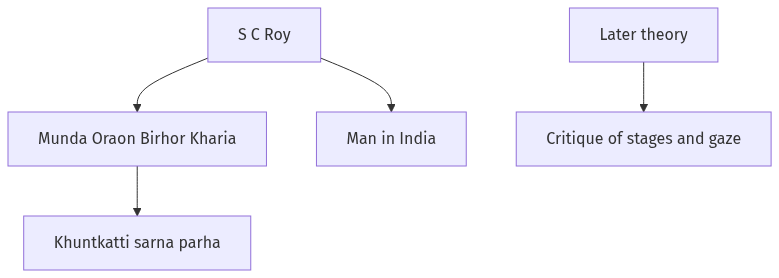
Conclusion
S. C. Roy created the Indian tribal monograph, the journal Man in India, and the ethnography of Munda, Oraon, Birhor, and Kharia institutions. His limits are evolutionist language and a town-court gaze. Nation and syllabus still start Chotanagpur with him, then add later critique.
Quick related
Students also ask
-
Illustrate the contribution of Irawati Karve to Indian Anthropology. Make a special mention of her literary contribution
Next question on this syllabus topic (2022 · Q2(a)). View answer →
-
Was Roy the first person to write on Indian tribes?
Colonial officers wrote earlier handbooks. Roy was the first Indian to produce a sustained ethnographic corpus of monographs and a journal.
-
Is Roy obsolete?
His theory language is dated. His institutional descriptions of khuntkatti and clan are still primary data.
Same topic · past papers
UPSC has asked this before
These previous-year questions sit on the same topic. Open one to practise the earlier ask.
-
2025 · Q2(c) · Anthropology GS 2 · 15 marks
Evaluate the impact of Christianity on Scheduled Tribe societies of North-East India -
2025 · Q7(c) · Anthropology GS 2 · 15 marks
Critically evaluate the concept of Nation-State and describe its impact on indigenous societies
More from this topic
Q3(c) · UPSC Mains 2026 · Anthropology GS 2 · 15 marks · Solution
Discuss with examples, how general comparative analogy has been used for ethnoarchaeological studies in India
Emergence, growth and development of Anthropology in India
1. Ethnoarchaeology uses present-day cultural practices to interpret prehistoric material remains through the principle of uniformitarianism. 2. General comparative analogy applies broad cross-cultural parallels to infer past human behavior when direct historical links are missing. 3. Studies of contemporary stone-knapping among groups like the Birhor help explain prehistoric microlithic manufacturing and campsite use. 4. Traditional rural Indian pottery techniques and vessel distributions offer vital clues for understanding ancient ceramic production and storage. 5. Living megalithic traditions among tribal communities, such as the Munda and Naga, provide models for interpreting Iron Age mortuary architecture. 6. These ethnographic parallels help archaeologists reconstruct dynamic past societies from static artifacts, provided researchers avoid overgeneralizations.
Q3(c) · UPSC Mains 2025 · Anthropology GS 2 · 15 marks · Solution
Highlight the significant contributions of B. S. Guha, Irawati Karve and S. R. K. Chopra to Indian Anthropology
Emergence, growth and development of Anthropology in India
Guha: 1931 racial types, ASI institution, Harappan osteology; typology is the limit. Karve: kinship organisation, Maharashtra, epics, north–south marriage contrast. Chopra: Siwalik Sivapithecus school at Chandigarh; Ramapithecus later revised. Together they cover living measurement, civilisation-as-kinship, and Miocene fossils. Keep their questions; update their boxes with genetics and ethnography.
Q5(b) · UPSC Mains 2024 · Anthropology GS 2 · 10 marks · Solution
Describe ILO's Convention No. 169 (1989) on Indigenous and Tribal people. Is India a signatory to it?
Emergence, growth and development of Anthropology in India
ILO Convention 169 (1989) covers indigenous and tribal peoples and stresses self-identification, consultation, land and custom. It replaced the integrationist Convention 107 (1957). India ratified 107 and has not ratified 169. Indian hesitation cites the ST list, sovereignty and land law; PESA and FRA already resemble 169 in parts. Never state that India is a signatory to 169.