
Revision summary
ILO Convention 169 (1989) covers indigenous and tribal peoples and stresses self-identification, consultation, land and custom. It replaced the integrationist Convention 107 (1957). India ratified 107 and has not ratified 169. Indian hesitation cites the ST list, sovereignty and land law; PESA and FRA already resemble 169 in parts. Never state that India is a signatory to 169.
Model answer
Copper italics in this answer — like this — are the key facts. Each one is unpacked in the Facts & figures rail.
Introduction
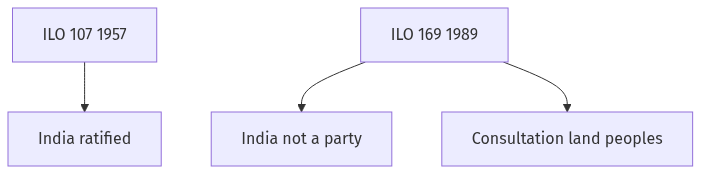
ILO Convention No. 169 (1989) is the Indigenous and Tribal Peoples Convention. It replaced the older integrationist Convention No. 107 (1957). India is not a signatory to Convention 169. India has ratified Convention 107. That contrast is the heart of the note.
Body
What Convention 169 says
Convention 169 covers tribal peoples in independent countries whose social and cultural conditions distinguish them, and peoples regarded as indigenous because they descend from populations present at conquest or colonisation and who retain some of their own institutions. It is a peoples convention: land, self-identification, custom, and participation are collective.
- Main principles include: self-identification as a fundamental criterion; consultation in good faith through representative institutions before legislative or administrative measures that affect them; rights to land and natural resources they traditionally occupy; respect for customary law where compatible with human rights; control over development priorities; cross-border contacts; and vocational and health programmes that are culturally appropriate. The consultation standard is often read toward free, prior and informed consent in later UN practice (UNDRIP 2007), though 169’s own wording is consultation aimed at agreement.
India and the two conventions
India ratified ILO 107 in 1958. Convention 107 spoke of protection and integration of tribal and semi-tribal populations. That language matches an older welfare state, Nehruvian Panchsheel, and parts of the Fifth Schedule, but it is paternal. Convention 169 dropped integration as the goal and recognised peoples’ rights to remain distinct.
- India has not ratified 169. Official hesitation has cited: the Constitution already lists Scheduled Tribes rather than a single “indigenous people”; fear of secessionist readings of “peoples”; land and subsoil vested in the state; and federal complexity. Anthropology and tribal movements (and Xaxa) argue that PESA, FRA and Samata already move toward 169’s land and consultation logic, so ratification would be a consistent next step. Until then, India is bound by 107, not 169.
Do not write that India signed 169. That is a common examination error.
Flow diagram
Conclusion
ILO 169 is the global rights charter for indigenous and tribal peoples, built on consultation, land and self-identification. India is not a signatory. It remains a party to the older ILO 107.
Quick related
Students also ask
-
Critically evaluate the contributions of S.C. Roy to Indian anthropology.
Next question on this syllabus topic (2023 · Q8(b)). View answer →
-
Is India a signatory to ILO 169?
No. India is not a party to Convention 169. It is a party to Convention 107.
-
Does non-ratification mean no tribal rights in India?
No. Fifth and Sixth Schedules, PESA, FRA and court cases such as Samata create domestic rights. 169 would add an international standard of consultation.
Same topic · past papers
UPSC has asked this before
These previous-year questions sit on the same topic. Open one to practise the earlier ask.
-
2021 · Q6(a) · Anthropology GS 2 · 20 marks
Discuss the impact of the Forest Rights Act (2006) on the livelihood and culture of tribal people in India -
2025 · Q7(c) · Anthropology GS 2 · 15 marks
Critically evaluate the concept of Nation-State and describe its impact on indigenous societies
More from this topic
Q3(c) · UPSC Mains 2026 · Anthropology GS 2 · 15 marks · Solution
Discuss with examples, how general comparative analogy has been used for ethnoarchaeological studies in India
Emergence, growth and development of Anthropology in India
1. Ethnoarchaeology uses present-day cultural practices to interpret prehistoric material remains through the principle of uniformitarianism. 2. General comparative analogy applies broad cross-cultural parallels to infer past human behavior when direct historical links are missing. 3. Studies of contemporary stone-knapping among groups like the Birhor help explain prehistoric microlithic manufacturing and campsite use. 4. Traditional rural Indian pottery techniques and vessel distributions offer vital clues for understanding ancient ceramic production and storage. 5. Living megalithic traditions among tribal communities, such as the Munda and Naga, provide models for interpreting Iron Age mortuary architecture. 6. These ethnographic parallels help archaeologists reconstruct dynamic past societies from static artifacts, provided researchers avoid overgeneralizations.
Q3(c) · UPSC Mains 2025 · Anthropology GS 2 · 15 marks · Solution
Highlight the significant contributions of B. S. Guha, Irawati Karve and S. R. K. Chopra to Indian Anthropology
Emergence, growth and development of Anthropology in India
Guha: 1931 racial types, ASI institution, Harappan osteology; typology is the limit. Karve: kinship organisation, Maharashtra, epics, north–south marriage contrast. Chopra: Siwalik Sivapithecus school at Chandigarh; Ramapithecus later revised. Together they cover living measurement, civilisation-as-kinship, and Miocene fossils. Keep their questions; update their boxes with genetics and ethnography.
Q2(c) · UPSC Mains 2024 · Anthropology GS 2 · 15 marks · Solution
Deconstruct the colonial history of Indian Anthropology highlighting the critical role played by the Indian Anthropologists in sustaining its autonomy.
Emergence, growth and development of Anthropology in India
Colonial anthropology served census, forest and criminal-tribe administration. S. C. Roy professionalised ethnography; ASI and university departments Indianised the job. Ghurye versus Elwin was an Indian debate on assimilation and isolation. Srinivas, Karve, Bose, Majumdar and Vidyarthi supplied Indian concepts and village-tribe fields. Autonomy means an Indian agenda and terms, not a refusal of world methods.