
Revision summary
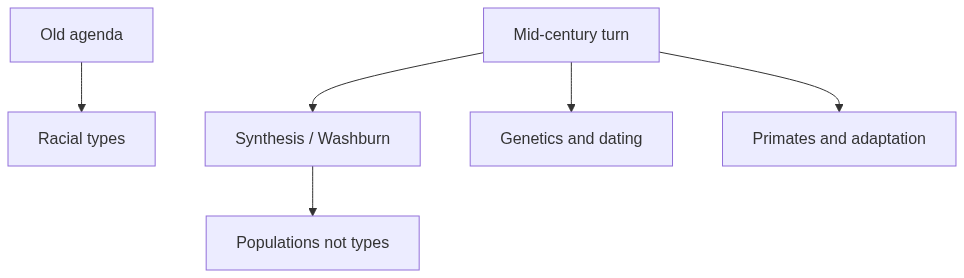
Earlier physical anthropology often measured skulls and built racial types. From the mid-twentieth century the field joined the modern synthesis and Washburn’s new physical anthropology. Dating methods and African fossils made evolution a testable chronology. Genetics and Lewontin’s variation argument weakened race as essence. Field primatology and human adaptability studies added living data. More scientific means hypotheses and populations, not a claim that the past had no measurements.
Model answer
Copper italics in this answer — like this — are the key facts. Each one is unpacked in the Facts & figures rail.
Introduction
Before the mid-twentieth century, much physical anthropology measured skulls, built racial types, and ranked groups. From about the 1940s and 1950s the agenda shifted toward evolutionary theory, hypothesis testing, genetics and behaviour. The quote is justified by that shift in names and methods, not by dismissing all earlier measurement.
Body
I. Conceptual Shift: From Typology and Morphology to Genetics and Evolutionary Synthesis
- The Modern Evolutionary Synthesis: Biological anthropology integrated Darwinian natural selection with Mendelian genetics and population genetics. Instead of viewing human variation as static “racial types,” anthropologists began analysing it as changes in allele and genotype frequencies within populations over generations.
- Population Genetics as a Scientific Tool: The application of the Hardy-Weinberg Law became the baseline “null model” to detect evolutionary forces such as mutation, natural selection, gene flow, and genetic drift operating on human gene pools. Deviations from this equilibrium can indicate that micro-evolutionary forces are shaping human biology.
- Concept of Clinal Variation over Race: Using genetic data, pioneering scientists such as Theodosius Dobzhansky promoted a population-based understanding of human variation. Physical traits such as skin colour vary along a continuous cline (geographic gradient) rather than through sharply separated biological boundaries. Richard Lewontin demonstrated that approximately 85–95% of human genetic variation occurs within populations rather than between broad continental groups, challenging the classical concept of biological race.
II. Methodological Revolution: Integration of Molecular, Cytogenetic, and Biochemical Techniques
- Transition of Genetic Markers: Anthropologists moved from using classical phenotypic markers and biochemical proteins such as ABO, Rh, and MN blood groups to highly polymorphic molecular DNA markers. These include RFLPs (Restriction Fragment Length Polymorphisms), STRs (Short Tandem Repeats), and SNPs (Single-Nucleotide Polymorphisms), which directly analyse variation at the DNA sequence level.
- Polymerase Chain Reaction (PCR) and Sequencing: The development of PCR by Kary Mullis in the 1980s enabled the rapid amplification of tiny or degraded DNA segments. Combined with gel electrophoresis and DNA sequencing, it allowed researchers to analyse genetic variation and conduct precise population profiling.
- Cytogenetics and Chromosomal Analysis: The study of chromosomes became highly precise through karyotyping, which visualises metaphase chromosomes, and advanced techniques such as G-banding and FISH (Fluorescence In Situ Hybridization). These methods enabled the diagnosis of numerical abnormalities such as Down syndrome, Turner syndrome, and Klinefelter syndrome, as well as structural abnormalities such as deletions, duplications, and translocations.
- Mitochondrial DNA (mtDNA) as a Molecular Clock: Because mtDNA is inherited predominantly through the maternal line and does not undergo the same recombination as nuclear DNA, its variation became useful for reconstructing maternal ancestry and population history. Studies by Cann, Stoneking and Wilson contributed to the identification of Mitochondrial Eve, the most recent common maternal ancestor of living humans, and provided important genetic evidence for an African origin of modern humans.
III. Functional Adaptation, Epidemiological, and Biocultural Paradigms
- Balanced Polymorphism and Natural Selection: Anthropologists began explaining seemingly deleterious traits through the lens of natural selection. For example, the high frequency of the sickle-cell trait (HbS) and some thalassemia variants in malaria-endemic regions can be explained through balanced polymorphism, where heterozygous individuals possess a survival advantage against severe malaria.
- The Biocultural Approach as the Discipline’s Hallmark: Modern biological anthropology operates on the premise that biology and culture are interdependent. Biology provides physiological capacities, while culture modifies the biological environment and can create new selective pressures over generations.
- Lactase Persistence: The evolution of lactase persistence in some adult populations provides a classic example of gene–culture coevolution. Pastoral populations with a long history of milk consumption experienced selection favouring genetic variants that allowed lactose digestion to continue into adulthood.
- Nutritional and Epidemiological Transitions: The field integrated the study of human health with developmental plasticity, nutrition, and socio-economic conditions. Rather than relying only on genetic explanations, researchers examined how early-life environments can influence adult health.
- Thrifty Phenotype Hypothesis: David Barker proposed that maternal and fetal undernutrition can permanently influence metabolic development, increasing susceptibility to adult chronic diseases such as obesity, type 2 diabetes, and cardiovascular disease in later life. This approach connects physiological adaptability with nutrition and social inequality.
IV. Practical and Forensic Applications
- Forensic Anthropology: Biological anthropology uses osteology, skeletal markers, and DNA profiling to estimate age, sex, stature, and other aspects of the biological profile and to assist in medico-legal investigations.
- Mass Disaster Identification: Forensic anthropological and genetic techniques can be used to identify victims of mass disasters, particularly when remains are fragmented, burned, or otherwise difficult to identify.
- Roopkund Lake: Analysis of the Roopkund Lake skeletal remains using osteological and ancient DNA evidence helped reveal that the individuals belonged to genetically distinct populations, demonstrating the application of biological anthropology to historical and archaeological questions.
- Pharmacogenomics and Personalised Medicine: Biological anthropology also examines how genetic polymorphisms influence drug responses, treatment outcomes, and disease susceptibility.
- HLA and Disease Susceptibility: Variations in the HLA system can influence susceptibility to infectious and autoimmune diseases. Studies of HLA variation in populations such as the Sahariya tribe illustrate how genetic variation can interact with infectious disease environments.
Flow diagram
Conclusion
In conclusion, the mid-20th-century transition systematically transformed biological anthropology from a descriptive, measuring, and highly typological "Physical Anthropology" into an analytical, experimental, and biocultural "Biological Anthropology". By adopting the Modern Evolutionary Synthesis, molecular genetics, and population-level analysis, the discipline moved away from unscientific classifications of "race" to map out the genuine complexities of human biological variation, micro-evolutionary adaptation, and health.
Quick related
Students also ask
-
"The bio-cultural approach is the hallmark of Biological Anthropology." Explain.
Next question on this syllabus topic (2021 · Q1(d)). View answer →
-
Did science begin only after 1950?
No. Anatomy and measurement are older. The quote is justified by the shift to evolutionary population thinking, dating, genetics and field behaviour.
-
What happened to race in this turn?
Typological ranking was scientifically weakened by within-group variation and clines.
Same topic · past papers
UPSC has asked this before
These previous-year questions sit on the same topic. Open one to practise the earlier ask.
-
2021 · Q1(d) · Anthropology GS 1 · 10 marks
"The bio-cultural approach is the hallmark of Biological Anthropology." Explain. -
2022 · Q6(b) · Anthropology GS 1 · 15 marks
What is meant by health? Is the burden of life style diseases on the rise? Justify your answer with suitable examples
More from this topic
Q1(d) · UPSC Mains 2021 · Anthropology GS 1 · 10 marks · Solution
"The bio-cultural approach is the hallmark of Biological Anthropology." Explain.
Biological Anthropology.
Bio-cultural anthropology joins bodies to diet, work, climate, and social rule. Lactase and sickle cell show culture as a selective environment. Washburn moved the field from racial types to process. Tibetan altitude and Inuit cold are teaching loops of physiology and practice. The hallmark is interaction, not genetic reduction.