
Revision summary
Boas, Sapir and Whorf linked language to habitual thought. Strong determinism is rejected; weak relativity remains. Berlin and Kay’s colour research showed universals and language-specific splits. Hymes’s ethnography of speaking studies who speaks how, when and to whom. Silverstein and language-socialisation work treat meaning as social and learned. Kinship terms and speech events are better illustrations than exotic mind-prisons. Chomsky’s innateness is a neighbouring foil, not the centre of this anthropological question.
Model answer
Copper italics in this answer — like this — are the key facts. Each one is unpacked in the Facts & figures rail.
Introduction
Linguistic anthropology asks whether the language we speak is only a tool for labelling a ready-made world, or whether it also organises what we notice and how we think. The field does not rest on one slogan. It offers a set of perspectives from Boas and Sapir to Whorf, Hymes, and later cognitive and practice approaches.
Body
Theoretical perspectives in linguistic anthropology
The relationship between culture, language, and thought is a central concern of linguistic anthropology. It examines how language reflects and shapes worldviews, cognition, social relations, cultural values, and human identity. Different theoretical perspectives explain this relationship from different directions.
- Franz Boas treated language as a window into culture and argued that every language should be understood on its own terms rather than judged through another language’s categories.
1. Linguistic Relativity and Determinism
- Sapir-Whorf Hypothesis: Edward Sapir and Benjamin Lee Whorf argued that the structure of language influences how people perceive, categorise, and think about the world.
- Strong form – Linguistic Determinism: The strong view argues that language determines thought. Example: Whorf’s comparison of Hopi and English was used to argue that different grammatical systems can produce different conceptions of time and reality.
- Weak form – Linguistic Relativity: The more accepted view is that language influences rather than determines thought by directing attention, memory, and categorisation.
- Colour terms: Example: Brent Berlin and Paul Kay found both universal patterns and language-specific differences in colour terminology, weakening strong Whorfian claims but supporting linguistic influence.
- Gender and cognition: Example: Research by Lera Boroditsky showed that grammatical and linguistic categories can influence habitual patterns of spatial and temporal thinking.
- Doublespeak: Example: William Lutz showed how euphemisms such as “collateral damage” can manipulate perception and soften the social meaning of events.
2. Cultural Determinism / Constructivist Perspective
- Core argument: This perspective emphasises that culture shapes language. Cultural values, economic activities, social organisation, and environmental conditions influence the vocabulary and linguistic structures of a society.
- Vocabulary of cultural emphasis: Example: The Nuer of Sudan have a highly developed vocabulary for cattle, reflecting the central importance of pastoralism in their culture and economy.
- Social values: Example: The use of elaborate honorifics in Urdu reflects culturally defined ideas of respect, status, age, and social hierarchy.
- Cultural adaptation of language: Example: The development of new radiation-related vocabulary among Marshallese communities after nuclear testing shows how language can adapt to new environmental and cultural experiences.
- Key implication: Culture does not simply use an existing language; it can reshape language to express culturally important experiences and realities.
3. Structural Linguistics and Semiotics
- Ferdinand de Saussure: Saussure viewed language as a structured system of signs in which meaning arises through relationships among linguistic elements.
- Claude Lévi-Strauss: Building on structural linguistics, Lévi-Strauss argued that language and culture share underlying structures through which humans organise and classify reality.
- Binary oppositions: Example: Contrasts such as Nature/Culture and Raw/Cooked reveal underlying patterns through which societies organise their understanding of the world.
4. Sociolinguistic and Interactionist Perspective
- Core argument: This perspective examines how class, caste, gender, prestige, identity, and power influence language use and how language, in turn, reproduces social relations.
- Language and caste: Example: John Gumperz showed how linguistic variation and speech styles can reflect and reinforce caste and social stratification, including in India.
- Language and hierarchy: Example: Clifford Geertz’s study of Javanese speech levels showed how linguistic choices vary according to social status and can actively reproduce hierarchy.
- Language as social capital: Particular accents, registers, and styles can acquire prestige, giving speakers advantages in education, employment, and institutional settings.
Flow diagram
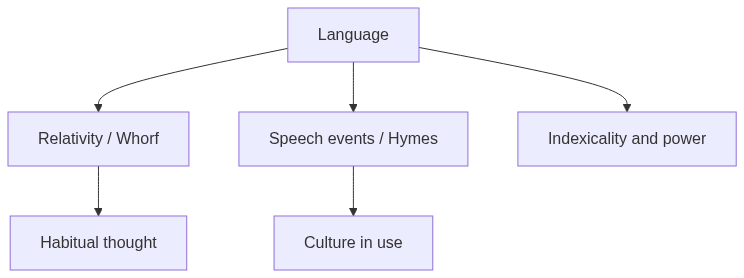
Conclusion
Language, culture and thought are deeply interrelated, language reflects cultural values while also influencing how people perceive reality. Thus, linguistic practices both express and reproduce the social structures, identities and worldviews of a society.
Quick related
Students also ask
-
Glottochronology
Next question on this syllabus topic (2023 · Q5(c)). View answer →
-
Does language determine worldview?
No. It biases attention and makes some distinctions easier. Kinship terms and colour words illustrate that.
-
Where does Chomsky fit?
As a contrast: a universal faculty versus anthropological interest in variation, use and power.
Same topic · past papers
UPSC has asked this before
These previous-year questions sit on the same topic. Open one to practise the earlier ask.
-
2021 · Q4(b) · Anthropology GS 1 · 15 marks
Mention the major branches of linguistic anthropology and discuss language use in social and cultural settings -
2025 · Q2(c) · Anthropology GS 1 · 15 marks
How political economy is integrated with ecological and adaptability perspectives in bio-cultural anthropology?
More from this topic
Q5(c) · UPSC Mains 2023 · Anthropology GS 1 · 10 marks · Solution
Glottochronology
Linguistic Anthropology.
Glottochronology dates language splits from retained basic vocabulary. Swadesh lists and an assumed replacement rate are the core. Hymes helped move the tool into anthropology. Bergsland and Vogt showed that rates vary. It remains a rough relatedness clock, not an absolute date.
Q4(b) · UPSC Mains 2021 · Anthropology GS 1 · 15 marks · Solution
Mention the major branches of linguistic anthropology and discuss language use in social and cultural settings
Linguistic Anthropology.
Branches cover structure, historical reconstruction, ethnolinguistics, and sociolinguistics. Hymes asked for an ethnography of speaking, not only a grammar. Labov showed class and style in variation. In settings, language does kinship, ritual, and rank. Code-switching and ideology show language as a social resource.