
Revision summary
Glottochronology dates language splits from retained basic vocabulary. Swadesh lists and an assumed replacement rate are the core. Hymes helped move the tool into anthropology. Bergsland and Vogt showed that rates vary. It remains a rough relatedness clock, not an absolute date.
Model answer
Copper italics in this answer — like this — are the key facts. Each one is unpacked in the Facts & figures rail.
Introduction
Glottochronology tries to date the split of related languages from the share of retained basic vocabulary. It is a linguistic clock, and anthropologists have used it with more hope than the clock can always keep.
Body
The method
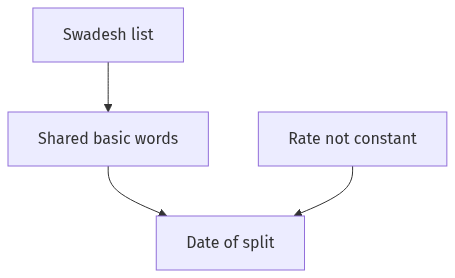
- Morris Swadesh built 100- and 200-word lists of supposedly stable meanings such as body parts and pronouns, a method called lexicostatistics when used only to measure relatedness.
- Glottochronology adds a constant rate, often taught as about 14 per cent loss per thousand years, to turn the shared percentage into a date of divergence.
- Dell Hymes and others brought the tool into anthropology as a companion to archaeology when no inscriptions exist.
Limits
- Knut Bergsland and Hans Vogt showed that real rates are not constant, using cases such as Icelandic.
- Borrowing, taboo replacement, and poorly chosen lists break the clock, which Lyle Campbell and historical linguists still stress.
- The method can still rank closeness of dialects; it should not be treated as a radiocarbon date for a people.
Flow diagram
Conclusion
Glottochronology is Swadesh’s dated lexicostatistics. It is a heuristic for language split, not a precise prehistoric calendar.
Quick related
Students also ask
-
Mention the major branches of linguistic anthropology and discuss language use in social and cultural settings
Next question on this syllabus topic (2021 · Q4(b)). View answer →
-
Is glottochronology the same as the comparative method?
No. The comparative method reconstructs proto-forms. Glottochronology only dates splits from word lists.
-
Can it date migrations by itself?
No. It may suggest a time range. Archaeology and genetics must be independent tests.
More from this topic
Q6(c) · UPSC Mains 2025 · Anthropology GS 1 · 15 marks · Solution
Describe briefly the theoretical perspectives in linguistic anthropology to explain the relationship of culture, language and thought
Linguistic Anthropology.
Boas, Sapir and Whorf linked language to habitual thought. Strong determinism is rejected; weak relativity remains. Berlin and Kay’s colour research showed universals and language-specific splits. Hymes’s ethnography of speaking studies who speaks how, when and to whom. Silverstein and language-socialisation work treat meaning as social and learned. Kinship terms and speech events are better illustrations than exotic mind-prisons. Chomsky’s innateness is a neighbouring foil, not the centre of this anthropological question.
Q4(b) · UPSC Mains 2021 · Anthropology GS 1 · 15 marks · Solution
Mention the major branches of linguistic anthropology and discuss language use in social and cultural settings
Linguistic Anthropology.
Branches cover structure, historical reconstruction, ethnolinguistics, and sociolinguistics. Hymes asked for an ethnography of speaking, not only a grammar. Labov showed class and style in variation. In settings, language does kinship, ritual, and rank. Code-switching and ideology show language as a social resource.