
Revision summary
Geertz treats culture as webs of significance, uses thick description, and reads the Balinese cockfight as a text. Turner treats ritual symbols as operators, distinguishes dominant and instrumental symbols, and uses liminality, communitas and social drama. Both are symbolic and anti-reductionist. The contrast is hermeneutic text versus processual performance, and order-reading versus conflict-and-redress. Geertz is not mere idealism, and Turner is not mere functionalism. They are complementary methods.
Model answer
Copper italics in this answer — like this — are the key facts. Each one is unpacked in the Facts & figures rail.
Introduction
Clifford Geertz and Victor Turner both took symbols seriously and both rejected thin behaviourism. Then they diverged. Geertz reads culture as a public text of meanings. Turner watches symbols work through ritual process. Compare them as two methods for understanding culture.
Body
Geertz: culture as a text
In The Interpretation of Cultures (1973) Geertz says that man is an animal suspended in webs of significance he himself has spun. The anthropologist’s job is interpretation, not law-like explanation. Thick description — his wink versus twitch example — recovers the public code that makes an action this action and not another.
- The Balinese cockfight is Geertz’s famous example. Status, masculinity and village structure are said in the fight. The event is a story the Balinese tell themselves about themselves.
- Models of and models for: Symbols both represent a world and give a template for acting in it.
- Method: Hermeneutic. The ethnographer is a literary critic of social life. Meaning is public, not locked in a private psyche. This was also a swipe at too-mental culture-and-personality work.
A comparable public text in India is a Republic Day parade or a televised temple festival: people perform a story about order, nation and devotion, which the observer then interprets.
Turner: symbol as process
Turner’s Ndembu ethnography in The Forest of Symbols (1967) treats ritual symbols as operators in social drama. A dominant symbol such as the milk tree condenses many meanings and does things: it moves people across statuses.
- Structure and anti-structure: In The Ritual Process (1969), drawing on Arnold van Gennep’s rites of passage, Turner describes liminality and communitas. Hierarchy is stripped in the in-between, then restored or remade.
- Instrumental versus dominant symbols: Some symbols are tools in a sequence. Some are ends in themselves, polyvalent and emotionally loaded.
- Method: Processual. Watch the ritual through time. Plot breach, crisis and redress. Meaning sits in performance and in social conflict, not only in a static dictionary of tropes.
An Indian wedding, a pilgrimage such as the Kanwar yatra, or a protest sit-in can be read in Turner’s terms: people pass through a liminal phase, a temporary communitas appears, then ordinary hierarchy returns.
Compare and contrast
- Shared ground: Both are symbolic anthropologists. Both refuse to reduce culture to ecology or to unconscious grammar alone. Turner can sound more Durkheimian. Geertz can sound more Weberian.
- Unit of analysis: Geertz studies the enacted text and the local interpretation. Turner studies the ritual process and the social drama around it.
- Conflict: Geertz can underplay rupture, as when the cockfight is read as a statement of order. Turner builds conflict in, as schism and repair.
- Field feel: Geertz’s ethnographer interprets. Turner’s ethnographer follows a sequence and the political work of symbols.
Flow diagram
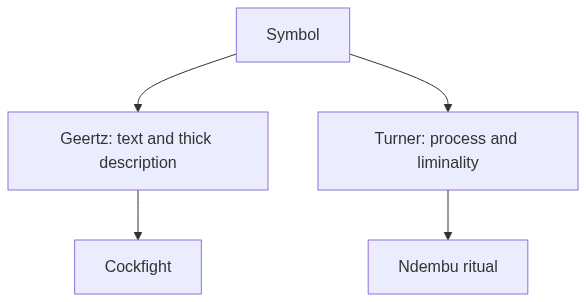
Conclusion
Geertz tells you what a public symbol means in a cultural web. Turner tells you what a symbol does as people pass through crisis and rite. Culture needs both: a readable order and a processual engine. The two methods work together.
Quick related
Students also ask
-
How did Clifford Geertz look at religion. Differentiate between anthropological and psychological approaches to the study of religion.
Next question on this syllabus topic (2023 · Q3(b)). View answer →
-
Where does Lévi-Strauss sit in this comparison?
To the side. Structuralism seeks unconscious binary codes. Geertz and Turner stay with public meaning and ritual action.
-
Can the two approaches be used on the same event?
Yes. Geertz reads culture as a public text; Turner watches symbols transform social relations. A wedding, pilgrimage or election rally can be read both ways.
Same topic · past papers
UPSC has asked this before
These previous-year questions sit on the same topic. Open one to practise the earlier ask.
-
2015 · Q4(c) · Anthropology GS 1 · 20 marks
What made Geertz's Interpretive Anthropology distinct from Turner's Symbolic Anthropology? What does each of them mean by the terms 'Symbol' and 'Symbolic'?
More from this topic
Q3(b) · UPSC Mains 2023 · Anthropology GS 1 · 15 marks · Solution
How did Clifford Geertz look at religion. Differentiate between anthropological and psychological approaches to the study of religion.
Symbolic and interpretive theories (Turner, Schneider and Geertz)
Geertz defined religion as a cultural system of symbols that found moods and motivations in a factual-feeling order. Thick description of public ritual is his method, as in Bali and Java. Anthropological approaches treat the sacred as social, from Durkheim to Evans-Pritchard and Turner. Psychological approaches treat experience, projection, and mental architecture, from James and Freud onward. Tylor’s animism is intellectualist psychology in anthropological dress. Geertz sides with public meaning, not with private psyche as the starting point.
Q2(b) · UPSC Mains 2021 · Anthropology GS 1 · 15 marks · Solution
Elucidate the concept of "thick description" of Clifford Geertz with a suitable example
Symbolic and interpretive theories (Turner, Schneider and Geertz)
Thick description names the meaning of an act in its cultural code. Ryle’s wink shows why a twitch is not a signal. Geertz’s Balinese cockfight reads status, kinship, and masculinity in a fight. Java work used the same interpretive method on religion and market. The limit is underplaying power; the gain is refusing empty behaviourism.
Q2(c) · UPSC Mains 2016 · Anthropology GS 1 · 15 marks · Solution
According to Geertz, how does the cock-fight reveal aspects of Balinese culture?
Symbolic and interpretive theories (Turner, Schneider and Geertz)
Geertz treats the Balinese cockfight as a readable public text. Cocks stand for men; deep bets stand for honour, not utility. Betting partnerships map kinship and rank. The bout is a commentary on status that ordinary talk hides. Thick description is the method that shows this.