
Revision summary
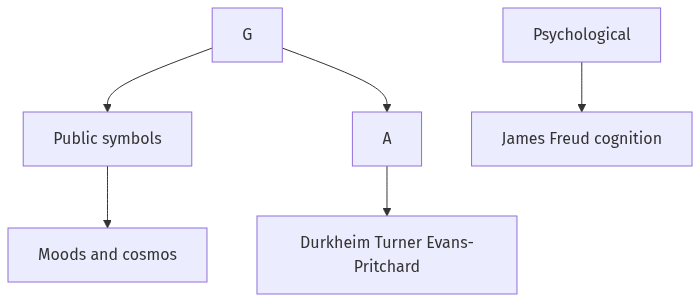
Geertz defined religion as a cultural system of symbols that found moods and motivations in a factual-feeling order. Thick description of public ritual is his method, as in Bali and Java. Anthropological approaches treat the sacred as social, from Durkheim to Evans-Pritchard and Turner. Psychological approaches treat experience, projection, and mental architecture, from James and Freud onward. Tylor’s animism is intellectualist psychology in anthropological dress. Geertz sides with public meaning, not with private psyche as the starting point.
Model answer
Copper italics in this answer — like this — are the key facts. Each one is unpacked in the Facts & figures rail.
Introduction
Clifford Geertz treated religion as a public system of symbols, not as a private feeling. That stance is anthropological, and it differs from psychological approaches that start inside the mind.
Body
Geertz on religion
- In the essay Religion as a Cultural System, collected in The Interpretation of Cultures (1973), Geertz defines religion as a system of symbols that establishes powerful moods and motivations by clothing a picture of order with an aura of factuality.
- Those moods then seem uniquely realistic, which is why a ritual is not a metaphor the believer sees through.
- Thick description is the method: the ethnographer reads the public code, as in a Javanese or Balinese rite, the way Geertz read the Balinese cockfight as a story people tell themselves.
- Models of reality and models for action meet in sacred symbols, so cosmology and ethics are one enacted web.
- Geertz is close to Max Weber on meaning and far from a search for the origin of gods in a single psychic error.
Anthropological approaches
- Anthropology treats religion as social and public: Émile Durkheim in The Elementary Forms of Religious Life made the sacred a figure of the group, illustrated by Australian totemism.
- Bronislaw Malinowski at the Trobriands treated magic and ritual as practical anxiety-management in gardening and canoe travel, still a social institution.
- E. E. Evans-Pritchard on Nuer religion and Azande witchcraft showed coherent local thought, not childish mentality.
- Victor Turner on Ndembu ritual treated symbols as operators in social drama, which complements Geertz’s textual reading.
- The unit is the rite, the congregation, the symbol, and the local cosmos.
Psychological approaches
- Psychology starts with the individual mind: William James in The Varieties of Religious Experience classified conversion, saintliness, and mysticism as personal states.
- Sigmund Freud in Totem and Taboo and later The Future of an Illusion read gods as projections of the father and ritual as compulsion.
- Culture-and-personality work, and later cognitive anthropology of modules and hyperactive agency, also explain belief from mental architecture first.
- E. B. Tylor’s intellectualist animism is a borderline case: it is a theory of error in the mind, even though Tylor wrote as an anthropologist.
The difference
- Anthropology asks what a symbol does in public life and how a group holds a cosmos.
- Psychology asks what a belief does in a nervous system or a biography.
- Geertz insisted that meaning is public, which is why a wink is not a twitch, and why religion is not exhausted by private emotion.
Flow diagram
Conclusion
Geertz looked at religion as a cultural system of symbols that make a cosmos feel uniquely real. Anthropological approaches read that public web; psychological approaches read inner states, and the two can meet only after each has kept its unit of study.
Quick related
Students also ask
-
Elucidate the concept of "thick description" of Clifford Geertz with a suitable example
Next question on this syllabus topic (2021 · Q2(b)). View answer →
-
Did Geertz deny that people feel religion?
No. He said moods are real, but they are established by public symbols, not discovered first as a private essence.
-
Can the two approaches be combined?
Yes, after the units are clear. Cognition can ask why symbols catch; ethnography still has to say which cosmos a people enact.
Same topic · past papers
UPSC has asked this before
These previous-year questions sit on the same topic. Open one to practise the earlier ask.
-
2025 · Q3(c) · Anthropology GS 1 · 15 marks
Differentiate between pedigree and genealogical analyses. Discuss the history and application of these methods in anthropological studies
More from this topic
Q2(b) · UPSC Mains 2025 · Anthropology GS 1 · 15 marks · Solution
Compare and contrast the symbolic approaches of Clifford Geertz and Victor Turner to understand culture
Symbolic and interpretive theories (Turner, Schneider and Geertz)
Geertz treats culture as webs of significance, uses thick description, and reads the Balinese cockfight as a text. Turner treats ritual symbols as operators, distinguishes dominant and instrumental symbols, and uses liminality, communitas and social drama. Both are symbolic and anti-reductionist. The contrast is hermeneutic text versus processual performance, and order-reading versus conflict-and-redress. Geertz is not mere idealism, and Turner is not mere functionalism. They are complementary methods.
Q2(b) · UPSC Mains 2021 · Anthropology GS 1 · 15 marks · Solution
Elucidate the concept of "thick description" of Clifford Geertz with a suitable example
Symbolic and interpretive theories (Turner, Schneider and Geertz)
Thick description names the meaning of an act in its cultural code. Ryle’s wink shows why a twitch is not a signal. Geertz’s Balinese cockfight reads status, kinship, and masculinity in a fight. Java work used the same interpretive method on religion and market. The limit is underplaying power; the gain is refusing empty behaviourism.
Q2(c) · UPSC Mains 2016 · Anthropology GS 1 · 15 marks · Solution
According to Geertz, how does the cock-fight reveal aspects of Balinese culture?
Symbolic and interpretive theories (Turner, Schneider and Geertz)
Geertz treats the Balinese cockfight as a readable public text. Cocks stand for men; deep bets stand for honour, not utility. Betting partnerships map kinship and rank. The bout is a commentary on status that ordinary talk hides. Thick description is the method that shows this.