
Revision summary
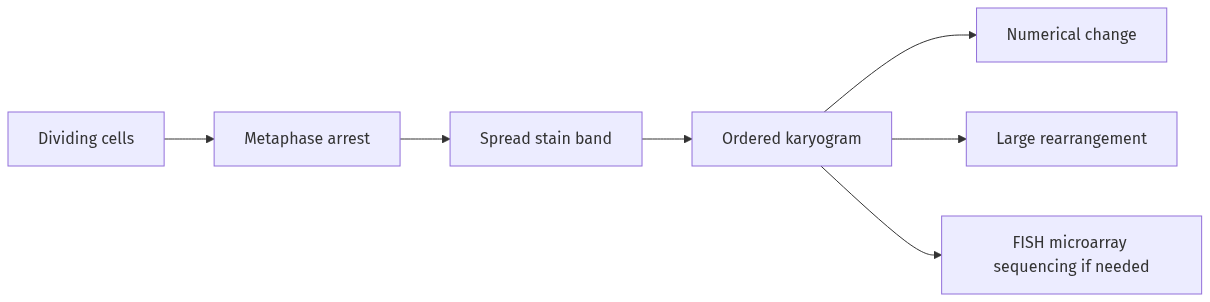
Karyotype means chromosome complement; karyogram is its ordered image. Metaphase arrest, hypotonic spreading and G-banding permit homologous pairing and notation. It diagnoses trisomy 21, Turner, Klinefelter and other numerical aberrations. It also finds large deletions, inversions and balanced or unbalanced translocations. Multiple cells must be examined for mosaicism. A normal karyotype does not exclude microdeletions or single-gene disease; use FISH, microarray or sequencing appropriately.
Model answer
Copper italics in this answer — like this — are the key facts. Each one is unpacked in the Facts & figures rail.
Introduction
A karyotype is an individual’s chromosome complement described by number, size, centromere position and banding pattern; a karyogram is its ordered visual display. Conventional analysis examines condensed metaphase chromosomes and is especially useful for whole-chromosome changes and large structural rearrangements.
Body
Preparation and reading
Dividing cells from blood, amniotic fluid, chorionic villi, marrow or tumour are cultured where necessary. Colchicine/colcemid arrests metaphase; hypotonic treatment spreads chromosomes; fixation, staining and microscopy follow. G-banding produces reproducible light and dark bands. Homologues are paired from chromosome 1 to 22 plus sex chromosomes, producing notations such as 46,XX or 46,XY.
Analysis checks:
- total chromosome number;
- homologous size and centromere position;
- missing, duplicated or rearranged bands;
- several cells to identify mosaicism.
Diagnostic value
- Numerical aberrations: meiotic nondisjunction may produce trisomy 21 (47,XX,+21), trisomy 18, trisomy 13, Turner syndrome (45,X) or Klinefelter syndrome (47,XXY). Polyploid conceptions can also be recognised.
- Structural aberrations: large deletions such as 5p deletion in cri-du-chat syndrome, duplications, inversions, ring chromosomes and reciprocal or Robertsonian translocations are visible when above the banding resolution.
- Reproductive diagnosis: A phenotypically normal parent may carry a balanced translocation. Karyotyping can explain recurrent miscarriage or a child with an unbalanced rearrangement and guide recurrence-risk counselling.
- Cancer cytogenetics: acquired rearrangements, classically the Philadelphia chromosome t(9;22) in chronic myeloid leukaemia, can classify disease.
Targeted FISH detects specified loci and rearrangements; chromosomal microarray detects smaller copy-number changes; sequencing detects nucleotide variants. These complement rather than make every karyotype obsolete.
Limits
Conventional resolution is usually several megabases and depends on band quality. It misses most single-gene mutations, small copy-number variants and many low-level mosaics. A normal karyotype therefore does not mean a normal genome, while a prenatal abnormality requires careful, non-directive interpretation rather than deterministic prediction.
Flow diagram
Conclusion
Karyotyping converts chromosome morphology into a diagnosis of aneuploidy and major rearrangement. Its strength is the genome-wide view of large changes; its limit is resolution. Sound diagnosis combines clinical findings, adequate cell sampling and the appropriate molecular follow-up.
Quick related
Students also ask
-
Describe the causes of structural abnormalities of chromosomes with suitable examples.
Next question on this syllabus topic (2023 · Q8(b)). View answer →
-
Can karyotyping diagnose sickle-cell disease?
No. HbS is a single-nucleotide HBB variant, below karyotype resolution; biochemical and molecular tests are used.
-
Why retain karyotyping after microarray?
It displays whole-chromosome architecture and can reveal balanced translocations, inversions and complex rearrangements that copy-number arrays may miss.
Same topic · past papers
UPSC has asked this before
These previous-year questions sit on the same topic. Open one to practise the earlier ask.
-
2026 · Q3(c) · Anthropology GS 1 · 15 marks
Numerical chromosomal aberrations can be due to abnormalities in autosomes as well as sex chromosomes. Elaborate in terms of the effects these have on human body, giving suitable examples -
2021 · Q4(c) · Anthropology GS 1 · 15 marks
"Chromosomal aberrations can play havoc with the human body and mind." Explain with suitable examples -
2015 · Q6(c) · Anthropology GS 1 · 15 marks
Discuss chromosomal aberrations in man illustrating with examples -
2026 · Q2(a) · Anthropology GS 1 · 20 marks
What is meant by a somatotype? Discuss the Heath-Carter anthropometric method, giving its advantages over that of Sheldon's method. How can somatotyping be applied in sports sciences? -
2022 · Q6(b) · Anthropology GS 1 · 15 marks
What is meant by health? Is the burden of life style diseases on the rise? Justify your answer with suitable examples
More from this topic
Q3(c) · UPSC Mains 2026 · Anthropology GS 1 · 15 marks · Solution
Numerical chromosomal aberrations can be due to abnormalities in autosomes as well as sex chromosomes. Elaborate in terms of the effects these have on human body, giving suitable examples
Numerical and structural aberrations (disorders).
Numerical chromosomal aberrations arise from non-disjunction during cell division, leading to abnormal chromosome numbers. Autosomal abnormalities such as Down syndrome, Patau syndrome, and Edwards syndrome cause severe physical and cognitive developmental delays. Sex chromosome abnormalities like Turner syndrome and Klinefelter syndrome result in distinct endocrine, reproductive, and morphological manifestations. Understanding these genetic variations provides essential insights into human variation, heredity, and clinical diagnostics.
Q8(b) · UPSC Mains 2023 · Anthropology GS 1 · 15 marks · Solution
Describe the causes of structural abnormalities of chromosomes with suitable examples.
Numerical and structural aberrations (disorders).
Structural abnormalities rearrange chromosome parts after breakage or unequal crossing-over. Types are deletion, duplication, inversion, translocation, ring, and isochromosome. Cri-du-chat is 5p deletion; 22q11 is a common microdeletion. Philadelphia t(9;22) is a somatic translocation in CML. Robertsonian 14;21 can cause translocation Down syndrome. Balanced parental carriers explain some recurrent unbalanced offspring.
Q4(c) · UPSC Mains 2021 · Anthropology GS 1 · 15 marks · Solution
"Chromosomal aberrations can play havoc with the human body and mind." Explain with suitable examples
Numerical and structural aberrations (disorders).
Aberrations are numerical or structural changes of chromosomes. Down syndrome is trisomy 21 with body and cognitive effects. Turner is 45,X; Klinefelter is 47,XXY; both alter gonads and sometimes learning. Deletions and unbalanced translocations can be as severe as extra chromosomes. Outcomes vary; counselling and care matter as much as the karyotype name.