
Revision summary
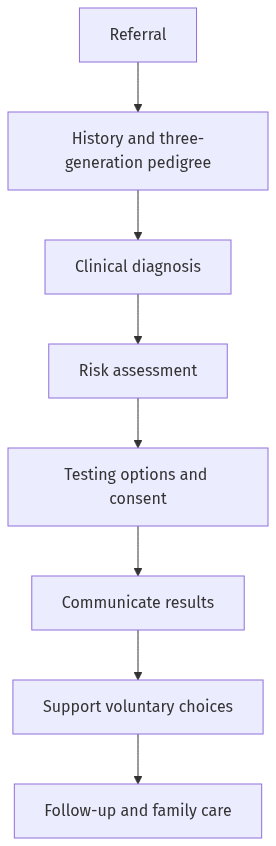
Genetic counselling helps families understand hereditary and psychosocial implications and choose voluntarily. The sequence is referral, pedigree, diagnosis, risk assessment, consented testing, communication, options and follow-up. Screening estimates risk; a positive screen is not automatically a diagnosis. Risk explanations must include penetrance, variable expression and uncertainty. Thalassaemia and sickle-cell programmes require confirmatory tests and non-stigmatising counselling. Privacy, coercion, sex selection and unequal access are central ethical concerns.
Model answer
Copper italics in this answer — like this — are the key facts. Each one is unpacked in the Facts & figures rail.
Introduction
Genetic counselling is a communication process that helps individuals and families understand the medical, hereditary and psychosocial implications of genetic conditions and make informed decisions. Sheldon Reed, who introduced the term, stressed counselling rather than eugenic command; modern practice is non-directive and autonomy-centred.
Body
Steps in genetic counselling
- Referral and contract: Clarify the client’s concern—affected child, family history, recurrent pregnancy loss, carrier screening or prenatal finding—and the limits of confidentiality.
- History and pedigree: Record a three-generation pedigree, diagnoses, ancestry where medically relevant, consanguinity, reproductive history and exposures. Social genealogy must not be assumed to equal biological parentage.
- Clinical diagnosis: Review records and phenotype; involve relevant specialists. A precise diagnosis precedes meaningful recurrence risk.
- Risk assessment: Identify Mendelian, chromosomal, mitochondrial or multifactorial inheritance. Calculate risk from the pedigree and population data while explaining penetrance, variable expression and uncertainty.
- Testing discussion and consent: Explain no-test, screening and diagnostic options; possible results include positive, negative, uncertain and incidental findings. Choose karyotype, biochemical assay, targeted variant test, panel, microarray or sequencing according to the question.
- Communication: Use plain language and absolute risk, check understanding and distinguish a carrier from an affected person. Provide a written summary.
- Options and decision support: Discuss treatment, surveillance, cascade testing and reproductive choices such as natural conception, prenatal diagnosis, IVF with PGT, donor gametes or adoption where available. The counsellor informs but does not prescribe.
- Psychosocial care and follow-up: Address guilt, family disclosure, grief, insurance or marriage stigma; revisit uncertain variants as knowledge changes and refer to support services.
Indian and anthropological relevance
Thalassaemia and sickle-cell programmes illustrate carrier screening followed by confirmatory testing and counselling. Consanguineous or endogamous populations may have elevated frequencies of particular recessives, but community labels are poor substitutes for testing. Prenatal screening such as NIPT estimates probability; CVS or amniocentesis can provide diagnostic material.
Counselling must guard against coerced testing, sex selection, caste/tribal stigmatisation, breach of genomic privacy and pressure to terminate pregnancy. Limited laboratories and uncertain variants can make “choice” unequal. Family benefit must be balanced with the client’s confidentiality.
Flow diagram
Conclusion
Good genetic counselling is not a laboratory result delivered with advice. It is a cycle of verified diagnosis, transparent risk, voluntary testing, supported choice and follow-up. Its anthropological quality lies in joining inheritance to kinship, stigma, language and unequal access without reviving eugenics.
Quick related
Students also ask
-
Pedigree analysis in genetic counselling
Next question on this syllabus topic (2022 · Q1(d)). View answer →
-
Does non-directive counselling mean giving no guidance?
No. It means clear expert information and decision support without coercing the client toward the counsellor’s preferred reproductive choice.
-
Is NIPT diagnostic?
No. It is a high-performance screening test for selected chromosomal conditions; significant positive findings generally require diagnostic confirmation.
Same topic · past papers
UPSC has asked this before
These previous-year questions sit on the same topic. Open one to practise the earlier ask.
-
2016 · Q7(b) · Anthropology GS 1 · 15 marks
Explain the significance of screening and counseling for genetic disorders.
More from this topic
Q6(a) · UPSC Mains 2026 · Anthropology GS 1 · 20 marks · Solution
How would you find out that a particular disease/disorder is inherited and, if so, in which manner? Elaborate with suitable examples
Genetic imprints in human disease, genetic screening, genetic counseling, human DNA profiling, gene mapping and genome study.
• Trace family health histories across generations using standardized pedigree charts to spot inheritance patterns. • Compare concordance rates between identical and fraternal twins to separate genetic traits from environmental effects. • Use adoption studies to isolate biological lineage from shared home environments and confirm innate vulnerability. • Run laboratory diagnostics like karyotyping to spot gross chromosomal anomalies and numerical aberrations. • Employ DNA sequencing, such as PCR and next-gen methods, to detect specific point mutations or deletions. • Identify autosomal recessive disorders like sickle cell anaemia, which typically appear with consanguineous parents. • Track X-linked traits like haemophilia to demonstrate skewed transmission patterns across different sexes.
Q8(b) · UPSC Mains 2025 · Anthropology GS 1 · 15 marks · Solution
'Genome-wide Disease Association Studies (GWAS) advanced our understanding of health and disease.' Discuss
Genetic imprints in human disease, genetic screening, genetic counseling, human DNA profiling, gene mapping and genome study.
GWAS tests common SNPs across the genome for association with a trait or disease. It showed that many adult diseases are polygenic and pointed to biological pathways. Polygenic scores are research tools, not fate. Limits include European-ancestry bias, missing heritability, and misuse as race biology. Environment, foetal programming and inequality still explain a large share of health. GWAS belongs with genetic markers and with non-Mendelian inheritance.
Q1(d) · UPSC Mains 2022 · Anthropology GS 1 · 10 marks · Solution
Pedigree analysis in genetic counselling
Genetic imprints in human disease, genetic screening, genetic counseling, human DNA profiling, gene mapping and genome study.
A pedigree uses standard symbols to show how a trait runs in a family. Dominant, recessive, and X-linked patterns can be read from the chart. Garrod linked such patterns to inborn errors of metabolism. Counselling uses the chart for recurrence risk, especially with consanguinity. Molecular tests refine, they do not replace, the family drawing.