
Revision summary
Cross-sectional study measures different children once. Longitudinal study remeasures the same children, as in Tanner’s work. Mixed-longitudinal study follows overlapping cohorts and may replace drop-outs. Merits are cost, speed, and some velocity data. Demerits are joining error, secular-trend mix, and remaining attrition bias. Indian school and ICMR work often uses this middle design.
Model answer
Copper italics in this answer — like this — are the key facts. Each one is unpacked in the Facts & figures rail.
Introduction
Human growth can be measured once, followed in the same children, or studied by a mix of both. The mixed-longitudinal method is that mix, designed to keep the truth of change without the full cost of a lifetime panel.
Body
The three designs
- A cross-sectional survey measures different children at each age once, which Franz Boas already used to show environment in stature, but it cannot show a single child’s velocity.
- A longitudinal study remeasures the same children, which J. M. Tanner made the gold standard for velocity, age at peak height velocity, and tempo.
- A mixed-longitudinal design follows several overlapping cohorts for a few years each, and it may add new children as others leave, so the study covers a wide age span in calendar time shorter than a full birth-to-adult panel.
How mixed-longitudinal work is done
- Cohort A is seen from 5 to 10 years, cohort B from 8 to 14, cohort C from 12 to 18, with overlap so curves can be joined.
- Drop-outs are replaced, which is why the method is common in school, ICMR, and clinic growth programmes that cannot lock a sample for twenty years.
- Distance (size attained) and velocity (rate) can both be estimated, with more error at the joins than in a pure panel.
Merits
- It is cheaper and faster than a complete longitudinal study of one birth cohort to adulthood.
- It captures tempo and seasonal or secular change better than a one-time cross-section.
- Overlap between cohorts lets the analyst check consistency, which a pure cross-section never sees.
- Ethical and practical loss of subjects is easier to repair by adding children than in a sealed panel.
Demerits
- Joining cohorts can hide real differences between groups born in different years, which is a secular-trend confound.
- Velocity estimates are weaker than in a long panel of the same bodies.
- Selective drop-out still biases the remaining sample if the poorest or most migrant children leave.
- Statistical handling is heavier than a simple cross-section, and poor joining produces a false smooth curve.
Use in anthropology
- Population comparisons, nutritional intervention, and secular-change studies in India often use mixed-longitudinal school data because a Tanner-style twenty-year clinic panel is rare.
Flow diagram
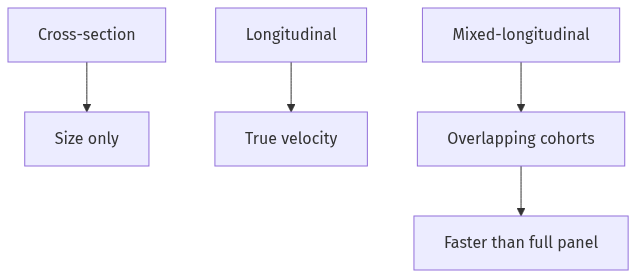
Conclusion
Mixed-longitudinal growth study follows overlapping cohorts instead of one lifelong sample. It buys velocity and speed at the price of joining error, and it is the practical middle path between a survey and a full panel.
Quick related
Students also ask
-
Critically discuss the Mendelian principles and their application to human populations.
Next question on this syllabus topic (2016 · Q7(a)). View answer →
-
Why not always use full longitudinal study?
It takes decades, loses subjects, and is expensive. Mixed-longitudinal work is the feasible substitute for many populations.
-
Does mixed-longitudinal replace Tanner’s panel?
No. It approximates velocity. A long panel of the same children remains stronger for individual tempo.
Same topic · past papers
UPSC has asked this before
These previous-year questions sit on the same topic. Open one to practise the earlier ask.
-
2015 · Q5(c) · Anthropology GS 1 · 10 marks
Longitudinal method of studying growth.
More from this topic
Q3(c) · UPSC Mains 2025 · Anthropology GS 1 · 15 marks · Solution
Differentiate between pedigree and genealogical analyses. Discuss the history and application of these methods in anthropological studies
Human Genetics
Genealogy is Rivers’ 1910 method: social ties, kin terms, marriage and rights. Fictive kin count. Pedigree is a genetic diagram of biological parentage and affected status, used to infer Mendelian inheritance. The two words are not synonyms. History runs from Cambridge field kinship on one side to clinical and then medical genetics on the other. Uses include kinship systems, consanguinity, counselling, and careful overlay with consent. Alliance theory criticised genealogy-as-enough. It did not erase the method.
Q7(a) · UPSC Mains 2016 · Anthropology GS 1 · 20 marks · Solution
Critically discuss the Mendelian principles and their application to human populations.
Human Genetics
Segregation and independent assortment are the core Mendelian laws. Human pedigrees of recessives, dominants, and X-linked traits apply them. Hardy–Weinberg is Mendelism at population scale. Consanguinity and caste mating violate random-mating assumptions. Polygenic traits and eugenic history are the critique.