
Revision summary
Social and cultural anthropology studies learned life in the round, from Tylor’s culture to Boas’s fieldwork. Malinowski and Radcliffe-Brown added living systems and social structure. The scope is kinship, economy, politics, religion, and change. Relevance lies in development, health, law, and comparison, as Srinivas and Elwin showed in India. Geertz keeps public meaning inside that same scope.
Model answer
Copper italics in this answer — like this — are the key facts. Each one is unpacked in the Facts & figures rail.
Introduction
Social and cultural anthropology studies how people live together and how they make meaning. Its scope is the whole of social life, and its relevance is that those lives still have to be known on the ground.
Body
Scope
- Edward Tylor treated culture as a learned whole of knowledge, belief, art, law, and custom, which set the first wide frame for the subject.
- Franz Boas made fieldwork, language, and history the method, and he refused to rank peoples on a single ladder of civilisation.
- Bronislaw Malinowski at Omarakana in the Trobriand Islands showed that economy, kinship, magic, and law hang together in one living system.
- A. R. Radcliffe-Brown asked how institutions maintain social structure, so the scope includes both meaning and organisation.
- The field therefore covers kinship, economy, politics, religion, gender, law, and change, using ethnography and comparison rather than laboratory isolation.
Relevance
- Development, public health, and law need this knowledge because a scheme that ignores caste, clan, and local tenure often fails, as M. N. Srinivas showed for the Indian village and Verrier Elwin argued for tribal policy.
- Medical and applied anthropology use the same tools in clinics, camps, and courts, from W. H. R. Rivers onward to contemporary public-health ethnography.
- In a world of migration and media, Clifford Geertz and later global ethnography keep the subject relevant by reading public meanings, not only village custom.
Flow diagram
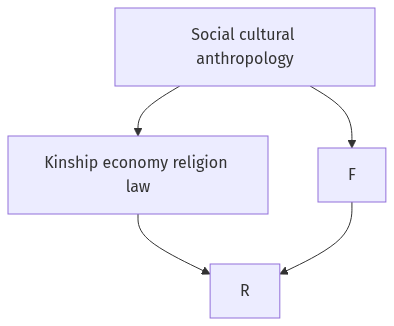
Conclusion
The scope of social and cultural anthropology is holism plus ethnography across institutions. Its relevance is practical: policy and comparison still need the local social fact.
Quick related
Students also ask
-
Elaborate the scope of anthropology and elucidate its uniqueness in the field of other social sciences
Next question on this syllabus topic (2021 · Q4(a)). View answer →
-
Is social anthropology only village study?
No. The classical field was often a village or island, but the scope now includes cities, courts, clinics, and transnational networks.
-
How does it differ from sociology?
The overlap is large. Anthropology still leans on long fieldwork, comparison across societies, and kinship and ritual as core files.
Same topic · past papers
UPSC has asked this before
These previous-year questions sit on the same topic. Open one to practise the earlier ask.
-
2024 · Q5(b) · Anthropology GS 1 · 10 marks
Cultural relevance of the Kula -
2023 · Q7(c) · Anthropology GS 1 · 15 marks
Discuss political and methodological aspects of national character studies. Elucidate the contemporary relevance of such studies.
More from this topic
Q2(b) · UPSC Mains 2026 · Anthropology GS 1 · 15 marks · Solution
How do religious beliefs help people to devise cultural mechanisms to adapt to their environment? Discuss in detail with appropriate examples
Social-cultural Anthropology.
Religion functions as an adaptive cultural mechanism that helps human societies sustainably manage their natural environments. Religious taboos and
Q1(a) · UPSC Mains 2026 · Anthropology GS 1 · 10 marks · Solution
Health as a cultural construct.
Social-cultural Anthropology.
• Health is a cultural construct shaped by societal values, distinguishing objective biological disease from the subjective experience of illness. • Different cultures use distinct ethnomedical systems, explaining sickness through spiritual breaches, humoral imbalances, or sorcery. • Societies express suffering through unique cultural metaphors and bodily symptoms, known as idioms of distress (e.g., *susto* or *koro*). • Healing practices rely on the social authority and symbolic power of traditional or biomedical healers validated by their communities. • Patients in pluralistic societies often choose treatments based on cultural compatibility rather than pure biomedical effectiveness. • Applying these anthropological insights to public health policies ensures culturally competent care and better health-seeking behavior.
Q4(a) · UPSC Mains 2021 · Anthropology GS 1 · 20 marks · Solution
Elaborate the scope of anthropology and elucidate its uniqueness in the field of other social sciences
Social-cultural Anthropology.
Scope is four-field: body, tools, language, and social life. It includes fossils, villages, and cities, not tribes alone. Uniqueness is holism plus long fieldwork and comparison. Sociology, economics, and history each drop a piece that anthropology keeps. The charter is connection across fields, not one scholar doing everything.