
Revision summary
The Indian Mesolithic is a Holocene microlithic hunter-gatherer phase. Ganga sites of Sharma’s school, Bagor under Misra, and Langhnaj under Sankalia are central. Bhimbetka, Adamgarh, Birbhanpur, and Teri sites widen the map. Typo-technology is backed blades, lunates, triangles, trapezes, and hafted composites. Bone tools and grinders complete the kit. Late Bagor shows copper on a microlithic base.
Model answer
Copper italics in this answer — like this — are the key facts. Each one is unpacked in the Facts & figures rail.
Introduction
The Indian Mesolithic is the Holocene hunter-gatherer world of microliths between Paleolithic flakes and Neolithic food production. Sites from the Ganga valley to the Thar and the south show a shared typo-technology with regional economies.
Body
Major sites
- Sarai Nahar Rai, Mahadaha, and Damdama in the Ganga valley, excavated under G. R. Sharma and later teams at Allahabad, yielded burials, bone tools, and microliths beside oxbow lakes.
- Bagor in Rajasthan, excavated by V. N. Misra, is a dune site with geometric microliths, hearths, and later copper, often cited for incipient animal management.
- Langhnaj in Gujarat, associated with H. D. Sankalia, produced microliths and burials in a sandy estuarine setting.
- Adamgarh and Bhimbetka in the Vindhyas show microlithic floors and a painted-shelter sequence after Acheulian use.
- Birbhanpur in West Bengal, Lekhahia and Morhana Pahar in the Vindhyan belt, and the Teri dune sites of Tamil Nadu extend the map to east and south.
- Patne, Andhra rock shelters, and Sri Lankan Microlithic comparisons sit in the same Holocene hunting world.
Typo-technology
- The signature is the microlith: small blades and bladelets in chert, chalcedony, quartz, and agate, often backed.
- Geometric types include lunates, triangles, and trapezes, which were hafted as composite points, barbs, and knives rather than used as tiny hand tools alone.
- Non-geometric microliths and fluted cores continue from an Upper Paleolithic blade habit in some regions, so the Mesolithic is a technological intensification, not a people arriving from nowhere.
- Bone points, grinding stones, and occasional pottery or copper at late sites such as Bagor show a broad-spectrum toolkit beside the stone.
- Hunting of deer and antelope, fishing and fowling in Ganga oxbows, and shell or dune foraging in the south match that toolkit.
Cultural reading
- Burials with ochre and grave goods at Damdama and Mahadaha show social life, not only waste flakes.
- The Mesolithic is the typo-technological bridge to food production, not yet the Neolithic village.
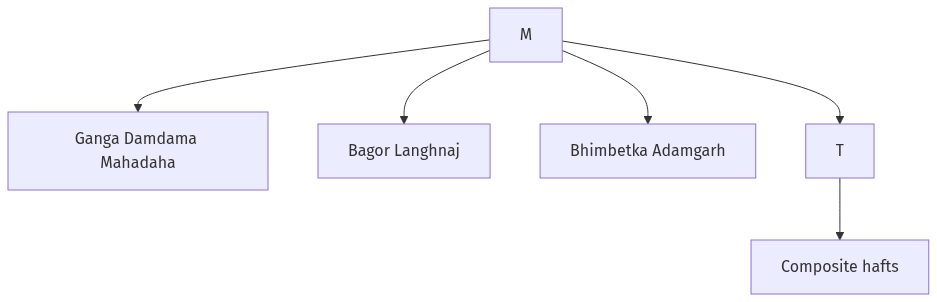
Flow diagram
Conclusion
Major Indian Mesolithic sites include Sarai Nahar Rai, Mahadaha, Damdama, Bagor, Langhnaj, Adamgarh, Bhimbetka, Birbhanpur, and the Teri dunes. Their typo-technology is geometric microliths in composite hafts, with bone, grinders, and later metal or pottery at some late camps.
Quick related
Students also ask
-
Mesolithic rock art in Indian subcontinent
Next question on this syllabus topic (2022 · Q1(b)). View answer →
-
Are microliths too small to be tools?
They were meant to be set in wood or bone as composite tools. Size is the design, not a failure of skill.
-
Is Bagor already Neolithic?
It is a late Mesolithic camp with hints of animal management and copper. Food production as a village system is a later question.
Same topic · past papers
UPSC has asked this before
These previous-year questions sit on the same topic. Open one to practise the earlier ask.
-
2022 · Q2(c) · Anthropology GS 1 · 15 marks
Discuss with suitable examples the typo-technological problems in Indian palaeolithic industry with reference to environmental hypotheses
More from this topic
Q1(b) · UPSC Mains 2022 · Anthropology GS 1 · 10 marks · Solution
Mesolithic rock art in Indian subcontinent
Mesolithic
Mesolithic paintings sit on Indian sandstone and granite shelters. Bhimbetka, recorded by Wakankar, is the central cluster. Scenes show hunt, dance, and early animal management. Microlith floors tie the pictures to a foraging economy. The art is ritual and record, not a later doodle.
Q3(c) · UPSC Mains 2021 · Anthropology GS 1 · 15 marks · Solution
Discuss the salient features of different traditions of European Mesolithic
Mesolithic
European Mesolithic traditions are regional, not one culture. Maglemosian is a northern forest-lake toolkit with bone points and canoes. Azilian follows Magdalenian with painted pebbles and small harpoons. Tardenoisian is inland geometric microliths. Asturian and Ertebølle add coastal middens; Lepenski Vir shows fisher sedentism.