
Revision summary
Wolf already placed local peoples inside world markets. Globalization intensifies land commodification, wage labour, and branded culture. Niyamgiri and dam displacement are Indian cases of resource enclosure. Remittances and tourism can feed and hollow the same household. New brokers create internal inequality. Friction, law, and cooperatives are the counter-moves, not a return to a closed isolate.
Model answer
Copper italics in this answer — like this — are the key facts. Each one is unpacked in the Facts & figures rail.
Introduction
Indigenous economies were already inside colonial markets, as Eric Wolf showed. Globalization intensifies that enclosure through price, land, media, and law, and it does not have one single effect.
Body
What is hit
- Subsistence mixes of hunting, shifting cultivation, pastoralism, and craft meet cash crops, wage labour, and packaged food, which Marshall Sahlins’s domestic mode of production no longer describes as a closed circuit.
- Land and forest become commodities through mines, dams, plantations, and conservation fences, so tenure is the first economic fact, not only income.
Typical impacts
- Dispossession: Dongria Kondh resistance at Niyamgiri, Narmada displacement ethnography, and Amazon oil frontiers show that global demand for bauxite, electricity, and crude rewrites local livelihood.
- Labour and cash: Gulf and city migration from highland and island communities sends remittances that both feed households and empty fields, a pattern Arjun Appadurai would read as ethnoscapes of labour.
- Commoditised culture: tourism, fair-trade coffee, and patented seed can raise cash while stripping ritual control of knowledge, as in many Andean and north-east Indian craft markets.
- New inequality: brokers, contractors, and educated youth capture rents; elders and women who held common resources often lose.
- Health and food: market starch and alcohol replace diverse forest diets, which nutritional anthropology records as a biological cost of the same economic shift.
Not only loss
- Indigenous firms, cooperatives, and legal victories such as community forest rights can use global courts and NGOs, which Anna Tsing would call friction rather than a steamroller.
- Some pastoralists and fishers specialise for urban markets and stay on the land under new terms.
How to write the impact
- Name the local system first: jhum, herd, reef, or forest.
- Then name the global chain: metal, tourist, carbon, or garment.
- Then say who captures the cash.
Flow diagram
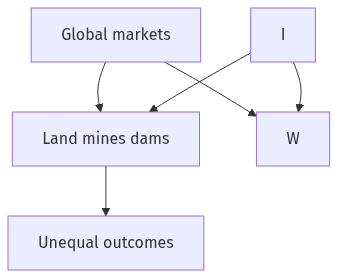
Conclusion
Globalization pulls indigenous economies into longer commodity chains and weaker tenure. The impact is dispossession and cash together, and the anthropological task is to show which households gain and which commons fail.
Quick related
Students also ask
-
Discuss political and methodological aspects of national character studies. Elucidate the contemporary relevance of such studies.
Next question on this syllabus topic (2023 · Q7(c)). View answer →
-
Does globalization always destroy indigenous economy?
It often encloses land and replaces subsistence. Some groups capture niches in tourism, craft, or law. The outcome is empirical and unequal.
-
Were these economies untouched before the 1990s?
No. Colonial tax, missions, and indenture already linked them. Globalization is intensification, not first contact.
Same topic · past papers
UPSC has asked this before
These previous-year questions sit on the same topic. Open one to practise the earlier ask.
-
2025 · Q8(a) · Anthropology GS 1 · 20 marks
How the theories of postmodernism are relevant in promoting social justice and empowerment of marginalised communities?
More from this topic
Q7(c) · UPSC Mains 2023 · Anthropology GS 1 · 15 marks · Solution
Discuss political and methodological aspects of national character studies. Elucidate the contemporary relevance of such studies.
Economic Organization
National character work grew from culture-and-personality, especially Benedict on Japan. It was politically funded as wartime culture-at-a-distance. Methods were life history, projective tests, film, and émigré interview. Faults are stereotyping, sample bias, and the ecological fallacy. Geertz moved the field from private character to public meaning. Today the genre survives in branding and populism; anthropology uses it as a caution.
Q1(a) · UPSC Mains 2022 · Anthropology GS 1 · 10 marks · Solution
Debate between formalist and substantivist approaches
Economic Organization
Formalists treat scarcity and choice as universal. Substantivists, after Polanyi, treat reciprocity, redistribution, and market as historical forms. Kula and Nuer cattle show goods locked in kinship and prestige. Spheres of exchange refuse one money. Use both tools: calculation inside an instituted process.
Q4(a) · UPSC Mains 2016 · Anthropology GS 1 · 20 marks · Solution
Discuss the principles governing production, distribution and exchange in simple societies.
Economic Organization
Production is household and lineage labour on common or clan land. Distribution follows reciprocity and redistribution more than wage. Exchange is gift, kula-like partnership, and spheres of goods. Polanyi and Sahlins name the principles. Price market is not the default law.