
Revision summary
Australopithecus is a small-brained African biped of the Pliocene and early Pleistocene. East African species include A. anamensis, A. afarensis, and A. garhi. South African species include A. africanus and A. sediba, with Little Foot as a key skeleton. Taung was found in 1924 and named by Raymond Dart in 1925. The child shows a downward foramen magnum, small canines, and an ape-sized brain. Significance is the African origin argument and the type of A. africanus after early rejection.
Model answer
Copper italics in this answer — like this — are the key facts. Each one is unpacked in the Facts & figures rail.
Introduction
Australopithecus is the Pliocene–early Pleistocene African hominin with small brains, large chewing teeth, and bipedal hips. South and East African caves and beds have yielded the named species, and the Taung child is the find that opened that file.
Body
East African species
- Australopithecus anamensis, named by Meave Leakey from Kanapoi and Allia Bay, Kenya, is among the earliest, with a primitive jaw and a tibia that already suggests upright walking.
- Australopithecus afarensis is the best-known East African species: Lucy (AL 288-1) from Hadar, Ethiopia, recovered by Donald Johanson, and the Laetoli footprints reported by Mary Leakey, show a small-brained biped with curved fingers.
- Australopithecus garhi from Bouri, Middle Awash, associated with Berhane Asfaw and Tim White’s team, has larger postcanine teeth and has been discussed beside early stone-tool cut marks.
- Later named East African forms such as A. deyiremeda add diversity beside Kenyanthropus platyops, which some workers still compare with the australopith grade.
South African species
- Australopithecus africanus is the South African type species, from Taung, then Sterkfontein and Makapansgat, with Robert Broom’s adult finds such as Mrs Ples confirming Dart’s child.
- Australopithecus sediba from Malapa, announced by Lee Berger, mixes australopith and more Homo-like pelvis and hand traits at about 2 million years.
- Little Foot (StW 573) from Sterkfontein, associated with Ron Clarke, is often placed in A. prometheus or in africanus; either way it is a near-complete South African skeleton.
- Robust forms from Kromdraai, Swartkrans, and Olduvai are usually now Paranthropus (P. robustus, P. boisei), not Australopithecus, and should be named as cousins, not as the same genus.
Taung baby: discovery
- In 1924 a limestone quarry at Taung, then in the northern Cape, yielded a child’s skull, mandible, and natural endocast that reached Raymond Dart in Johannesburg.
- Dart named Australopithecus africanus in Nature in 1925 and argued that the child was a hominin, not an ape.
Taung baby: features
- The child was about three to four years old on dental eruption, with a mixed deciduous and first-molar set.
- The endocast suggested a brain larger than a chimpanzee of similar age in Dart’s reading, though still far below later Homo.
- The foramen magnum sits toward the underside, which Dart used as evidence of upright carriage.
- Canines are small, the face is less projecting than in living apes, and there is no simian shelf of the kind expected in a young ape.
Taung baby: significance
- Taung shifted the search for human origins toward Africa, against the then-preferred European and Asian candidates and against Piltdown.
- Arthur Keith and others rejected an infant from a quarry; Broom’s later adults and East African work after the 1950s reversed that rejection.
- Taphonomy later suggested a bird of prey may have taken the child, which is a caution about cave death, not a denial of the taxon.
- The specimen remains the type of A. africanus and the teaching start of australopith bipedalism with an ape-sized brain.
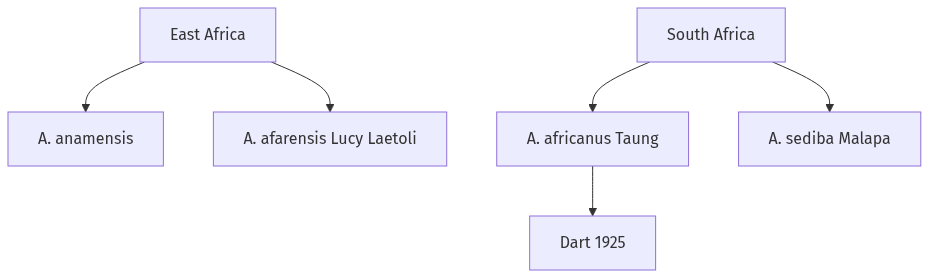
Flow diagram
Conclusion
East Africa supplies anamensis, afarensis, and related named species; South Africa supplies africanus, sediba, and Little Foot. The Taung child is the 1924–25 discovery that made that African biped real to science, even before the adult caves and Hadar confirmed it.
Quick related
Students also ask
-
Is Paranthropus an Australopithecus species?
Most current taxonomies keep robust East and South African forms in Paranthropus. They are related hominins, not the gracile Australopithecus species asked here.
-
Why was Taung rejected at first?
It was a child, from Africa, with a small brain. European authorities preferred Piltdown and large-brained ancestors until later adult finds.
Same topic · past papers
UPSC has asked this before
These previous-year questions sit on the same topic. Open one to practise the earlier ask.
-
2024 · Q6(a) · Anthropology GS 1 · 20 marks
Discuss the geographical distribution of Homo erectus. Taking into account its physical features, where does it fit in human evolutionary line? -
2021 · Q2(a) · Anthropology GS 1 · 20 marks
What are the physical and cultural characteristics of Homo erectus? Discuss its phylogenetic status