
Revision summary
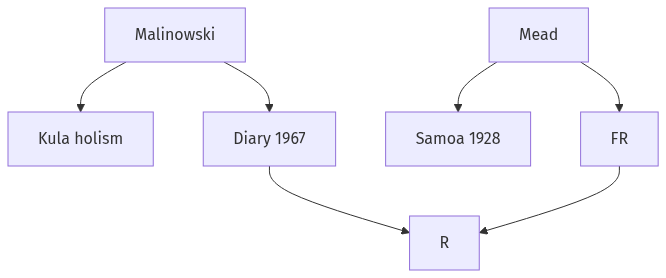
Malinowski’s Trobriand fieldwork founded participant observation and the kula monograph. The 1967 diaries exposed racist and sexual private speech, prompting reflexivity, not a simple cancellation of Argonauts. Mead’s Samoa argued that adolescence is culturally shaped. Freeman’s 1983 attack overstated hoax and ignored time and sample. Shankman and others restored a more careful Mead. Both controversies teach positioned method, not the death of ethnography.
Model answer
Copper italics in this answer — like this — are the key facts. Each one is unpacked in the Facts & figures rail.
Introduction
Malinowski and Mead made fieldwork the public face of anthropology, and both were later put on trial. The controversies are about honesty, power, and whether an ethnography can be trusted, not about deleting the Trobriands or Samoa from the syllabus.
Body
Malinowski: the Trobriand achievement
- From 1915–18 Bronislaw Malinowski lived in the Trobriand Islands and wrote Argonauts of the Western Pacific (1922), which made participant observation, the kula, and the imponderabilia of daily life the method of the discipline.
- Crime and Custom, The Sexual Life of Savages, and coral-garden functionalism showed a working society rather than a list of survivals.
- That achievement is the baseline against which the later files must be read.
Malinowski: the diary controversy
- His private diaries, published in 1967 with a preface by Raymond Firth, used racist abuse, sexual frustration, and contempt for Trobrianders beside the published empathy.
- Critics said the functionalist whole was a literary mask; defenders said a diary is not the ethnography, and that kula, canoe magic, and matriliny still stand as public facts.
- The lasting critical yield is reflexivity: the ethnographer’s body, race, and desire are part of the field, as later writers from James Clifford to feminist ethnography insisted.
- Colonial permit and a white man’s freedom of movement also structured the famous tent, which Talal Asad and colonial critiques of anthropology placed on the table.
Mead: Samoa
- Margaret Mead’s Coming of Age in Samoa (1928), under Franz Boas, argued that Samoan adolescence was easier than the American storm-and-stress, so culture, not biology, shaped youth and sex.
- The book became a public charter of cultural relativism and of Boasian anti-racism.
Mead: the Freeman controversy
- Derek Freeman in 1983 charged that Mead was hoaxed by joking girls, that Samoa was puritan and violent, and that she had found what Boas wanted.
- Later assessments, including Paul Shankman, showed that Freeman over-claimed a hoax, mixed decades, and ignored that Mead’s sample was a particular place and time.
- The controversy still teaches method: short fieldwork, language skill, the sex of the ethnographer, and the danger of one-island laws of human nature.
What to keep
- Malinowski remains the charter of long residence and synchronic holism; the diary remains a warning about the hidden transcript of the fieldworker.
- Mead remains a charter of culture against biological fatalism; Samoa remains a warning against over-generalising youth from one study.
- Neither controversy proves that ethnography is fiction. Both prove that ethnography is a positioned, revisable account.
Flow diagram
Conclusion
Malinowski’s tent and Mead’s Samoa made modern fieldwork, and the diary and Freeman files made its ethics public. Keep the kula and the culture argument, and keep the critique of race, sex, and over-claim.
Quick related
Students also ask
-
Radcliffe-Brown's ideas on status, role and institution
Next question on this syllabus topic (2022 · Q1(c)). View answer →
-
Do the diaries ruin Malinowski’s ethnography?
They ruin the myth of the transparent, kindly observer. Kula, garden magic, and Trobriand kinship still have to be argued on public evidence.
-
Was Mead simply hoaxed?
Freeman’s hoax story is not the settled last word. Mead generalised too far from one study; that is not the same as a practical joke explaining the whole book.
Same topic · past papers
UPSC has asked this before
These previous-year questions sit on the same topic. Open one to practise the earlier ask.
-
2026 · Q5(a) · Anthropology GS 1 · 10 marks
Ethics in anthropological fieldwork. -
2024 · Q3(c) · Anthropology GS 1 · 15 marks
Discuss the contemporary challenges in fieldwork method in anthropological research. -
2016 · Q4(c) · Anthropology GS 1 · 15 marks
Describe the evolution of Fieldwork tradition in Anthropology.
More from this topic
Q1(c) · UPSC Mains 2022 · Anthropology GS 1 · 10 marks · Solution
Radcliffe-Brown's ideas on status, role and institution
Functionalism (Malinowski)
Status is a recognised position in social structure. Role is the rights and duties of that position. Institution is the standardised behaviour that holds statuses together. Andaman and Australian fieldwork supplied the cases. The triad is useful if conflict and history are not treated as noise.
Q1(e) · UPSC Mains 2016 · Anthropology GS 1 · 10 marks · Solution
Functionalism.
Functionalism (Malinowski)
Functionalism asks what a custom does in the present. Malinowski tied culture to individual needs. Radcliffe-Brown tied institutions to structural continuity. It justified intensive fieldwork against unilinear history. Limits are harmony bias and a thin sense of time.