
Revision summary
A blood group system is a locus of cell-surface antigens. ABO and Rh are red-cell systems for transfusion. HLA is the MHC on leukocytes, used in graft matching. HLA polymorphism dwarfs ABO. Anthropology used both as population markers, not as races.
Model answer
Copper italics in this answer — like this — are the key facts. Each one is unpacked in the Facts & figures rail.
Introduction
A blood group system is a set of antigens on blood cells, inherited at one genetic locus or cluster, that can raise antibodies. ABO and Rh are red-cell systems. HLA is a white-cell system of a different biological job.
Body
Red-cell systems
- Landsteiner found ABO. Rh, MN, Duffy, and others followed. They sit on erythrocytes and matter in transfusion and haemolytic disease of the newborn.
- Anthropology used ABO maps, after Hirszfeld and Boyd, as population markers. They are poor race types.
HLA
- Human Leukocyte Antigen genes sit in the MHC on chromosome 6. They present peptides to T cells. Matching them matters in graft survival, not in ordinary packed-red-cell transfusion.
- HLA is vastly more polymorphic than ABO. That diversity is immune history, including pathogen pressure.
- Disease associations (ankylosing spondylitis and HLA-B27) have no ABO parallel in strength.
Contrast
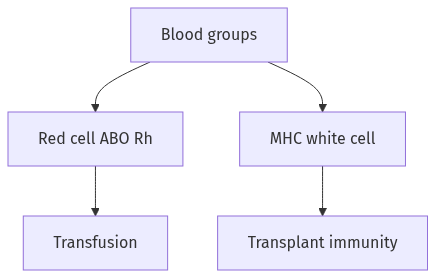
- Red-cell groups are mostly carbohydrate or protein badges on the erythrocyte. HLA is an immune recognition system on leukocytes and tissues.
- Both are genetic polymorphisms. Only HLA is the transplant barcode.
Flow diagram
Conclusion
Blood group systems are inherited antigen families. Red-cell systems guide transfusion. HLA guides immunity and transplantation and is not a red-cell blood group in the Landsteiner sense.
Quick related
Students also ask
-
Rh-Blood Group
Next question on this syllabus topic (2016 · Q5(a)). View answer →
-
Do we match HLA for every blood transfusion?
No. Packed red cells follow ABO and Rh. HLA matters for platelets, marrow, and organs.
-
Is HLA a blood group?
In a wide sense it is a leukocyte antigen system. In exam contrast, it is not a red-cell group.
Same topic · past papers
UPSC has asked this before
These previous-year questions sit on the same topic. Open one to practise the earlier ask.
-
2024 · Q8(b) · Anthropology GS 1 · 15 marks
Describe the genetics and inheritance patterns of the ABO and Rh blood groups in man. -
2016 · Q5(a) · Anthropology GS 1 · 10 marks
Rh-Blood Group -
2023 · Q4(b) · Anthropology GS 1 · 15 marks
Discuss various methods of personal identification based on skeletal remains.
More from this topic
Q8(a) · UPSC Mains 2022 · Anthropology GS 1 · 20 marks · Solution
Discuss the contemporary population problems in the light of various socio-cultural demographic theories
Age, sex and population variation as genetic marker
Malthus and transition still frame public talk. Caldwell links fertility fall to reversed wealth flows and schooling. Boserup sees people as a force for agrarian intensification. Son preference and sex ratio are socio-cultural, as Sen showed. Ageing, migration, and slums are today’s problems, not a single explosion.
Q5(a) · UPSC Mains 2016 · Anthropology GS 1 · 10 marks · Solution
Rh-Blood Group
Age, sex and population variation as genetic marker
Rh groups centre on the D antigen. Positive means D present; negative means D absent. An Rh-negative mother can be sensitised by an Rh-positive fetus. Anti-D prophylaxis prevents most haemolytic disease. Frequencies differ by population, as a polymorphism.