
Revision summary
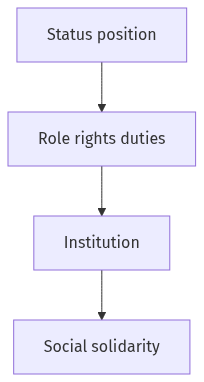
Status is a recognised position in social structure. Role is the rights and duties of that position. Institution is the standardised behaviour that holds statuses together. Andaman and Australian fieldwork supplied the cases. The triad is useful if conflict and history are not treated as noise.
Model answer
Copper italics in this answer — like this — are the key facts. Each one is unpacked in the Facts & figures rail.
Introduction
A. R. Radcliffe-Brown treated society as a structure of positions. Status, role, and institution are the three words he used to show how persons fit that structure.
Body
The three terms
- Status is a socially recognised position, such as mother’s brother among the Andaman Islanders or a Nuer leopard-skin chief.
- Role is the bundle of rights and duties that go with the status. The person acts the role; the structure is not the biography.
- Institution is a standardised mode of behaviour, marriage or a legal ritual, which keeps statuses in relation.
Use and limit
- His Andaman and Australian work showed kinship statuses knitting solidarity, which he called social statics.
- S. F. Nadel later tightened role analysis. Evans-Pritchard kept the words but put history and feud back in.
- The limit is that status can look too fixed. Persons switch roles, and conflict is not a pathology of structure alone.
Flow diagram
Conclusion
Radcliffe-Brown’s triad is position, performance, and standardised relation. It is still the cleanest teaching kit for social structure, if history is not erased.
Quick related
Students also ask
-
Functionalism.
Next question on this syllabus topic (2016 · Q1(e)). View answer →
-
Is status the same as prestige?
No. Prestige is evaluation. Status is position, which may or may not carry high esteem.
-
Can one person have many statuses?
Yes. A man can be sister’s brother, hunter, and ritual specialist at once. Role conflict follows.
Same topic · past papers
UPSC has asked this before
These previous-year questions sit on the same topic. Open one to practise the earlier ask.
-
2026 · Q4(c) · Anthropology GS 1 · 20 marks
Discuss the phylogenetic status, characteristic features, geographical distribution and lifeway of Paranthropus -
2025 · Q3(a) · Anthropology GS 1 · 20 marks
How anthropologists assess the nutritional status of a community? Discuss the significance of intersectionality of ecology, culture, and social inequality in the study of nutritional anthropology -
2021 · Q2(a) · Anthropology GS 1 · 20 marks
What are the physical and cultural characteristics of Homo erectus? Discuss its phylogenetic status -
2021 · Q7(c) · Anthropology GS 1 · 15 marks
What is Anthropometry? Discuss its role in assessing the nutritional status and sports capability of a person
More from this topic
Q6(a) · UPSC Mains 2023 · Anthropology GS 1 · 20 marks · Solution
Critically discuss the controversies related to fieldwork of Bronislaw-Malinowski and Margaret Mead.
Functionalism (Malinowski)
Malinowski’s Trobriand fieldwork founded participant observation and the kula monograph. The 1967 diaries exposed racist and sexual private speech, prompting reflexivity, not a simple cancellation of Argonauts. Mead’s Samoa argued that adolescence is culturally shaped. Freeman’s 1983 attack overstated hoax and ignored time and sample. Shankman and others restored a more careful Mead. Both controversies teach positioned method, not the death of ethnography.
Q1(e) · UPSC Mains 2016 · Anthropology GS 1 · 10 marks · Solution
Functionalism.
Functionalism (Malinowski)
Functionalism asks what a custom does in the present. Malinowski tied culture to individual needs. Radcliffe-Brown tied institutions to structural continuity. It justified intensive fieldwork against unilinear history. Limits are harmony bias and a thin sense of time.