
Revision summary
U.P. launched a Green Star Rating in 2025 as a state mark for greener buildings and industry. Stars rest on energy, water, and waste performance. The rating is a signal for buyers and departments, not a replacement for pollution law. It has no privately invented ISO number in this answer. Its worth depends on audit, not on the logo alone.
Model answer
Introduction
In 2025 Uttar Pradesh launched a Green Star Rating System as a state mark for greener buildings and industry. It is a public rating of how a campus uses energy, water, and waste, not a substitute for national environmental law and not a privately numbered ISO certificate.
Body
What the rating is
- The system grades a building or industrial unit on stars so that buyers, departments, and investors can see environmental performance at a glance.
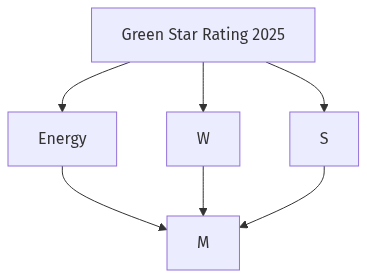
- Energy use, water use, and waste handling are the three everyday pillars; a high star means lower draw and cleaner disposal, not only a painted facade.
- It sits beside older national tools such as Energy Conservation Building Code practice and pollution consents; it does not repeal the Water Act or the Air Act.
- Departments can prefer higher-rated campuses in public procurement and industrial parks, which is how a rating becomes a market signal.
Why it was launched
- U.P. is adding expressway industry, data centres, and urban floor space, so a simple green mark is meant to steer that stock toward efficiency.
- Municipal waste and groundwater stress make water and waste scores as important as electricity scores.
- The honest limit is that a 2025 state rating is only as strong as inspection and disclosure; a star without audit is advertisement.
Flow diagram
Conclusion
The 2025 Green Star Rating System is Uttar Pradesh’s state grade for energy, water, and waste in buildings and industry. It can guide investment and public buying if audits are real; it is not an invented ISO number and it does not replace CPCB consents.
Quick related
Students also ask
-
Biomass energy considered renewable and ecologically sensitive in Uttar Pradesh. Explain.
Next question in the 2025 paper (Q4). View answer →
-
Does a Green Star replace a pollution consent?
No. Red, Orange, Green, and White consents under pollution law remain compulsory where they apply.
-
Is the rating only for luxury housing?
The design is for buildings and industry more widely, including parks and campuses, not only high-end housing.
Same topic · past papers
UPPSC has asked this before
These previous-year questions sit on the same topic. Open one to practise the earlier ask.
-
2025 · Q5 · UPGS6 · 8 marks
Briefly evaluate the major schemes launched by Government of Uttar Pradesh to promote silk production.
More from this paper
Q1 · UPSC Mains 2025 · UPGS6 · 8 marks · Solution
Discuss the recent tax reforms undertaken by the Uttar Pradesh Government.
Public finance and ODOP
U.P. tax reform after GST is mainly stamp duty, electricity duty, SGST incentives, and online commercial tax. Industrial policy uses those three state tools to attract plants. Digitised registration and e-way bills cut compliance delay. Households see stamp-duty concessions more clearly than GST rates, which are Union-led. The state cannot rewrite GST slabs; it can only run administration and property-linked taxes better.
Q2 · UPSC Mains 2025 · UPGS6 · 8 marks · Solution
What is the concept of Invest U.P.? Evaluate its role in the economic development of Uttar Pradesh.
Schemes, skill and investment
Invest U.P. is the state investment promotion agency, not a factory owner. It markets sectors and walks files through Nivesh Mitra. Summits and land banks are the pitch; after-care is the development test. It helps a land-locked state compete on speed of clearance. It cannot substitute power, logistics, or skills.
Q4 · UPSC Mains 2025 · UPGS6 · 8 marks · Solution
Biomass energy considered renewable and ecologically sensitive in Uttar Pradesh. Explain.
Energy resources of UP
U.P. biomass is mainly bagasse, straw, and dung that grow again each season. Sugar-mill cogeneration is the large working example. Field burning of paddy straw is the ecological failure the policy must reverse. Residue must not strip soil carbon or fodder. A biomass boiler still needs pollution consent if it is a polluting unit.