
Revision summary
U.P. biomass is mainly bagasse, straw, and dung that grow again each season. Sugar-mill cogeneration is the large working example. Field burning of paddy straw is the ecological failure the policy must reverse. Residue must not strip soil carbon or fodder. A biomass boiler still needs pollution consent if it is a polluting unit.
Model answer
Introduction
Uttar Pradesh grows cane, paddy, and wheat at a scale that leaves bagasse, straw, and dung as daily biomass. Using that stream for heat and power is renewable in the carbon-cycle sense, but only if collection, combustion, and ash do not poison fields and lungs.
Body
Why it is renewable
- Crop residue and bagasse grow again each season, so the fuel is not a mined stock like coal.
- Sugar mills already burn bagasse in cogeneration; this is the state’s largest working biomass power base.
- Paddy straw that is otherwise burnt in fields can feed briquette plants and biomass boilers if collection is paid and timely.
- Gobar and agro-waste biogas cut household smoke and give slurry back to the field, which is why biomass sits in the renewable mix with solar.
Why it must be ecologically sensitive
- Open burning of straw is still common in western and central plains; a biomass plant that merely shifts smoke to a dirty boiler is not ecological.
- Over-harvest of every stalk can strip soil carbon and fodder, so residue use must leave a mulch share on the land.
- Transport of wet biomass over long distances wastes the energy gain; plants should sit near mills, mandis, and dairies.
- Fly ash, effluent, and chimney norms of the pollution board still apply; renewable is not a licence to skip Red or Orange consent where the unit is polluting.
Flow diagram
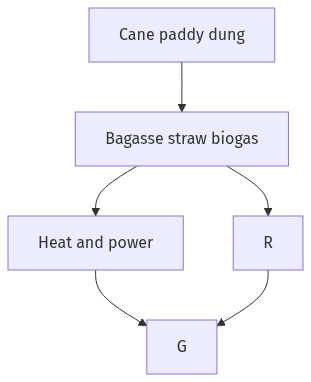
Conclusion
Biomass is renewable in U.P. because cane, grain, and dung restock each year, and bagasse cogeneration already works. It is ecologically sensitive only when straw is collected instead of burnt, soil cover is left, and plants meet air and ash rules.
Quick related
Students also ask
-
Briefly evaluate the major schemes launched by Government of Uttar Pradesh to promote silk production.
Next question in the 2025 paper (Q5). View answer →
-
Is all biomass automatically clean?
No. Dirty combustion and open burning still pollute. Renewable refers to the fuel cycle, not to every chimney.
-
Should every last straw leave the field?
No. A share should stay as mulch for soil carbon and moisture; only the surplus is fuel.
More from this paper
Q1 · UPSC Mains 2025 · UPGS6 · 8 marks · Solution
Discuss the recent tax reforms undertaken by the Uttar Pradesh Government.
Public finance and ODOP
U.P. tax reform after GST is mainly stamp duty, electricity duty, SGST incentives, and online commercial tax. Industrial policy uses those three state tools to attract plants. Digitised registration and e-way bills cut compliance delay. Households see stamp-duty concessions more clearly than GST rates, which are Union-led. The state cannot rewrite GST slabs; it can only run administration and property-linked taxes better.
Q2 · UPSC Mains 2025 · UPGS6 · 8 marks · Solution
What is the concept of Invest U.P.? Evaluate its role in the economic development of Uttar Pradesh.
Schemes, skill and investment
Invest U.P. is the state investment promotion agency, not a factory owner. It markets sectors and walks files through Nivesh Mitra. Summits and land banks are the pitch; after-care is the development test. It helps a land-locked state compete on speed of clearance. It cannot substitute power, logistics, or skills.
Q3 · UPSC Mains 2025 · UPGS6 · 8 marks · Solution
What is "Green Star Rating System" launched in 2025?
Economy, budget and industry of UP
U.P. launched a Green Star Rating in 2025 as a state mark for greener buildings and industry. Stars rest on energy, water, and waste performance. The rating is a signal for buyers and departments, not a replacement for pollution law. It has no privately invented ISO number in this answer. Its worth depends on audit, not on the logo alone.