
Revision summary
U.P. silk policy joins Central Silk Board schemes with state sericulture in the Varanasi–Deoria belt. ODOP and GI support the Banarasi loom, which is not the same as raising cocoons. Women groups are used at the rearing end. Cocoons still arrive from outside in large share, so farm value is weaker than weaving fame. Evaluation is mixed: brand strong, sericulture still thin.
Model answer
Introduction
- Uttar Pradesh silk is a farm-to-loom chain: mulberry and tasar in the east, and weaving in Varanasi. Promotion therefore needs both sericulture schemes and handloom support, not only a Banarasi sari brand.
Body
Major schemes
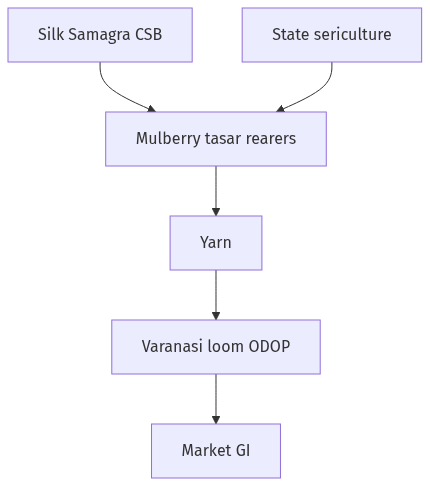
- The Central Silk Board’s Silk Samagra-type programmes fund planting, rearing houses, and reeling, and U.P. implements them through the state sericulture department.
- State sericulture schemes in the Varanasi, Chandauli, Deoria, and neighbouring belt support mulberry gardens, disease-free layings, and training of rearers.
- Handloom and ODOP packaging for Banarasi silk help the loom end, including GI use and marketing, which is not the same as raising cocoons.
- Women self-help groups are used for rearing and spinning so that silk income is not only a weaver-master’s margin.
Brief evaluation
- The Varanasi loom is famous, but cocoons still come in large share from outside the state, so U.P. captures weaving value more than farm value.
- Deoria and the north-east plains can rear if leaf, seed, and extension arrive on time; gaps in disease-free seed are the usual failure.
- Tasar and mulberry need different forests and gardens; one slogan does not fit both.
- Evaluation is therefore mixed: brand and GI are strong; farm-level sericulture is still thin relative to the loom’s fame.
Flow diagram
Conclusion
Major silk promotion in U.P. is Central Silk Board support plus state sericulture in the Varanasi–Deoria belt and ODOP-handloom marketing. The brief verdict is a strong loom and a still-weak cocoon base, which is why evaluation must separate weaving glory from farm output.
Quick related
Students also ask
-
"Soil health and rising input cost are threatening the sustainability of agriculture in Uttar Pradesh." Analyse this statement.
Next question in the 2025 paper (Q6). View answer →
-
Is Banarasi silk all reared in Varanasi?
No. Much yarn and many cocoons are sourced from other states. Varanasi is strongest at weaving and finishing.
-
Is ODOP a sericulture farm scheme?
ODOP is mainly branding and market support for a district product. Farm support sits in sericulture and Silk Board schemes.
Same topic · past papers
UPPSC has asked this before
These previous-year questions sit on the same topic. Open one to practise the earlier ask.
More from this paper
Q1 · UPSC Mains 2025 · UPGS6 · 8 marks · Solution
Discuss the recent tax reforms undertaken by the Uttar Pradesh Government.
Public finance and ODOP
U.P. tax reform after GST is mainly stamp duty, electricity duty, SGST incentives, and online commercial tax. Industrial policy uses those three state tools to attract plants. Digitised registration and e-way bills cut compliance delay. Households see stamp-duty concessions more clearly than GST rates, which are Union-led. The state cannot rewrite GST slabs; it can only run administration and property-linked taxes better.
Q2 · UPSC Mains 2025 · UPGS6 · 8 marks · Solution
What is the concept of Invest U.P.? Evaluate its role in the economic development of Uttar Pradesh.
Schemes, skill and investment
Invest U.P. is the state investment promotion agency, not a factory owner. It markets sectors and walks files through Nivesh Mitra. Summits and land banks are the pitch; after-care is the development test. It helps a land-locked state compete on speed of clearance. It cannot substitute power, logistics, or skills.
Q3 · UPSC Mains 2025 · UPGS6 · 8 marks · Solution
What is "Green Star Rating System" launched in 2025?
Economy, budget and industry of UP
U.P. launched a Green Star Rating in 2025 as a state mark for greener buildings and industry. Stars rest on energy, water, and waste performance. The rating is a signal for buyers and departments, not a replacement for pollution law. It has no privately invented ISO number in this answer. Its worth depends on audit, not on the logo alone.