
Revision summary
The last decade stacked Mission Shakti, Kanya Sumangala, Poshan, and maternity windows. Benefits are coverage: helplines, girl cash, anganwadi, institutional delivery. Challenges are portal overlap, honorary staff, and still-high malnutrition and violence. Cash ladders break when Aadhaar or school records fail. Welfare is not yet the same as women’s paid work.
Model answer
Introduction
The last decade in Uttar Pradesh stacked Union and state windows for women and children: Mission Shakti, Kanya Sumangala, Poshan, ICDS, One Stop Centres, and maternity cash. Benefits are real coverage. Challenges are overlap, last-mile staff, and outcomes that still lag the poster.
Body
Benefits
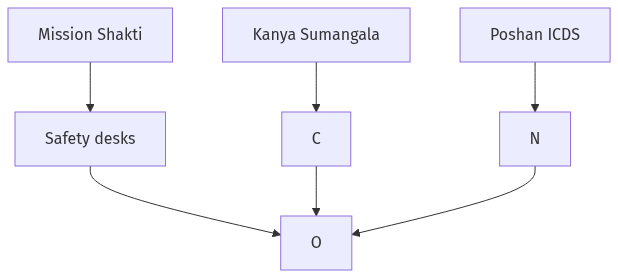
- Mission Shakti phases bundled safety helplines, One Stop Centres, and women’s collectives so that a complaint is not only a police station queue.
- Mukhyamantri Kanya Sumangala-type transfers put cash at birth, immunisation, and school gates, which raises the chance that a girl stays on the record.
- Poshan Abhiyaan and anganwadi take-home rations remain the largest child-nutrition machine in the plains.
- Maternity benefits, institutional delivery drives, and 102/108 transport cut some maternal risk where the facility actually opens.
- School enrolment of girls and open defecation campaigns changed the public story of the girl child, even if learning and anaemia are unfinished.
Challenges
- Too many portals and instalments confuse the same household; a missed Aadhaar link drops the girl from the cash ladder.
- Anganwadi honorary workers carry Poshan, pre-school, and survey duty without matching pay or food stocks.
- One Stop Centres and helplines fail if the next step — charge-sheet, shelter, livelihood — is missing.
- Child malnutrition and anaemia remain high in several belts, so scheme count is not outcome.
- Women’s work schemes still meet unpaid care, unsafe mobility, and a thin creche, which is why welfare does not automatically become employment.
Balance
- The decade built a thicker safety-and-nutrition net than the early 2010s.
- The net still leaks at the anganwadi, the police desk, and the classroom.
- A fair examination therefore credits coverage and still names stunting, anaemia, and violence as unfinished.
Flow diagram
Conclusion
Women and child schemes in U.P. over the last decade expanded cash, nutrition, and safety windows. Benefits are reach. Challenges are overlap, staff, and outcomes. Coverage without anganwadi food and without a working FIR is not welfare completed.
Quick related
Students also ask
-
Analyse in detail the role of Defence Industrial Corridor in promoting industrial and regional development in Uttar Pradesh.
Next question in the 2025 paper (Q12). View answer →
-
Did more schemes end child malnutrition in U.P.?
No. They expanded coverage. Stunting and anaemia remain high in several regions, which is the outcome gap.
-
Is Kanya Sumangala a substitute for a school?
No. It is a cash incentive at gates. Learning still needs a teacher and a working classroom.
Same topic · past papers
UPPSC has asked this before
These previous-year questions sit on the same topic. Open one to practise the earlier ask.
More from this paper
Q1 · UPSC Mains 2025 · UPGS6 · 8 marks · Solution
Discuss the recent tax reforms undertaken by the Uttar Pradesh Government.
Public finance and ODOP
U.P. tax reform after GST is mainly stamp duty, electricity duty, SGST incentives, and online commercial tax. Industrial policy uses those three state tools to attract plants. Digitised registration and e-way bills cut compliance delay. Households see stamp-duty concessions more clearly than GST rates, which are Union-led. The state cannot rewrite GST slabs; it can only run administration and property-linked taxes better.
Q2 · UPSC Mains 2025 · UPGS6 · 8 marks · Solution
What is the concept of Invest U.P.? Evaluate its role in the economic development of Uttar Pradesh.
Schemes, skill and investment
Invest U.P. is the state investment promotion agency, not a factory owner. It markets sectors and walks files through Nivesh Mitra. Summits and land banks are the pitch; after-care is the development test. It helps a land-locked state compete on speed of clearance. It cannot substitute power, logistics, or skills.
Q3 · UPSC Mains 2025 · UPGS6 · 8 marks · Solution
What is "Green Star Rating System" launched in 2025?
Economy, budget and industry of UP
U.P. launched a Green Star Rating in 2025 as a state mark for greener buildings and industry. Stars rest on energy, water, and waste performance. The rating is a signal for buyers and departments, not a replacement for pollution law. It has no privately invented ISO number in this answer. Its worth depends on audit, not on the logo alone.