
Revision summary
UPDIC is a six-node defence manufacturing belt: Aligarh, Agra, Jhansi, Chitrakoot, Kanpur, Lucknow. It aims to use ordnance heritage and expressways for Make in India work. Industrial gain is patient: tools, then assemblies, then platforms. Jhansi and Chitrakoot are the Bundelkhand regional test. A corridor without vendors, skills, and MoD or OEM orders is only a map.
Model answer
Introduction
The Uttar Pradesh Defence Industrial Corridor is a six-node belt meant to put guns, electronics, and aerospace work inside the state instead of only on coastal OEM maps. Industrial development is the factory. Regional development is whether Aligarh, Jhansi, and Chitrakoot get the same lift as Lucknow and Kanpur.
Body
The corridor idea
- The corridor was launched to use U.P.’s size, ordnance heritage, and expressway spine for defence manufacturing under Make in India.
- Six nodes are Aligarh, Agra, Jhansi, Chitrakoot, Kanpur, and Lucknow, which is a deliberate east–west and Bundelkhand spread, not a single Noida park.
- Invest U.P. and the defence-corridor authority market land, testing, and vendor parks; the Union defence production system remains the order-giver.
- Private OEMs, DPSU units, and MSME ancillaries are all part of the design; a corridor without vendors is only a fence.
Industrial development
- Anchors in ammunition, aerospace, electronics, and dual-use engineering can thicken a supply chain that U.P. already partly has in Kanpur leather-metal and Aligarh locks-hardware.
- Testing ranges, common facility centres, and plug-and-play sheds cut the capital that a small unit must sink before the first offset order.
- Defence work is quality-heavy and slow to certify, so the industrial gain is patient: first tools and jigs, then assemblies, then platforms.
- Export and domestic capital acquisition both matter; a node that only waits for one large PSU order will idle.
Regional development
- Lucknow and Kanpur start with airports, IT, and engineering colleges; they can absorb high-skill electronics faster.
- Jhansi and Chitrakoot are the regional test: if they get vendors, hostels, and rail-road links, Bundelkhand’s out-migration story can bend.
- Aligarh and Agra already have metal and foundry skills; the corridor can upgrade them from hardware clusters to certified defence ancillaries.
- Regional development fails if land is notified and labour still leaves, or if pollution and water are ignored in a rush to fill sheds.
Limits
- Orders sit in the Ministry of Defence and in OEM global lists; a state corridor cannot print demand.
- Skills in CNC, composites, and quality systems are thinner in Bundelkhand than in Noida.
- A detailed verdict is therefore conditional: the map is right; plants, vendors, and apprenticeships decide whether the map becomes a region.
Flow diagram
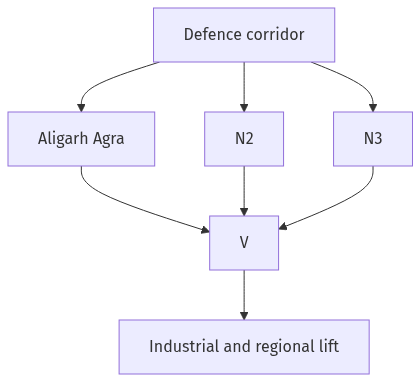
Conclusion
The Defence Industrial Corridor can industrialise U.P. and rebalance regions if the six nodes — Aligarh, Agra, Jhansi, Chitrakoot, Kanpur, Lucknow — fill with certified vendors, not only land banks. It is a long industrial bet. Regional development follows the vendor, the hostel, and the order book.
Quick related
Students also ask
-
What are the aims and objectives of Green Hydrogen Policy - 2024 of Uttar Pradesh Government? Mention the government's incentives for Green Hydrogen Projects.
Next question in the 2025 paper (Q13). View answer →
-
Does the corridor include Noida as a named node?
The six named nodes are Aligarh, Agra, Jhansi, Chitrakoot, Kanpur, and Lucknow. Noida remains an electronics and IT base beside, not as, those six names.
-
Can the state guarantee defence orders?
No. It can offer land, skills, and facilitation. Capital acquisition and OEM contracts sit largely with the Union and firms.
Same topic · past papers
UPPSC has asked this before
These previous-year questions sit on the same topic. Open one to practise the earlier ask.
More from this paper
Q1 · UPSC Mains 2025 · UPGS6 · 8 marks · Solution
Discuss the recent tax reforms undertaken by the Uttar Pradesh Government.
Public finance and ODOP
U.P. tax reform after GST is mainly stamp duty, electricity duty, SGST incentives, and online commercial tax. Industrial policy uses those three state tools to attract plants. Digitised registration and e-way bills cut compliance delay. Households see stamp-duty concessions more clearly than GST rates, which are Union-led. The state cannot rewrite GST slabs; it can only run administration and property-linked taxes better.
Q2 · UPSC Mains 2025 · UPGS6 · 8 marks · Solution
What is the concept of Invest U.P.? Evaluate its role in the economic development of Uttar Pradesh.
Schemes, skill and investment
Invest U.P. is the state investment promotion agency, not a factory owner. It markets sectors and walks files through Nivesh Mitra. Summits and land banks are the pitch; after-care is the development test. It helps a land-locked state compete on speed of clearance. It cannot substitute power, logistics, or skills.
Q3 · UPSC Mains 2025 · UPGS6 · 8 marks · Solution
What is "Green Star Rating System" launched in 2025?
Economy, budget and industry of UP
U.P. launched a Green Star Rating in 2025 as a state mark for greener buildings and industry. Stars rest on energy, water, and waste performance. The rating is a signal for buyers and departments, not a replacement for pollution law. It has no privately invented ISO number in this answer. Its worth depends on audit, not on the logo alone.