
Revision summary
The RTI Act, 2005 gives a time-bound right to official records. Uttar Pradesh Information Commission at Lucknow is the second appeal body. The Act is most used on welfare, land, recruitment, and police files. Section 4 disclosure matters as much as individual applications. Delay and vacancies in the Commission weaken relevance.
Model answer
Introduction
The Right to Information Act, 2005 gives every citizen a legal right to official records, subject to listed exemptions. A comment for Uttar Pradesh must show why that right still matters in the largest State administration.
Body
What the Act does
- Sections 3 to 7 create a request, a Public Information Officer, and a time limit; Section 4 asks departments to publish suo motu.
- Appeals lie to a departmental appellate officer and then to the Uttar Pradesh Information Commission at Lucknow.
- Exemptions in Section 8 protect sovereignty, privacy, and some commercial secrets, so RTI is not a total opening of files.
Relevance in UP
- Welfare rolls for ration, pensions, scholarships, MGNREGA, and housing are huge, so a paper trail is often the only check a village applicant has.
- Land records, police, recruitment, and local bodies generate the most disputes; RTI is used to copy orders, muster rolls, and cut-off lists.
- Suo motu disclosure and online portals reduce visits to Lucknow, which matters in a State of long distances.
Comment
- Relevance is high where Commissions are staffed and penalties are used; it falls where appeals pend for years or PIOs leave posts vacant.
- RTI complements, and does not replace, the citizen charter and grievance helplines of the State.
Flow diagram
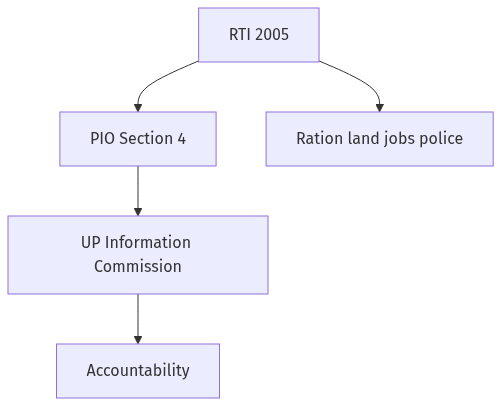
Conclusion
RTI, 2005 remains relevant in Uttar Pradesh because a vast welfare and land administration cannot be watched by courts alone. The comment is that the law is only as live as the Information Commission and Section 4 disclosure.
Quick related
Students also ask
-
Define Social Media and identify few threats it has generated for internal security with special reference to Uttar Pradesh.
Next question in the 2025 paper (Q8). View answer →
-
Does RTI cover every UP file?
No. Section 8 lists exemptions, including privacy and specified security and commercial grounds.
-
Why is RTI still relevant after online services?
Portals do not publish every file. Applicants still need copies of muster rolls, lists, and notings.
Same topic · past papers
UPPSC has asked this before
These previous-year questions sit on the same topic. Open one to practise the earlier ask.
More from this paper
Q1 · UPSC Mains 2025 · UPGS5 · 8 marks · Solution
Describe the cultural significance of 'Ayodhya' on the basis of ancient literature.
UP history, civilisation and culture
The Ramayana makes Ayodhya the Kosalan capital of Rama. The Skanda Purana’s Ayodhya Mahatmya places it among the moksha-puris. Buddhist texts remember Saketa, and Jain books remember Tirthankara births at Vinita or Saketa. Together these books give Ayodhya its lasting cultural weight in Uttar Pradesh.
Q2 · UPSC Mains 2025 · UPGS5 · 8 marks · Solution
Agra's Indo-Islamic architecture has a blend of Indian, Persian and Islamic styles. Comment.
UP history, civilisation and culture
Agra’s Mughal buildings mix Indian craft, Persian gardens, and Islamic tombs. Agra Fort shows Akbar’s sandstone and Shah Jahan’s marble in one complex. The Taj Mahal is a Persian garden-tomb built by Indian workshops. Itimad-ud-Daulah is an early white-marble inlay tomb in Agra.
Q3 · UPSC Mains 2025 · UPGS5 · 8 marks · Solution
Discuss in short the contribution of Arya Samaj in education of Uttar Pradesh.
Health and education in UP
Arya Samaj treated Vedic and modern schooling as one programme in the United Provinces. DAV schools and colleges became the main urban chain. Gurukul Kangri and kanya gurukuls modelled residential and girls’ education. Hindi as a medium was a lasting Samaj mark in Uttar Pradesh. The spread was stronger in the west than in Purvanchal.