
Revision summary
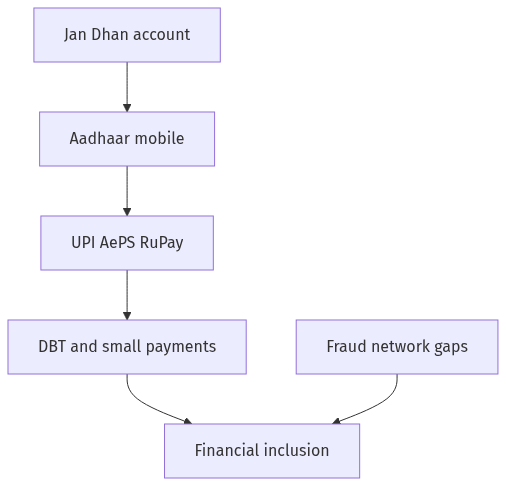
Inclusion needs an account, a cheap payment rail, and public money that arrives. Jan Dhan, Aadhaar, and mobile numbers built the base. UPI, AePS, RuPay, and BHIM make small payments possible without a branch. DBT rides the same rails for pensions and subsidies. Fraud and last-mile cash agents remain the unfinished part.
Model answer
Introduction
Financial inclusion means a usable account, a cheap way to pay, and a path for public money to reach the poor. Digital payments sit on the Jan Dhan–Aadhaar–mobile stack and have made small transfers ordinary.
Body
Access and use
- Jan Dhan accounts gave a first bank account to many households; Aadhaar and mobile numbers made those accounts reachable.
- UPI, AePS, RuPay, and BHIM let a person pay or withdraw without a branch visit, which matters in villages and for women who cannot travel far.
- Direct Benefit Transfer uses the same rails so that scholarships, pensions, and LPG subsidy can skip several middle layers.
Why this is inclusion, not only convenience
- Low-value payments become cheap, so a vegetable seller or a migrant worker can join the formal trail.
- Account use, not only account opening, is the inclusion test; UPI volumes show that many accounts are now live.
- Gaps remain: smartphone access, network, fraud, and people who still need cash-in and cash-out agents.
Digital payments therefore widen inclusion when the last-mile agent and grievance redress also work.
Flow diagram
Conclusion
Digital payments promote inclusion by turning a Jan Dhan account into a daily payment tool and a DBT pipe. The limit is fraud, network, and those who still need a human cash agent.
Quick related
Students also ask
-
"Jobless Growth" is a major concern for the Indian economy. In this backdrop, analyze the reasons behind the "stagnation of employment elasticity" in the manufacturing sector.
Next question in the 2025 paper (Q5). View answer →
-
Is opening a Jan Dhan account enough for inclusion?
No. Inclusion needs the account to be used for payments, savings, and transfers.
-
Do digital payments remove cash?
They reduce some cash trips. Many people still cash in and cash out through agents.
Same topic · past papers
UPPSC has asked this before
These previous-year questions sit on the same topic. Open one to practise the earlier ask.
-
2022 · Q4 · UPGS3 · 8 marks
Financial inclusion is a critical part of the development process to achieve social justice. Comment.
More from this paper
Q1 · UPSC Mains 2025 · UPGS3 · 8 marks · Solution
Identify the critical challenges faced by the handicraft industries in India and discuss their challenges.
Food processing
Handicrafts are large in jobs but weak in organisation. Costly inputs, middlemen, and machine-made copies cut the artisan’s price. Credit, GST paperwork, and export compliance are hard for household units. GI tags and e-commerce help some clusters, not the whole sector. The challenge is to move skill, credit, and direct sale to the maker.
Q2 · UPSC Mains 2025 · UPGS3 · 8 marks · Solution
"Construction of new airports will facilitate industrialization and development in India." Examine.
Infrastructure
Airports can shorten time to markets and support logistics jobs. UDAN tries to spread air access beyond metros. Land, wetlands, and noise are real costs of greenfield sites. Thin traffic means some airports need heavy subsidy and still do not pull factories. Industrialisation needs hinterland demand, not only a terminal.
Q3 · UPSC Mains 2025 · UPGS3 · 8 marks · Solution
Discuss the concept of unemployment in India as developed by National Sample Survey Office (NSSO).
Poverty, unemployment and inclusive growth
India measures unemployment on more than one reference period because work is often casual. Usual status (ps and ps+ss) uses the last year and usually gives the lowest rate. Current weekly status uses the last seven days. Current daily status counts person-days and captures underemployment. PLFS is the present NSO survey that carries these NSSO concepts.