
Revision summary
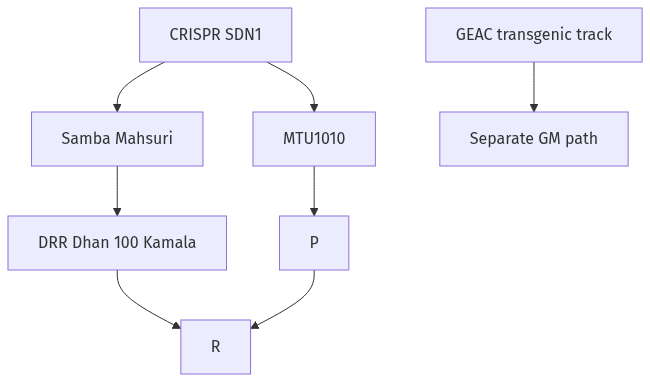
SDN-1 genome editing changes the plant’s own genes without a foreign gene insert. ICAR used this on Samba Mahsuri and MTU1010 rice. In May 2024 India released DRR Dhan 100 (Kamala) and Pusa DST Rice 1 from that work. The 2022 MoEFCC note keeps such SDN-1 products outside the old GM rules; GEAC still handles transgenics. Climate gain is drought and salt tolerance plus shorter duration, if seed systems deliver.
Model answer
Introduction
Genome editing lets breeders change a plant’s own DNA without inserting a foreign gene in the SDN-1 path. In 2024 India publicly showed this on rice, which is the staple most exposed to drought and salt.
Body
What changed in 2024–2025
- ICAR institutes used CRISPR-based SDN-1 editing on two widely grown rice types: Samba Mahsuri (BPT 5204) and MTU1010.
- In May 2024 the Union Agriculture Minister released two genome-edited rice lines from that work: DRR Dhan 100 (Kamala), from Samba Mahsuri, aimed at drought tolerance, earlier harvest, and higher yield in trials; and Pusa DST Rice 1, from MTU1010, aimed at drought and salinity.
- These are not transgenic GM crops; SDN-1 products without foreign DNA were placed outside the 1989 GM rules by a 2022 MoEFCC office memorandum, while GEAC still regulates transgenic events.
Productivity and resilience
- Shorter duration and stress tolerance are climate tools: they save irrigation days and protect yield when the monsoon slips.
- CRISPR research in ICAR-IIRR, ICAR-IARI, and other labs continues on yield, disease, and abiotic stress; field release still needs seed systems and state trials.
- Public trust depends on calling these lines by their real names and not mixing them with Bt or other transgenic files.
Flow diagram
Conclusion
Genome editing is reshaping the rice file through real SDN-1 lines on Samba Mahsuri and MTU1010 backgrounds. Climate resilience will follow only if seed reaches farmers and GEAC’s transgenic track stays distinct.
Quick related
Students also ask
-
Evaluate the role of social media in radicalization across the borders.
Next question in the 2025 paper (Q8). View answer →
-
Are Kamala and Pusa DST Rice 1 Bt rice?
No. They are SDN-1 genome-edited lines on Samba Mahsuri and MTU1010. They are not foreign-gene Bt events.
-
Does GEAC approve all genome-edited plants?
Transgenic GM still goes through GEAC. SDN-1 without foreign DNA follows the 2022 exemption path, not the old GM dossier.
Same topic · past papers
UPPSC has asked this before
These previous-year questions sit on the same topic. Open one to practise the earlier ask.
More from this paper
Q1 · UPSC Mains 2025 · UPGS3 · 8 marks · Solution
Identify the critical challenges faced by the handicraft industries in India and discuss their challenges.
Food processing
Handicrafts are large in jobs but weak in organisation. Costly inputs, middlemen, and machine-made copies cut the artisan’s price. Credit, GST paperwork, and export compliance are hard for household units. GI tags and e-commerce help some clusters, not the whole sector. The challenge is to move skill, credit, and direct sale to the maker.
Q2 · UPSC Mains 2025 · UPGS3 · 8 marks · Solution
"Construction of new airports will facilitate industrialization and development in India." Examine.
Infrastructure
Airports can shorten time to markets and support logistics jobs. UDAN tries to spread air access beyond metros. Land, wetlands, and noise are real costs of greenfield sites. Thin traffic means some airports need heavy subsidy and still do not pull factories. Industrialisation needs hinterland demand, not only a terminal.
Q3 · UPSC Mains 2025 · UPGS3 · 8 marks · Solution
Discuss the concept of unemployment in India as developed by National Sample Survey Office (NSSO).
Poverty, unemployment and inclusive growth
India measures unemployment on more than one reference period because work is often casual. Usual status (ps and ps+ss) uses the last year and usually gives the lowest rate. Current weekly status uses the last seven days. Current daily status counts person-days and captures underemployment. PLFS is the present NSO survey that carries these NSSO concepts.