
Revision summary
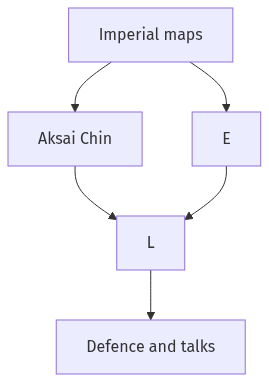
The origin is overlapping British, Tibetan, and Chinese maps, especially Aksai Chin and the McMahon Line. India inherited those alignments; the PRC rejected them and built the Aksai Chin road. The 1962 war left a Line of Actual Control, not a treaty boundary. Western, eastern, and middle sectors are the geographic dimensions. Implications include Galwan-type clashes, higher defence cost, and talks without a final map.
Model answer
Introduction
The Sino-Indian border is not a single surveyed line accepted by both states. Its origin lies in imperial maps, and its dimensions and implications still shape the Himalaya.
Body
Origin
- British India, Tibet, and Qing China left overlapping claims: the McMahon Line in the east from the 1914 Simla Convention, and unclear posts in Aksai Chin in the west.
- Independent India treated the McMahon Line and the Johnson–Ardagh alignments as the inherited boundary; the People’s Republic of China rejected those as unequal or unagreed.
- China built a road through Aksai Chin in the 1950s linking Xinjiang and Tibet, which India regarded as occupation of claimed land.
- The 1962 war followed failed talks, and no comprehensive boundary treaty has been signed since.
Dimensions
- The western sector is Aksai Chin and adjoining Ladakh, where China administers the plateau and India claims it as part of Ladakh.
- The eastern sector is Arunachal Pradesh, which China calls Zangnan or part of southern Tibet, while India administers it as a full state.
- The middle sector is smaller and less public, but it still has unmatched posts.
- The dispute is cartographic, military, and legal at once: maps, patrols, and the absence of a delimited and demarcated line.
Implications
- The Line of Actual Control needs protocols, yet patrol clashes such as Galwan in 2020 show that the line is still live.
- India has to split military attention between the northern land border and the Indian Ocean, which raises the cost of defence.
- Diplomacy uses special representatives, confidence-building agreements of 1993 and 1996, and later disengagement talks, without a final map.
- Trade and membership in forums such as BRICS and the Shanghai Cooperation Organisation sit beside an unresolved border, which is a structural tension in the relationship.
Flow diagram
Conclusion
The dispute began in unmatched colonial and republican maps of Aksai Chin and the McMahon Line. Its dimensions are western, eastern, and middle sectors under a live LAC. Its implication is a long military and diplomatic burden without a boundary treaty.
Quick related
Students also ask
-
Examine critically the recent theories of the origin of monsoon and discuss the effects of El Niño on monsoon.
Next question in the 2025 paper (Q10). View answer →
-
Is the LAC the same as an international boundary?
No. It is a practical military line. A boundary would be delimited on a map and demarcated on the ground by treaty.
-
Does trade mean the dispute is over?
No. Trade and forum membership continue beside an undelimited border, which is the core implication.
Same topic · past papers
UPPSC has asked this before
These previous-year questions sit on the same topic. Open one to practise the earlier ask.
-
2023 · Q12 · UPGS1 · 12 marks
Underline the ideological dimensions of the uprising of 1857.
More from this paper
Q1 · UPSC Mains 2025 · UPGS1 · 8 marks · Solution
Comment briefly on the development of art and technology during the Maurya period.
Indian culture
Mauryan art is court stone: edict pillars, the Sarnath lion capital, yaksha figures, Barabar caves, and early stupas. Mauryan technology is iron, state mines, punch-marked coins, roads, wells, and the Sudarshana lake begun under Pushyagupta. Both grew under one imperial administration from Chandragupta to Ashoka.
Q2 · UPSC Mains 2025 · UPGS1 · 8 marks · Solution
"Women's issue was a major concern in the socio-religious reform movements of 19th century India." Explain.
Women, population and associated issues
Reformers treated women’s status as a public test of social change in the nineteenth century. Sati was prohibited in Bengal Presidency in 1829 after Rammohan Roy’s campaign. The Hindu Widows’ Remarriage Act, 1856, followed Vidyasagar’s work. Phule schools and later women writers showed that education and household power were part of the same question. Child marriage remained contested in the Age of Consent debates of 1891.
Q3 · UPSC Mains 2025 · UPGS1 · 8 marks · Solution
"Extremism was a reaction against the ideas and modus operandi of the moderates." Critically explain this statement.
Modern Indian history
Moderates trusted petitions, councils, and British public opinion. The 1905 partition and failed prayers pushed Tilak, Pal, and Lajpat Rai toward Swaraj, boycott, and Swadeshi. Surat 1907 displayed the clash of methods inside Congress. Extremism also had a constructive Swadeshi programme, so it was not only a reaction. Later nationalism combined constitutional work with mass pressure.