
Revision summary
A refugee flees persecution or war; an infiltrator enters illegally without an asylum claim. India is not a party to the 1951 Convention but uses constitutional and administrative practice. Tibetan, Sri Lankan Tamil, and some Chakma-Hajong groups have received camps or documents. UNHCR registers some urban refugees on a case-by-case stay. Infiltration is met with the Foreigners Act, fencing, and the BSF. The absence of a comprehensive refugee law makes assistance uneven.
Model answer
Introduction
Refugee and infiltrator are not the same in law or in policy. A refugee flees persecution or conflict and seeks protection. An infiltrator enters illegally, often for work, crime, or a political purpose, without a claim to asylum.
Body
Difference
- A refugee is a person who cannot return home because of a well-founded fear of persecution or because of war; the 1951 UN Refugee Convention uses that idea, even though India is not a party to it.
- An infiltrator is a person who crosses a border without permission, including those who mix with crowds to settle, smuggle, or harm security.
- Refugees usually identify themselves to camp authorities or to the UNHCR; infiltrators avoid identification.
- Assistance is owed to refugees as a humanitarian and constitutional practice under Articles 14 and 21 as read by courts; infiltration is a policing and border problem under the Foreigners Act, 1946, and the Passport Act.
- In public debate the two words are often mixed, which is why a mains answer must keep the legal difference.
Security and assistance for refugees
- India has hosted Tibetan refugees since 1959 with settlements, identity documents, and school support, without a single refugee statute.
- Sri Lankan Tamil refugees have been housed in camps in Tamil Nadu with rations and, in phases, voluntary repatriation.
- Chakma and Hajong refugees in the North-East received, after litigation, a path toward citizenship in some cohorts.
- UNHCR registers some urban refugees, such as Afghans and Myanmarese, and India allows stay on a case-by-case basis.
- Security steps include border fencing, the Border Security Force, visa control, and criminal prosecution of illegal entry that is not treated as asylum.
- The Citizenship Amendment Act, 2019, offers a fast track to specified non-Muslim minorities from three neighbours who entered before a cut-off; it is assistance for some groups and is criticised as unequal for others.
Limit
- India has no comprehensive domestic refugee law, so assistance is administrative and uneven by group and state.
- Security screening of camps is necessary; treating every refugee as an infiltrator violates the distinction this question asks.
Flow diagram
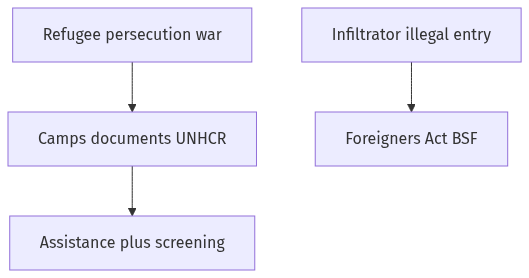
Conclusion
A refugee seeks protection from persecution or war; an infiltrator is an illegal crosser without that claim. India assists selected refugee groups through camps, documents, and case-by-case stay, and it polices infiltration through foreigners law and border forces, without a single refugee statute.
Quick related
Students also ask
-
"India's continental shelf is a storehouse of mineral and energy resources." Critically examine this statement with suitable examples.
Next question in the 2025 paper (Q19). View answer →
-
Is every illegal entrant an infiltrator?
Illegal entry is a fact. Infiltrator in security use implies hostile or concealed purpose. A person who then seeks asylum is assessed as a refugee claim, not automatically as an infiltrator.
-
Does India refuse all refugees?
No. It has hosted several groups for decades. The gap is the lack of a uniform statutory procedure.
Same topic · past papers
UPPSC has asked this before
These previous-year questions sit on the same topic. Open one to practise the earlier ask.
More from this paper
Q1 · UPSC Mains 2025 · UPGS1 · 8 marks · Solution
Comment briefly on the development of art and technology during the Maurya period.
Indian culture
Mauryan art is court stone: edict pillars, the Sarnath lion capital, yaksha figures, Barabar caves, and early stupas. Mauryan technology is iron, state mines, punch-marked coins, roads, wells, and the Sudarshana lake begun under Pushyagupta. Both grew under one imperial administration from Chandragupta to Ashoka.
Q2 · UPSC Mains 2025 · UPGS1 · 8 marks · Solution
"Women's issue was a major concern in the socio-religious reform movements of 19th century India." Explain.
Women, population and associated issues
Reformers treated women’s status as a public test of social change in the nineteenth century. Sati was prohibited in Bengal Presidency in 1829 after Rammohan Roy’s campaign. The Hindu Widows’ Remarriage Act, 1856, followed Vidyasagar’s work. Phule schools and later women writers showed that education and household power were part of the same question. Child marriage remained contested in the Age of Consent debates of 1891.
Q3 · UPSC Mains 2025 · UPGS1 · 8 marks · Solution
"Extremism was a reaction against the ideas and modus operandi of the moderates." Critically explain this statement.
Modern Indian history
Moderates trusted petitions, councils, and British public opinion. The 1905 partition and failed prayers pushed Tilak, Pal, and Lajpat Rai toward Swaraj, boycott, and Swadeshi. Surat 1907 displayed the clash of methods inside Congress. Extremism also had a constructive Swadeshi programme, so it was not only a reaction. Later nationalism combined constitutional work with mass pressure.