
Revision summary
A frontier is a belt; a boundary is a delimited and often demarcated line. Radcliffe 1947 drew international boundaries in Punjab and Bengal; the Durand Line is a superimposed colonial line. Natural examples include Himalayan crest claims and the Thar dry belt. Geometric stretches appear in desert and Rann sectors. The LoC and fenced India–Pakistan border are live military or fortified lines. Maritime examples include Palk Bay and the Sir Creek dispute.
Model answer
Introduction
A frontier is a zone. A boundary is a line. Political geography treats the first as a belt of contact and the second as a delimited and, if possible, demarcated limit of sovereignty.
Body
Frontier and boundary
- A frontier is a transitional belt where state control, culture, and settlement thin out, such as a tribal hill tract or a desert margin before it is surveyed.
- A boundary is an agreed or claimed line that separates two sovereignties on a map and, after pillars, on the ground.
- Frontiers can be absorbed when a state advances roads and posts; boundaries remain even when the frontier character of the borderland continues.
- In the subcontinent, the older North-West tribal belt behaved as a frontier; the Radcliffe Line of 1947 was drawn as a boundary, however hurried.
Types of boundaries, with examples
- Natural or physical boundaries follow a mountain, river, or desert: the crest of the Himalaya in parts of the India–China claim, the Thar as a dry belt toward Pakistan, and river sectors on the India–Bangladesh border before they were adjusted.
- Geometric boundaries follow latitude, longitude, or a straight survey line: parts of the India–Pakistan border in the desert, and colonial lines in the Rann of Kutch before the later tribunal award.
- Anthropogeographic or cultural boundaries attempt to follow language or religion: Radcliffe’s 1947 lines in Punjab and Bengal were of this claimed type and still left mixed districts.
- Relict boundaries are former lines that remain in landscape or memory, such as princely-state borders inside India after accession.
- Superimposed boundaries are drawn by an outside power with limited local fit: colonial Durand Line between British India and Afghanistan, which Pakistan inherited, and which Afghanistan has often treated as a frontier not a settled boundary.
- Subsequent boundaries are drawn after settlement, with more local knowledge; many internal state boundaries after 1956 linguistic reorganisation are of this kind inside India.
- Antecedent boundaries are drawn before dense settlement; few subcontinental international lines are purely antecedent, though some Himalayan watershed claims are argued in that language.
- Fortified or live boundaries have fences and patrols, such as the India–Pakistan international border and the Line of Control in Jammu and Kashmir, which is a military line rather than a fully agreed boundary.
- Maritime boundaries are lines at sea: India–Sri Lanka in the Palk Bay and Gulf of Mannar, and India–Maldives and India–Myanmar delimitations, plus the unsettled or sensitive Sir Creek sector with Pakistan.
Detail to keep
- The McMahon Line is a claimed Himalayan boundary whose frontier character on the ground produced the later LAC.
- Internal boundaries of Indian states are legal, but they are not international boundaries.
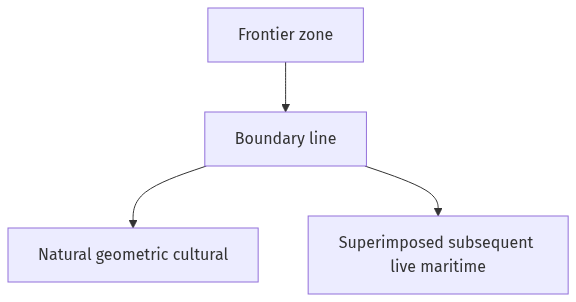
Flow diagram
Conclusion
A frontier is a zone of contact; a boundary is a line of sovereignty. The Indian subcontinent shows natural, geometric, cultural, superimposed, subsequent, live, and maritime types, from Radcliffe and Durand to Sir Creek and the Himalayan LAC.
Quick related
Students also ask
-
Is the LAC a boundary?
It is a military line of actual control. India and China have not agreed a delimited and demarcated boundary there.
-
Are Indian state borders ‘boundaries’ in this sense?
They are internal administrative boundaries. The question’s types are illustrated most sharply on international lines, with state borders as subsequent examples inside the Union.
Same topic · past papers
UPPSC has asked this before
These previous-year questions sit on the same topic. Open one to practise the earlier ask.
-
2025 · Q18 · UPGS1 · 12 marks
Differentiate between refugees and infiltrators. What steps have been taken by the Government of India for the security and assistance of refugees? -
2025 · Q19 · UPGS1 · 12 marks
"India's continental shelf is a storehouse of mineral and energy resources." Critically examine this statement with suitable examples. -
2022 · Q9 · UPGS1 · 8 marks
Give an account of Irrigation Projects of Uttar Pradesh in detail with suitable examples. -
2019 · Q10 · UPGS1 · 8 marks
Give an account of Minor Irrigation Projects of Uttar Pradesh with suitable examples. -
2018 · Q15 · UPGS1 · 12 marks
Discuss the impact of globalization on the status of women in Indian society by citing suitable examples.
More from this paper
Q1 · UPSC Mains 2025 · UPGS1 · 8 marks · Solution
Comment briefly on the development of art and technology during the Maurya period.
Indian culture
Mauryan art is court stone: edict pillars, the Sarnath lion capital, yaksha figures, Barabar caves, and early stupas. Mauryan technology is iron, state mines, punch-marked coins, roads, wells, and the Sudarshana lake begun under Pushyagupta. Both grew under one imperial administration from Chandragupta to Ashoka.
Q2 · UPSC Mains 2025 · UPGS1 · 8 marks · Solution
"Women's issue was a major concern in the socio-religious reform movements of 19th century India." Explain.
Women, population and associated issues
Reformers treated women’s status as a public test of social change in the nineteenth century. Sati was prohibited in Bengal Presidency in 1829 after Rammohan Roy’s campaign. The Hindu Widows’ Remarriage Act, 1856, followed Vidyasagar’s work. Phule schools and later women writers showed that education and household power were part of the same question. Child marriage remained contested in the Age of Consent debates of 1891.
Q3 · UPSC Mains 2025 · UPGS1 · 8 marks · Solution
"Extremism was a reaction against the ideas and modus operandi of the moderates." Critically explain this statement.
Modern Indian history
Moderates trusted petitions, councils, and British public opinion. The 1905 partition and failed prayers pushed Tilak, Pal, and Lajpat Rai toward Swaraj, boycott, and Swadeshi. Surat 1907 displayed the clash of methods inside Congress. Extremism also had a constructive Swadeshi programme, so it was not only a reaction. Later nationalism combined constitutional work with mass pressure.