
Revision summary
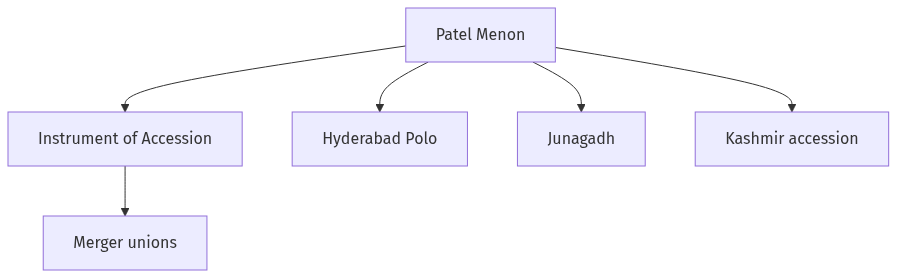
The Independence Act left princes free, which threatened a broken India. Patel and Menon used the Instrument of Accession, privy purses, and merger of small states. Junagadh was reversed by blockade and plebiscite after a Pakistan accession. Hyderabad was taken by Operation Polo in 1948, with communal violence in the aftermath. Kashmir acceded under invasion; later UN and Article 370 tracks were not only Patel’s file. The map was unified; society and Kashmir politics were not finished.
Model answer
Introduction
After 15 August 1947 more than five hundred princely states sat beside British Indian provinces. Sardar Patel, with V. P. Menon, made most of them accede to India, and a critical analysis must weigh speed against the methods used.
Body
The task and the method
- The Indian Independence Act left princes free to accede to India or Pakistan or, in theory, to stand out, which threatened a broken map.
- Patel’s States Department used the Instrument of Accession for defence, external affairs, and communications as the first legal step.
- Privy purses and the promise to respect internal autonomy were the political price that bought peaceful accession in most states.
- Menon’s tours and Patel’s pressure on stubborn courts were administrative, not only ceremonial.
Hard cases
- Junagadh’s nawab acceded to Pakistan while the population was largely Hindu; India used a blockade and a later plebiscite, which a critic may call force dressed as consent.
- Hyderabad’s nizam delayed; Operation Polo in September 1948 ended the stand-off, and communal killing in the aftermath remains a stain on the military success.
- Jammu and Kashmir acceded after the tribal invasion; Patel backed the accession, but the UN track and Article 370 were Nehru’s diplomatic frame more than Patel’s file.
- Patel also pushed the merger of smaller states into unions such as Saurashtra and Madhya Bharat so that administration could actually run.
Critical balance
- Unification avoided a Balkans of princely India, which is Patel’s main achievement.
- The methods mixed law, money, and the army, so the story is not only persuasion.
- Land reform, linguistic states, and Kashmir remained after Patel’s death, so unification of the map was not unification of society.
- A fair analysis therefore credits Patel for the map and still names Hyderabad’s violence and Kashmir’s unfinished politics.
Flow diagram
Conclusion
Patel unified almost all princely states through accession, merger, and, where needed, force. The critical limit is that Junagadh, Hyderabad, and Kashmir show the cost of speed, and that social unification was a later task.
Quick related
Students also ask
-
"The period from 1857 to 1947 was a time of immense change of Indian history." Analyse this statement.
Next question in the 2025 paper (Q12). View answer →
-
Did Patel integrate Kashmir in the same way as Hyderabad?
No. Kashmir’s maharaja acceded during an invasion. Hyderabad was taken by a military operation after a long delay.
-
Was unification only Patel’s work?
Patel led the States Department. Mountbatten, Menon, and later cabinets also acted. Nehru led the Kashmir diplomacy.
Same topic · past papers
UPPSC has asked this before
These previous-year questions sit on the same topic. Open one to practise the earlier ask.
-
2023 · Q3 · UPGS1 · 8 marks
Discuss the role of Sardar Patel in the unification of India after independence. -
2024 · Q2 · UPGS1 · 8 marks
Give an account of the challenges faced by India immediately after Independence.
More from this paper
Q1 · UPSC Mains 2025 · UPGS1 · 8 marks · Solution
Comment briefly on the development of art and technology during the Maurya period.
Indian culture
Mauryan art is court stone: edict pillars, the Sarnath lion capital, yaksha figures, Barabar caves, and early stupas. Mauryan technology is iron, state mines, punch-marked coins, roads, wells, and the Sudarshana lake begun under Pushyagupta. Both grew under one imperial administration from Chandragupta to Ashoka.
Q2 · UPSC Mains 2025 · UPGS1 · 8 marks · Solution
"Women's issue was a major concern in the socio-religious reform movements of 19th century India." Explain.
Women, population and associated issues
Reformers treated women’s status as a public test of social change in the nineteenth century. Sati was prohibited in Bengal Presidency in 1829 after Rammohan Roy’s campaign. The Hindu Widows’ Remarriage Act, 1856, followed Vidyasagar’s work. Phule schools and later women writers showed that education and household power were part of the same question. Child marriage remained contested in the Age of Consent debates of 1891.
Q3 · UPSC Mains 2025 · UPGS1 · 8 marks · Solution
"Extremism was a reaction against the ideas and modus operandi of the moderates." Critically explain this statement.
Modern Indian history
Moderates trusted petitions, councils, and British public opinion. The 1905 partition and failed prayers pushed Tilak, Pal, and Lajpat Rai toward Swaraj, boycott, and Swadeshi. Surat 1907 displayed the clash of methods inside Congress. Extremism also had a constructive Swadeshi programme, so it was not only a reaction. Later nationalism combined constitutional work with mass pressure.