
Revision summary
Yogendra Singh treats modernization of Indian tradition as internal and external change together. Sanskritization, westernization and the Rudolphs’ modernity of tradition describe recasting, not simple death. Law, education, media, the developmental state and the post-1991 market are the main levers. Caste, household and religion persist in new organisational forms. Unevenness remains: mobility in class can coexist with control in marriage.
Model answer
Copper italics in this answer — like this — are the key facts. Each one is unpacked in the Facts & figures rail.
Introduction
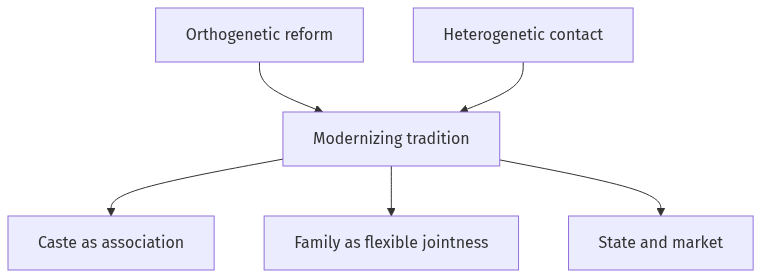
Indian traditions are modernizing, not evaporating. Yogendra Singh argued that change comes from inside the civilisation (orthogenetic) and from contact with Islam, the West and the colonial state (heterogenetic). The outcome is a reconstituted tradition: caste associations, temple trusts, and arranged love marriages sit beside the Constitution and the market.
Body
Continuity through change
M. N. Srinivas named sanskritization and westernization as twin processes. A jati copies the diet, ritual and education of a locally higher group, and also takes English, office and the vote. Lloyd and Susanne Rudolph called this the modernity of tradition: caste sabhas become interest groups; panchayats become statutory bodies. Milton Singer saw the “great tradition” travelling into Madras industry through ritual and kinship.
Contributing factors are stacked. Colonial law and the census objectified community. Missionary and state education created a bilingual elite. Railways, print and now the smartphone spread both katha and coaching. The post-colonial state—reservation, Hindu Code, NEP 2020—rewrites who may enter school and office. The market after 1991 sells lifestyle while matrimonial sites sell gotra filters. Internal reformers—Bhakti, Phule, Gandhi, Ambedkar—gave tradition a language of equality without always abandoning religious idiom.
Where we see it
Caste does not vanish; it differentiates. Endogamy remains high; occupation and politics open. The joint household may split residentially while remaining a property and ritual unit (I. P. Desai, A. M. Shah). Festivals become televised public culture. Yoga and Ayurveda are packaged as global wellness, which is a modern career for an old repertoire.
The risk is to call every change “modernization.” Dipankar Gupta notes that inter-caste violence and khap diktats are also contemporary. Tradition modernizes unevenly: a software engineer may still police a sister’s marriage.
Flow diagram
Conclusion
Indian traditions modernize by differentiation and by borrowing. The contributing factors are law, school, market, media and indigenous critique. The result is not Western replica but a layered social system that still speaks in caste, kinship and dharma while using the vote, the court and the firm.
Quick related
Students also ask
-
How would you appropriate to characterise G. S. Ghurye as a practitioner of 'theoretical pluralism'?
Next question on this syllabus topic (2025 · Q1(e)). View answer →
-
Does modernization mean Westernization?
Not only. Westernization is one stream. Bhakti, social reform and constitutional equality are internal modernizations of tradition.
-
Has caste become class?
Occupation and income have loosened for some groups, but marriage, networks and politics still carry caste. The two overlap rather than replace each other.
Same topic · past papers
UPSC has asked this before
These previous-year questions sit on the same topic. Open one to practise the earlier ask.
-
2015 · Q5(e) · Sociology GS 2 · 10 marks
How far Srinivas Sanskritization is modernizing force or traditionalizing force in understanding the changes in caste system?
More from this topic
Q5(e) · UPSC Mains 2026 · Sociology GS 2 · 10 marks · Solution
Bring out the debates of 'insiders' and 'outsiders' approaches in understanding Indian society.
Perspectives on the study of Indian society
• The insider (emic) approach studies Indian society using native categories, sacred texts, and cultural immersion, championed by G.S. Ghurye and D.P. Mukerji. • Critics argue the insider view suffers from upper-caste bias and ignores ground realities in favor of normative texts. • The outsider (etic) approach applies universal models and comparative frameworks, famously used by Western scholars like Louis Dumont. • Critics dismiss the outsider view as orientalist reductionism that imposes Western concepts and misinterprets local idioms. • Modern Indian sociology bridges this binary through a reflexive methodology combining cultural familiarity with analytical rigor. • Ultimately, combining native insights with objective scrutiny is essential to capture India's complex social dynamics.
Q5(a) · UPSC Mains 2026 · Sociology GS 2 · 10 marks · Solution
Discuss the challenges faced by the aged people in receiving 'elder care'.
Perspectives on the study of Indian society
• India's aging population faces severe elder care challenges due to the breakdown of traditional joint families and youth out-migration. • Over 80% of seniors lack formal pensions because they worked in the informal sector, worsening financial vulnerability. • High out-of-pocket medical costs for chronic illnesses quickly drain meager personal savings. • Public hospitals suffer from an acute shortage of geriatric specialists, dedicated wards, and rehabilitation facilities. • Implementation of the Maintenance and Welfare of Parents and Senior Citizens Act, 2007 remains weak, leaving legal tribunals overburdened. • Solutions require shifting from a welfare approach to a rights-based framework, combining community care networks with strict legal enforcement under Article 41.
Q4(c) · UPSC Mains 2026 · Sociology GS 2 · 10 marks · Solution
Compare G. S. Ghurye's and A. R. Desai's approaches used in understanding Indian society
Perspectives on the study of Indian society
• **Ghurye’s Indological Approach:** Relied on sacred texts and classical literature to study Indian society through civilizational continuity. • **Core Themes in Ghurye:** Focused on caste, kin, and how Hinduism historically integrated diverse tribal and regional groups. • **Desai’s Materialist Approach:** Rejected textual idealism in favor of Marxist political economy to study social structures. • **Economic Formations:** Analyzed Indian society through successive modes of production—ancient, feudal, and colonial capitalist. • **Caste vs. Class:** Viewed caste and religion as superstructural elements that mask underlying economic exploitation. • **Critique of State and Nationalism:** Argued that the nationalist movement was bourgeois, leaving agrarian inequalities intact post-independence. • **Key Contrast:** Ghurye highlights cultural tradition and integration, while Desai emphasizes economic power and class conflict.