
Revision summary
Education is necessary for mobility and anti-caste citizenship but not a solo panacea. NEP 2020 reforms structure, language, vocation and equity on paper. Without teachers, public finance and jobs, it becomes credentialism and a dual private-public system. Caste, land and informal labour reproduce ills that schooling alone cannot dissolve. Phule–Ambedkar were right to start with the school and wrong if we stop there.
Model answer
Copper italics in this answer — like this — are the key facts. Each one is unpacked in the Facts & figures rail.
Introduction
Education is a necessary solvent of many Indian ills. It is not the only panacea. NEP 2020 is the latest state attempt to make schooling and higher education do too much—nation-building, skills, equity, culture—while the surrounding structure of caste, informal labour and underfunded public systems remains. A sociological reading must praise the ambition and refuse the magic.
Body
What NEP gets right
NEP names foundational literacy, mother-tongue / home-language teaching in early years, a 5+3+3+4 structure, vocational exposure, multiple entry-exit in higher education, and a concern for Socio-Economically Disadvantaged Groups. If implemented with teachers and buildings, this could reduce the brutal sorting that Béteille described as the education system reproducing inequality. Phule and Ambedkar already treated the school as the first anti-caste institution. In that lineage NEP is not trivial. The four-year undergraduate design and Academic Bank of Credits try to differentiate a rigid degree into stacked skills—Singh’s language of differentiation applied to the university.
Why education is not enough
Ills such as landlessness, atrocity, gendered unpaid labour, pollution, and jobless growth are not cured by a better textbook. A degree without employment yields credential inflation and coaching factories. Caste endogamy can absorb graduates. Privatisation and philanthropy in NEP’s financing imagination risk a dual system: English private for the new middle class, understaffed public for the rest—the opposite of a panacea. The digital push meets a device-and-connectivity divide that COVID exposed. Mother-tongue policy collides with the labour market’s English premium unless the state equalises both.
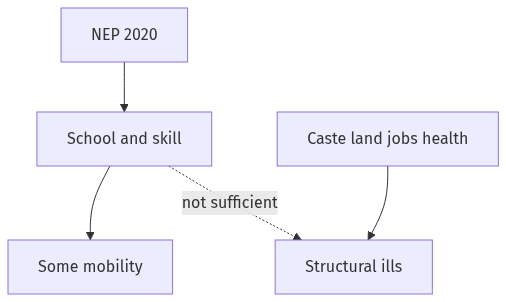
Yogendra Singh would treat NEP as heterogenetic state reform landing on an orthogenetic schooling culture of tuitions and honour. Desai would ask who owns the private university. Implementation depends on state finances and teacher unions, not on a PDF from Delhi. Elite boarding schools and under-resourced government schools will both quote NEP and remain two Indias of opportunity. Critical examination: NEP is a necessary reform script, not a substitute for industrial policy, health (which determines attendance), and annihilation of caste in everyday life. Treat it as one institution among others—not as a holy single lever.
Flow diagram
Conclusion
NEP 2020 can widen learning and skill if publicly funded and fairly staffed. It cannot be the only cure for India’s structural evils. Education plus land, health, jobs and anti-caste law is a programme; education alone is a slogan.
Quick related
Students also ask
-
Is patriarchy a key to understanding different forms of inequalities in Indian society? Elaborate.
Next question on this syllabus topic (2024 · Q1(c)). View answer →
-
Does NEP abolish reservation?
No. It speaks of equity and SEDGs; reservation remains a constitutional track beside policy.
-
Why not call education the only panacea?
Because labour markets, property and honour can cancel a certificate. Panacea talk excuses the rest of the state.
More from this topic
Q5(e) · UPSC Mains 2026 · Sociology GS 2 · 10 marks · Solution
Bring out the debates of 'insiders' and 'outsiders' approaches in understanding Indian society.
Perspectives on the study of Indian society
• The insider (emic) approach studies Indian society using native categories, sacred texts, and cultural immersion, championed by G.S. Ghurye and D.P. Mukerji. • Critics argue the insider view suffers from upper-caste bias and ignores ground realities in favor of normative texts. • The outsider (etic) approach applies universal models and comparative frameworks, famously used by Western scholars like Louis Dumont. • Critics dismiss the outsider view as orientalist reductionism that imposes Western concepts and misinterprets local idioms. • Modern Indian sociology bridges this binary through a reflexive methodology combining cultural familiarity with analytical rigor. • Ultimately, combining native insights with objective scrutiny is essential to capture India's complex social dynamics.
Q5(a) · UPSC Mains 2026 · Sociology GS 2 · 10 marks · Solution
Discuss the challenges faced by the aged people in receiving 'elder care'.
Perspectives on the study of Indian society
• India's aging population faces severe elder care challenges due to the breakdown of traditional joint families and youth out-migration. • Over 80% of seniors lack formal pensions because they worked in the informal sector, worsening financial vulnerability. • High out-of-pocket medical costs for chronic illnesses quickly drain meager personal savings. • Public hospitals suffer from an acute shortage of geriatric specialists, dedicated wards, and rehabilitation facilities. • Implementation of the Maintenance and Welfare of Parents and Senior Citizens Act, 2007 remains weak, leaving legal tribunals overburdened. • Solutions require shifting from a welfare approach to a rights-based framework, combining community care networks with strict legal enforcement under Article 41.
Q4(c) · UPSC Mains 2026 · Sociology GS 2 · 10 marks · Solution
Compare G. S. Ghurye's and A. R. Desai's approaches used in understanding Indian society
Perspectives on the study of Indian society
• **Ghurye’s Indological Approach:** Relied on sacred texts and classical literature to study Indian society through civilizational continuity. • **Core Themes in Ghurye:** Focused on caste, kin, and how Hinduism historically integrated diverse tribal and regional groups. • **Desai’s Materialist Approach:** Rejected textual idealism in favor of Marxist political economy to study social structures. • **Economic Formations:** Analyzed Indian society through successive modes of production—ancient, feudal, and colonial capitalist. • **Caste vs. Class:** Viewed caste and religion as superstructural elements that mask underlying economic exploitation. • **Critique of State and Nationalism:** Argued that the nationalist movement was bourgeois, leaving agrarian inequalities intact post-independence. • **Key Contrast:** Ghurye highlights cultural tradition and integration, while Desai emphasizes economic power and class conflict.