
Revision summary
The 2020–21 movement opposed three Union farm laws and won repeal in 2021. Its core was organised cultivators of the north-western grain belt, including strong women’s support work. It used sit-ins, highways and a food-producer moral claim. It succeeded as a veto; it did not transform landless labour’s condition. It continues the New Farmers’ Movement tradition at a national scale.
Model answer
Copper italics in this answer — like this — are the key facts. Each one is unpacked in the Facts & figures rail.
Introduction
The farmers’ movement of 2020–21 was a prolonged sit-in, mainly at Delhi’s borders, against three Union farm laws on trade, contract farming and stock limits. The laws were repealed in 2021. Assessment means asking who moved, how, what they won, and what agrarian structure they could not change.
Body
Who and how
Unions from Punjab, Haryana and western Uttar Pradesh—often Jat and related cultivating groups with a history of Green Revolution surplus and MSP grain—led the blockade. BKU and later a wider coalition, including women langar and kit-work, made it more than a male tractor protest. It used highways, social media, and a moral language of annadata. That is a regional agrarian class movement with a nationalist frame, not an all-India landless labour uprising.
Assessment
As a veto on a particular liberalisation of grain trade, it succeeded. It showed that organised farmers can still check the Union when logistics (Punjab–Delhi) and union density align. It politicised MSP as a public guarantee. Limits are clear: landless Dalit labour and many dryland farmers were weakly centred; corporate and class inequalities inside agriculture remain; the movement did not rewrite tenancy or women’s land titles. Some violence and a contested Republic Day tractor march complicated its civic claim.
Sociologically it is a dominant-cultivator defence of a state-supported grain regime, allied at times with wider rural anger, effective as protest, incomplete as agrarian justice. Compared with earlier New Farmers’ Movements (Sharad Joshi, BKU in the 1980s), it was more national-media visible and more focused on Union statute.
- The assessment, then: historically large, regionally skewed, tactically successful on repeal, structurally conservative on labour and landless interests.
Flow diagram
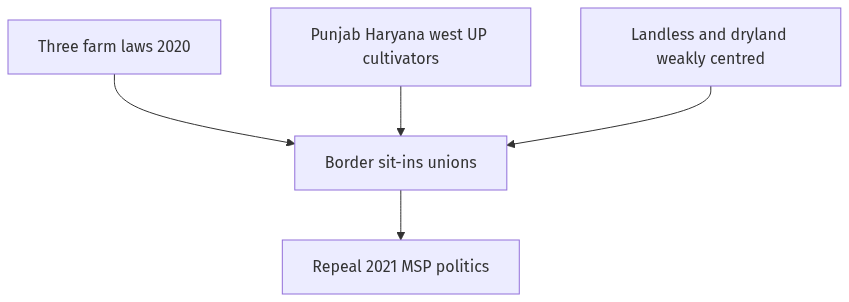
Conclusion
The 2020–21 farmers’ movement was a powerful, union-led, Green-Revolution-belt mobilisation that forced repeal of the three laws. It defended MSP and cultivator dignity more than it represented all rural classes. That is both its strength and its limit.
Quick related
Students also ask
-
Analyse the trilogy between environmental movement, development, and tribal identity
Next question on this syllabus topic (2024 · Q7(a)). View answer →
-
Was this an all-India peasant war?
No. It was strongest where MSP wheat-paddy unions are dense. Other regions sympathised unevenly.
-
Did women only cook in langars?
Langar was central, and women also sat on the roads and spoke as farmers and farm wives. Leadership remained largely male.
Same topic · past papers
UPSC has asked this before
These previous-year questions sit on the same topic. Open one to practise the earlier ask.
-
2020 · Q7(c) · Sociology GS 2 · 15 marks
Are the contemporary farmers' movements in India changing their course? Discuss. -
2015 · Q7(b) · Sociology GS 2 · 15 marks
Discuss the main features of farmers' movements in independent India. -
2017 · Q3(a) · Sociology GS 2 · 20 marks
Indebtedness is one of the serious issues leading to farmers suicides Discuss reasons and suggest solutions -
2015 · Q5(c) · Sociology GS 2 · 10 marks
Effect of displacement through development on the rural landless and marginal farmers .
More from this topic
Q8(b) · UPSC Mains 2026 · Sociology GS 2 · 20 marks · Solution
How have the women's movements made the presence of women in every moment felt and more women participation in various fields? Discuss
Social Movements in Modern India
• 19th-century social reformers initiated the women's movement by targeting regressive practices like sati and child marriage. • The nationalist freedom struggle successfully pulled women out of households into public satyagrahas and political forums. • Post-independence autonomous movements in the 1970s–80s fiercely protested dowry, price rises, and custodial violence. • Constitutional amendments (73rd and 74th) reserved one-third of local governance seats, drawing millions into grassroots leadership. • Grassroots unions like SEWA successfully organized informal female labourers to secure fair wages and basic social security. • Sustained public advocacy and PILs compelled historic criminal law reforms against domestic violence and workplace harassment. • Modern agitations continue to push for structural equality, demanding legislative reservation in Parliament and state assemblies.
Q5(b) · UPSC Mains 2026 · Sociology GS 2 · 10 marks · Solution
Examine the transiting social movements from physical movements to virtual movements in 21st century India.
Social Movements in Modern India
• 21st-century Indian social movements have shifted from physical street protests to digital and virtual mobilisation. • Virtual platforms provide borderless reach, instant information sharing, and bypass traditional gatekeepers. • Movements like #MeToo India show a shift toward decentralised, network-centric leadership without rigid hierarchies. • Digital tools lower transaction costs and enable real-time narration to counter official state narratives. • Severe limitations remain, including the digital divide, gender gaps in internet access, and superficial "slacktivism." • True democratic dissent requires blending fast digital outreach with deep, durable grassroots solidarity for marginalised voices.
Q1(c) · UPSC Mains 2026 · Sociology GS 2 · 10 marks · Solution
In the context of women's movements and laws do you think that matriarchy is the need of the hour? Discuss in detail.
Social Movements in Modern India
This answer evaluates the proposition of matriarchy as a remedy for patriarchal oppression in modern India. It traces the historical trajectory of women's movements and legal reforms from social reform acts to contemporary rights-based frameworks. It analyses the distinction between matrilineal systems and matriarchy, noting that true matriarchy involves institutionalized female authority rather than mere descent tracking. The discussion highlights the limitations of replacing one power hierarchy with another, advocating instead for gender-egalitarian models. Constitutional provisions like Article 15 and statutory measures such as the Protection of Women from Domestic Violence Act, 2005 are integrated to ground the analysis in Indian jurisprudence. Finally, a policy-oriented conclusion emphasizes substantive equality and shared governance over inverted power structures.