
Revision summary
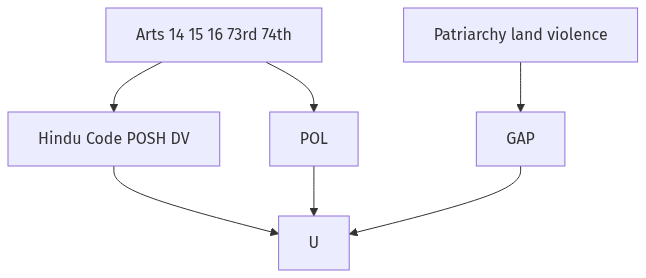
Articles 14, 15 and 16 and panchayat reservations made women constitutional citizens and local office-holders. Hindu Code, labour and harassment law extended that personhood. Literacy, some delay of marriage, and public visibility are real gains. Labour force, son preference, violence and personal-law plurality limit uplift. The result is partial, caste-class uneven citizenship rather than completed equality.
Model answer
Copper italics in this answer — like this — are the key facts. Each one is unpacked in the Facts & figures rail.
Introduction
The Constitution made women citizens, not only dependants of a community. Articles 14, 15, 16, Directive Principles on equal pay and maternity, Article 51A, and later the 73rd and 74th Amendments with reserved panchayat and municipality seats, are the core provisions. They have led to real uplift in law and in some public roles. They have not dissolved Brahmanical and other patriarchies in the household, the field and the street. The honest answer is a qualified yes.
Body
What the provisions did
Article 15 bars sex discrimination and allows special measures. Article 16 opens public employment. These clauses underwrote the Hindu Code project that Ambedkar steered: marriage, divorce, succession and adoption as statute rather than only custom. Maternity benefit, equal remuneration law, and later POSH sit on that floor. Panchayati Raj reservations created a large class of women representatives, including sarpanchs who, even when mediated by male kin, entered the local state. The Supreme Court in cases from Shah Bano through Vishaka to later privacy and adultery judgments used constitutional equality to push personal and criminal law.
- Education and health missions used the citizenship frame: girls’ schooling, ICDS, and reproductive programmes treat women as public subjects. Relative to 1950, literacy, age at marriage in many states, and visibility in universities and services are genuine uplift.
Why the record is not emancipation
Uplift is not the same as equality of condition. Female labour-force participation is weak and informal. Unpaid care is uncounted. Sex ratio and gender-biased abortion (despite PCPNDT) show households still preferring sons. Violence—domestic, caste, communal, workplace—continues; law exists, conviction and social support lag. Personal laws still fragment Muslim, Christian and customary rights. Panchayat reservation meets proxy rule and violence against women who sit in the chair. NEP 2020 can widen schooling without automatically raising workplace power.
Uma Chakravarti and feminist political economy argue that constitutional liberalism meets a social structure that stores honour in women’s bodies. Béteille would add that a right on paper is not a resource in the village class map. So provisions led to uplift where the state and organised movements could convert text into seats, schools and case law. They did not uplift evenly across caste, class, region and religion.
Workplace and property are the stubborn middle. Without land titles and without regular jobs, a reserved panchayat seat does not feed a household. NEP 2020 and scholarships can raise enrolment; they do not automatically raise bargaining inside marriage. POSH does not reach the brick kiln or the farm. So constitutional uplift is strongest in legal personhood and local office, middling in education, and weakest in informal labour and the private family.
- Reasons, in short: the Constitution changed the legal person; patriarchy, land and labour markets still organise everyday inequality; implementation is local and male-dominated; community personal law was only partly constitutionalised.
Flow diagram
Conclusion
Constitutional provisions have led to women’s uplift in citizenship, education, local office and a body of protective law. They have not completed uplift because marriage, work and violence remain structured by caste-patriarchy and uneven enforcement. The provisions are a necessary floor, not a finished building.
Quick related
Students also ask
-
Highlight the significant features of A.R. Desai's 'Dialectical Perspective' to study Indian Society
Next question on this syllabus topic (2023 · Q1(a)). View answer →
-
Did Shah Bano prove constitutional uplift?
The 1985 judgment used equality and maintenance. The 1986 Act then limited that path for Muslim women, showing political reversal.
-
Are reserved sarpanchs proof of empowerment?
They are proof of access to office. Empowerment depends on whether the woman can decide, which varies widely.
Same topic · past papers
UPSC has asked this before
These previous-year questions sit on the same topic. Open one to practise the earlier ask.
-
2018 · Q5(a) · Sociology GS 2 · 10 marks
Elaborate the concept of constitutional morality as given by B.R.Ambedkar.
More from this topic
Q5(e) · UPSC Mains 2026 · Sociology GS 2 · 10 marks · Solution
Bring out the debates of 'insiders' and 'outsiders' approaches in understanding Indian society.
Perspectives on the study of Indian society
• The insider (emic) approach studies Indian society using native categories, sacred texts, and cultural immersion, championed by G.S. Ghurye and D.P. Mukerji. • Critics argue the insider view suffers from upper-caste bias and ignores ground realities in favor of normative texts. • The outsider (etic) approach applies universal models and comparative frameworks, famously used by Western scholars like Louis Dumont. • Critics dismiss the outsider view as orientalist reductionism that imposes Western concepts and misinterprets local idioms. • Modern Indian sociology bridges this binary through a reflexive methodology combining cultural familiarity with analytical rigor. • Ultimately, combining native insights with objective scrutiny is essential to capture India's complex social dynamics.
Q5(a) · UPSC Mains 2026 · Sociology GS 2 · 10 marks · Solution
Discuss the challenges faced by the aged people in receiving 'elder care'.
Perspectives on the study of Indian society
• India's aging population faces severe elder care challenges due to the breakdown of traditional joint families and youth out-migration. • Over 80% of seniors lack formal pensions because they worked in the informal sector, worsening financial vulnerability. • High out-of-pocket medical costs for chronic illnesses quickly drain meager personal savings. • Public hospitals suffer from an acute shortage of geriatric specialists, dedicated wards, and rehabilitation facilities. • Implementation of the Maintenance and Welfare of Parents and Senior Citizens Act, 2007 remains weak, leaving legal tribunals overburdened. • Solutions require shifting from a welfare approach to a rights-based framework, combining community care networks with strict legal enforcement under Article 41.
Q4(c) · UPSC Mains 2026 · Sociology GS 2 · 10 marks · Solution
Compare G. S. Ghurye's and A. R. Desai's approaches used in understanding Indian society
Perspectives on the study of Indian society
• **Ghurye’s Indological Approach:** Relied on sacred texts and classical literature to study Indian society through civilizational continuity. • **Core Themes in Ghurye:** Focused on caste, kin, and how Hinduism historically integrated diverse tribal and regional groups. • **Desai’s Materialist Approach:** Rejected textual idealism in favor of Marxist political economy to study social structures. • **Economic Formations:** Analyzed Indian society through successive modes of production—ancient, feudal, and colonial capitalist. • **Caste vs. Class:** Viewed caste and religion as superstructural elements that mask underlying economic exploitation. • **Critique of State and Nationalism:** Argued that the nationalist movement was bourgeois, leaving agrarian inequalities intact post-independence. • **Key Contrast:** Ghurye highlights cultural tradition and integration, while Desai emphasizes economic power and class conflict.