
Revision summary
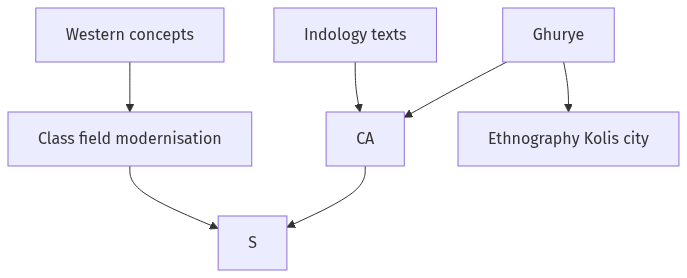
Western perspectives start from class, function, modernisation or Marxism and then read India. Indological perspectives start from shastra and civilisational categories such as varna and jati. Ghurye used Indology to specify caste features, gotra, sadhus and cultural history. He combined texts with urban and tribal ethnography and an assimilation thesis on tribes. The method is strong on continuity and weak on class, gender and minority as independent structures.
Model answer
Copper italics in this answer — like this — are the key facts. Each one is unpacked in the Facts & figures rail.
Introduction
Two professional habits have organised the sociology of India. A Western perspective starts from concepts forged in European and American debates—class, bureaucracy, modernisation, structure-function, Marxism—and asks how India fits or fails those concepts. An Indological perspective starts from Indian texts and civilisational categories—varna, jati, ashrama, dharma—and treats them as the first grammar of the social system. G. S. Ghurye is the central Indian name for the second habit, though he never worked as a pure philologist.
Body
The Western perspective
Colonial administrators and early anthropologists often used Western race science, evolutionism and later functionalism. After Independence, A. R. Desai used Marxist political economy: Indian society as a class structure shaped by colonialism and the state. M. N. Srinivas, trained in the Oxford structural-functional tradition, used the field view of the village, dominant caste, sanskritization and westernization. Yogendra Singh used modernisation theory, recast as orthogenetic and heterogenetic change. Louis Dumont is a partial exception: a Western scholar who insisted on Indian ideological categories, which is why he sits on the border of the two perspectives.
The Western kit is strong on power, class, state and observed practice. It is tempted to treat Indian categories as epiphenomena, or to read the village as a delayed Europe. Marxists sometimes reduced caste to class. Functionalists sometimes underplayed conflict. The gain is comparison and a language for capitalism and bureaucracy.
The Indological perspective
Indology reads Dharmashastra, epics, Puranas, Buddhist and Jain canons, inscriptions and later commentaries as maps of social order. McKim Marriott and Dumont–Pocock’s “For a Sociology of India” argued that Indian facts need Indian thought. The method explains long continuities: hierarchy, ritual rank, joint-family duty, and the idea of a ranked cosmos. Its risk is the book view that Srinivas criticised: Brahmanical texts over-represent priests and under-represent women, artisans, Adivasis and bargaining in the field.
Ghurye’s contribution
Ghurye, at Bombay, made Indology sociological. In Caste and Race in India he used Sanskrit and historical materials to fix features of caste: segmental division, hierarchy, restrictions on feeding and marriage, civil and religious disabilities, and lack of unrestricted occupational choice. He discussed race and caste without reducing the system to a simple racial stock tale. Gotra and Charana, work on sadhus, Indian costume, and civilisational diffusion showed a historical-Indological method: texts plus the spread of custom.
He did not stop at the library. Studies of Mahadev Kolis and urban groups brought ethnography in. On tribes he argued assimilation into Hindu society (The Aborigines—So-Called), against Verrier Elwin’s isolation. That thesis is Indological in spirit: tribes as backward Hindus rather than as a separate civilisation. It is also political: it shaped integrationist policy talk.
- Major aspects, then: (1) caste as a civilisational institution described from texts and history; (2) diffusion and cultural history of Indian social forms; (3) a Hindu-centred synthesis of tribe, sect and city; (4) theoretical pluralism in method—text, survey, diffusion—without a single imported ism. Limits follow the same list. Class and gender are thinner than in Desai or later feminism. Minorities can appear as residuals. Dumont later accused Indian sociology of mixed empiricism; Ghurye’s reply is the archive of books, not a tight theory of hierarchy.
Ghurye’s Hindu-civilisational frame also shaped how later Bombay students read sect, costume and urban types as Indian facts first, Western labels second. That pedagogical contribution is easy to miss if one only lists books. S. C. Dube and village sociologists who followed still had to answer Ghurye’s archive even when they chose the field. Yogendra Singh later placed Indology inside a map of Indian sociological traditions rather than treating it as pre-sociology.
Critics remain necessary. A purely Indological Ghurye can under-describe mill labour, Partition, and Muslim and Christian personal worlds. A purely Western class analysis can miss why a factory worker still needs a caste match. The productive use of the contrast is sequential: read the text for the claimed order, then read the field for land, gender and the state.
The contrast should not be turned into a war. Srinivas needed Indology to name sanskritization. Ghurye needed observation to write the Kolis. Indian sociology still works by holding the two perspectives in tension.
Flow diagram
Conclusion
Western perspectives explain India with class, field and modernisation; Indological perspectives explain it with texts and civilisational categories. Ghurye made the second into a university sociology of caste, gotra, sadhus and tribe-as-Hindu, using texts with ethnography. The approach is indispensable for hierarchy and continuity, and incomplete for labour, gender and the state.
Quick related
Students also ask
-
Why is the study of marriage important in Sociology? Analyse the implications of changing marriage patterns for Indian society
Next question on this syllabus topic (2024 · Q3(a)). View answer →
-
Is Dumont Western or Indological?
He was a Western scholar who built theory from Brahmanical ideology. He belongs to both conversations.
-
Did Ghurye reject fieldwork?
No. He used texts as a primary archive and also wrote community and urban studies.
Same topic · past papers
UPSC has asked this before
These previous-year questions sit on the same topic. Open one to practise the earlier ask.
-
2025 · Q4(c) · Sociology GS 2 · 10 marks
What is kinship? Briefly explain G. P. Murdock's contribution to the study of the kinship system -
2026 · Q2(a) · Sociology GS 2 · 20 marks
Indological approach, advocated by G. S. Ghurye, focuses on the study of Indian society through Indian texts. How can Indological approach be useful in the study of other society? Comment in detail -
2022 · Q2(a) · Sociology GS 2 · 20 marks
Critically examine GS Ghurye's Indological approach to the understanding of Indian society. -
2018 · Q1(a) · Sociology GS 2 · 10 marks
Write a note on G.S.Ghurye's Indological perspective of understanding Indian society.
More from this topic
Q5(e) · UPSC Mains 2026 · Sociology GS 2 · 10 marks · Solution
Bring out the debates of 'insiders' and 'outsiders' approaches in understanding Indian society.
Perspectives on the study of Indian society
• The insider (emic) approach studies Indian society using native categories, sacred texts, and cultural immersion, championed by G.S. Ghurye and D.P. Mukerji. • Critics argue the insider view suffers from upper-caste bias and ignores ground realities in favor of normative texts. • The outsider (etic) approach applies universal models and comparative frameworks, famously used by Western scholars like Louis Dumont. • Critics dismiss the outsider view as orientalist reductionism that imposes Western concepts and misinterprets local idioms. • Modern Indian sociology bridges this binary through a reflexive methodology combining cultural familiarity with analytical rigor. • Ultimately, combining native insights with objective scrutiny is essential to capture India's complex social dynamics.
Q5(a) · UPSC Mains 2026 · Sociology GS 2 · 10 marks · Solution
Discuss the challenges faced by the aged people in receiving 'elder care'.
Perspectives on the study of Indian society
• India's aging population faces severe elder care challenges due to the breakdown of traditional joint families and youth out-migration. • Over 80% of seniors lack formal pensions because they worked in the informal sector, worsening financial vulnerability. • High out-of-pocket medical costs for chronic illnesses quickly drain meager personal savings. • Public hospitals suffer from an acute shortage of geriatric specialists, dedicated wards, and rehabilitation facilities. • Implementation of the Maintenance and Welfare of Parents and Senior Citizens Act, 2007 remains weak, leaving legal tribunals overburdened. • Solutions require shifting from a welfare approach to a rights-based framework, combining community care networks with strict legal enforcement under Article 41.
Q4(c) · UPSC Mains 2026 · Sociology GS 2 · 10 marks · Solution
Compare G. S. Ghurye's and A. R. Desai's approaches used in understanding Indian society
Perspectives on the study of Indian society
• **Ghurye’s Indological Approach:** Relied on sacred texts and classical literature to study Indian society through civilizational continuity. • **Core Themes in Ghurye:** Focused on caste, kin, and how Hinduism historically integrated diverse tribal and regional groups. • **Desai’s Materialist Approach:** Rejected textual idealism in favor of Marxist political economy to study social structures. • **Economic Formations:** Analyzed Indian society through successive modes of production—ancient, feudal, and colonial capitalist. • **Caste vs. Class:** Viewed caste and religion as superstructural elements that mask underlying economic exploitation. • **Critique of State and Nationalism:** Argued that the nationalist movement was bourgeois, leaving agrarian inequalities intact post-independence. • **Key Contrast:** Ghurye highlights cultural tradition and integration, while Desai emphasizes economic power and class conflict.