
Revision summary
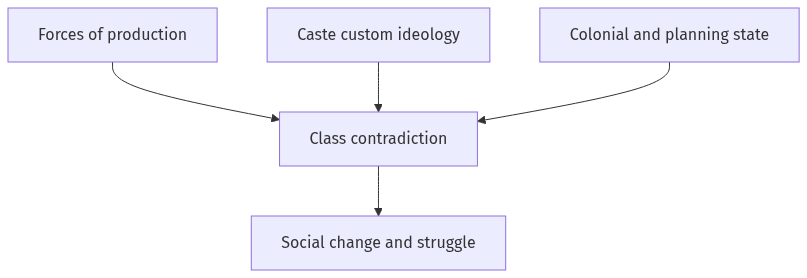
Desai studies Indian society as historical materialism, not as a harmonious village. Caste and custom are read as ideology over agrarian class. The colonial and planning state are part of the contradiction, not neutral umpires. Village studies of consensus are criticised as incomplete. The method is strong on land, labour, and struggle.
Model answer
Copper italics in this answer — like this — are the key facts. Each one is unpacked in the Facts & figures rail.
Introduction
A. R. Desai read Indian society through historical materialism, not through a timeless village or a pure caste ideology. His dialectical perspective treats social life as a field of contradiction between classes, the state, and changing forces of production.
Body
Method
- Desai used Marx’s dialectic: every social form contains opposing interests, and change comes from those contradictions rather than from slow cultural drift.
- He studied India as a historically produced formation of colonialism, landlordism, and later planned capitalism, not as a frozen civilisation.
- Texts, caste rules, and village custom are treated as ideology that can hide surplus extraction, not as a full map of society.
Class, caste, and the village
- Caste, for Desai, is a ranked covering over agrarian class: landlords, rich peasants, tenants, and landless labourers.
- The village is not a little republic of harmony. It is a unit of rent, usury, and labour control, which is why he wrote rural sociology as political economy.
- Nationalism and the post-independence state are class projects as well as freedom struggles; planning can serve industrial capital while leaving rural inequality in place.
Contrast with other Indian sociology
- Against a functional village ethnography that stresses consensus, Desai stresses conflict, peasant struggle, and the colonial land settlement.
- Against a purely Indological reading of hierarchy, he asks who owns land, who pays rent, and who supplies cheap labour.
- The perspective remains useful for Operation Barga, farm laws debates, and displacement, because it keeps production and the state in the same frame.
Flow diagram
Conclusion
Desai’s dialectical perspective is a class-and-history method for Indian society. It does not deny caste or culture; it locates them inside changing property and power.
Quick related
Students also ask
-
Are Tradition and Modernity antithetical to each other? Comment
Next question on this syllabus topic (2023 · Q1(d)). View answer →
-
Does Desai ignore caste?
No. He treats caste as real ideology and organisation, but he refuses to let it replace class and the state.
-
Is the dialectical perspective only about peasants?
Peasants are central, yet the same method covers nationalism, industry, and the post-independence state.
Same topic · past papers
UPSC has asked this before
These previous-year questions sit on the same topic. Open one to practise the earlier ask.
-
2017 · Q1(b) · Sociology GS 2 · 10 marks
Which is more significant, the principle of 'hierarchy' or the principal of difference; in inter caste relations in the present day ?
More from this topic
Q5(e) · UPSC Mains 2026 · Sociology GS 2 · 10 marks · Solution
Bring out the debates of 'insiders' and 'outsiders' approaches in understanding Indian society.
Perspectives on the study of Indian society
• The insider (emic) approach studies Indian society using native categories, sacred texts, and cultural immersion, championed by G.S. Ghurye and D.P. Mukerji. • Critics argue the insider view suffers from upper-caste bias and ignores ground realities in favor of normative texts. • The outsider (etic) approach applies universal models and comparative frameworks, famously used by Western scholars like Louis Dumont. • Critics dismiss the outsider view as orientalist reductionism that imposes Western concepts and misinterprets local idioms. • Modern Indian sociology bridges this binary through a reflexive methodology combining cultural familiarity with analytical rigor. • Ultimately, combining native insights with objective scrutiny is essential to capture India's complex social dynamics.
Q5(a) · UPSC Mains 2026 · Sociology GS 2 · 10 marks · Solution
Discuss the challenges faced by the aged people in receiving 'elder care'.
Perspectives on the study of Indian society
• India's aging population faces severe elder care challenges due to the breakdown of traditional joint families and youth out-migration. • Over 80% of seniors lack formal pensions because they worked in the informal sector, worsening financial vulnerability. • High out-of-pocket medical costs for chronic illnesses quickly drain meager personal savings. • Public hospitals suffer from an acute shortage of geriatric specialists, dedicated wards, and rehabilitation facilities. • Implementation of the Maintenance and Welfare of Parents and Senior Citizens Act, 2007 remains weak, leaving legal tribunals overburdened. • Solutions require shifting from a welfare approach to a rights-based framework, combining community care networks with strict legal enforcement under Article 41.
Q4(c) · UPSC Mains 2026 · Sociology GS 2 · 10 marks · Solution
Compare G. S. Ghurye's and A. R. Desai's approaches used in understanding Indian society
Perspectives on the study of Indian society
• **Ghurye’s Indological Approach:** Relied on sacred texts and classical literature to study Indian society through civilizational continuity. • **Core Themes in Ghurye:** Focused on caste, kin, and how Hinduism historically integrated diverse tribal and regional groups. • **Desai’s Materialist Approach:** Rejected textual idealism in favor of Marxist political economy to study social structures. • **Economic Formations:** Analyzed Indian society through successive modes of production—ancient, feudal, and colonial capitalist. • **Caste vs. Class:** Viewed caste and religion as superstructural elements that mask underlying economic exploitation. • **Critique of State and Nationalism:** Argued that the nationalist movement was bourgeois, leaving agrarian inequalities intact post-independence. • **Key Contrast:** Ghurye highlights cultural tradition and integration, while Desai emphasizes economic power and class conflict.