
Revision summary
The rural-urban continuum is a gradient of settlement and social organisation. Indian census towns and peri-urban belts are textbook cases. Kinship, caste and investment still bind city workers to villages. Circular migration is the labour form of the continuum. Two-box policy misses the middle.
Model answer
Copper italics in this answer — like this — are the key facts. Each one is unpacked in the Facts & figures rail.
Introduction
The rural-urban continuum means settlement and social life form a gradient, not two sealed boxes. Indian evidence is strong: census towns, peri-urban belts, and circular migrants live in between village and city.
Body
Concept
- Robert Redfield’s folk-urban idea was later recast as a continuum: occupation, density, and values change by degree.
- M. S. A. Rao and Indian urban sociology stressed rurban ties: the city household still votes, marries, and invests in the village.
Indian examples
- Gurgaon–Faridabad–Noida belts mix high-rise capital with villages that sold land but keep caste panchayats and fields at the edge.
- Census towns are administratively rural and functionally urban: workshops, warehouses, and denser streets without municipal services.
- Srinivas’s village is tied to town markets; Marriott’s interactional caste now also happens in factory canteens and urban neighbourhoods.
- Kerala’s town-village mix and Punjab’s industrial villages show agriculture and industry on the same road.
- Reverse and circular migration during 2020 made the continuum visible as a single labour system.
Why it matters
- Policy that funds only ‘pure’ village or ‘pure’ city misses the peri-urban poor.
- Beteille’s civilisational values are not parked only in villages; the continuum carries hierarchy into the town.
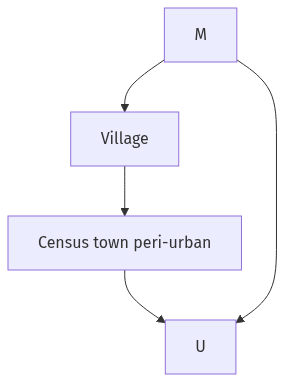
Flow diagram
Conclusion
Rural and urban in India are poles of a continuum of work, kinship, and governance. Census towns, peri-urban NCR, and migrant corridors are the examples that make the concept concrete.
Quick related
Students also ask
-
Elaborate on M.N. Srinivas's structural functionalist approach to the study of Indian society.
Next question on this syllabus topic (2022 · Q1(a)). View answer →
-
If there is a continuum, is the village gone?
No. Agrarian power and kinship still organise large populations. They now sit next to urban work.
-
Is a census town a city?
Functionally it may be. Legally it may still be rural, which is the point of the continuum.
Same topic · past papers
UPSC has asked this before
These previous-year questions sit on the same topic. Open one to practise the earlier ask.
-
2021 · Q2(b) · Sociology GS 2 · 20 marks
Is Indian society moving from "Hierarchy" towards "differentiation" ? Illustrate your answer with suitable examples -
2025 · Q2(a) · Sociology GS 2 · 20 marks
Do you think that in a society like India orthogenetic changes take place through differentiation? Do you observe continuities in the orthogenetic process ? Elaborate your answer with suitable examples -
2025 · Q3(b) · Sociology GS 2 · 20 marks
Do you think that new economic reforms of British rule have disrupted the old economic system of India? Substantiate your answer with suitable examples -
2024 · Q5(a) · Sociology GS 2 · 10 marks
Examine with suitable examples the recent trends in the growth of urban settlements in India. -
2020 · Q6(b) · Sociology GS 2 · 15 marks
Do you think MSP (Minimum Support Price) Scheme for ag can help in rural development? Elaborate your response with suitable examples.
More from this topic
Q5(e) · UPSC Mains 2026 · Sociology GS 2 · 10 marks · Solution
Bring out the debates of 'insiders' and 'outsiders' approaches in understanding Indian society.
Perspectives on the study of Indian society
• The insider (emic) approach studies Indian society using native categories, sacred texts, and cultural immersion, championed by G.S. Ghurye and D.P. Mukerji. • Critics argue the insider view suffers from upper-caste bias and ignores ground realities in favor of normative texts. • The outsider (etic) approach applies universal models and comparative frameworks, famously used by Western scholars like Louis Dumont. • Critics dismiss the outsider view as orientalist reductionism that imposes Western concepts and misinterprets local idioms. • Modern Indian sociology bridges this binary through a reflexive methodology combining cultural familiarity with analytical rigor. • Ultimately, combining native insights with objective scrutiny is essential to capture India's complex social dynamics.
Q5(a) · UPSC Mains 2026 · Sociology GS 2 · 10 marks · Solution
Discuss the challenges faced by the aged people in receiving 'elder care'.
Perspectives on the study of Indian society
• India's aging population faces severe elder care challenges due to the breakdown of traditional joint families and youth out-migration. • Over 80% of seniors lack formal pensions because they worked in the informal sector, worsening financial vulnerability. • High out-of-pocket medical costs for chronic illnesses quickly drain meager personal savings. • Public hospitals suffer from an acute shortage of geriatric specialists, dedicated wards, and rehabilitation facilities. • Implementation of the Maintenance and Welfare of Parents and Senior Citizens Act, 2007 remains weak, leaving legal tribunals overburdened. • Solutions require shifting from a welfare approach to a rights-based framework, combining community care networks with strict legal enforcement under Article 41.
Q4(c) · UPSC Mains 2026 · Sociology GS 2 · 10 marks · Solution
Compare G. S. Ghurye's and A. R. Desai's approaches used in understanding Indian society
Perspectives on the study of Indian society
• **Ghurye’s Indological Approach:** Relied on sacred texts and classical literature to study Indian society through civilizational continuity. • **Core Themes in Ghurye:** Focused on caste, kin, and how Hinduism historically integrated diverse tribal and regional groups. • **Desai’s Materialist Approach:** Rejected textual idealism in favor of Marxist political economy to study social structures. • **Economic Formations:** Analyzed Indian society through successive modes of production—ancient, feudal, and colonial capitalist. • **Caste vs. Class:** Viewed caste and religion as superstructural elements that mask underlying economic exploitation. • **Critique of State and Nationalism:** Argued that the nationalist movement was bourgeois, leaving agrarian inequalities intact post-independence. • **Key Contrast:** Ghurye highlights cultural tradition and integration, while Desai emphasizes economic power and class conflict.