
Revision summary
Common sense is everyday, untested knowledge that naturalises custom and blame. Sociology is related to it because it studies the same lifeworld of meanings. It differs by using systematic concepts, comparison and evidence. Durkheim on suicide and Mills’s sociological imagination show private acts as public patterns. Indian illustrations such as dowry as custom versus patriarchy and property make the contrast concrete. The task is interrogation of common knowledge, not contempt for ordinary people.
Model answer
Copper italics in this answer — like this — are the key facts. Each one is unpacked in the Facts & figures rail.
Introduction
Common sense is the stock of everyday beliefs that people treat as obvious without asking how those beliefs were produced, or whose interest they serve. Sociology is the systematic study of social relationships, using concepts, comparison and evidence rather than proverb. Auguste Comte named the discipline as a science of society, and Emile Durkheim insisted that social facts must be treated as things, not as household wisdom. The two kinds of knowledge are related, but they are not the same.
Body
Common sense as unexamined knowledge
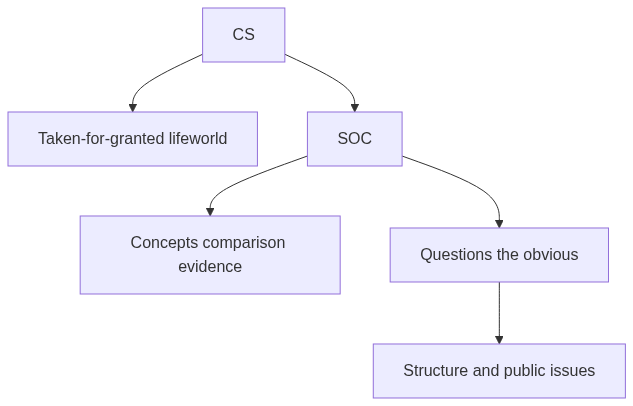
Common knowledge is practical, local and morally loaded. It tells a person how to greet an elder, whom to marry, and why poverty is “laziness” or “fate”. Alfred Schutz called this the taken-for-granted lifeworld: we act first and theorise later. Peter Berger argued that sociology begins by making that lifeworld strange. C. Wright Mills’s sociological imagination asks how a private trouble is also a public issue. Common sense rarely makes that move. It naturalises caste endogamy, women’s unpaid care, or the idea that a government job is the only respectable work.
How sociology is related, and how it differs
Sociology does not float above ordinary life. It starts from common knowledge, because that is where meanings live. Max Weber’s interpretative method takes actors’ reasons seriously. What sociology adds is method. It compares cases, names structures, and allows evidence to embarrass a proverb. Durkheim’s study of suicide showed that a highly personal act varies with religion, family and crisis, which no folk saying about “weak character” can explain. Karl Marx treated “hard work brings success” as ideology when property and class set the odds. Robert Merton distinguished manifest functions that people announce from latent functions they do not see.
In India, common sense may say that dowry is custom. A sociological account follows property, hypergamy and the marriage market, as Uma Chakravarti does with Brahmanical patriarchy. Common knowledge is the raw material; sociology is its disciplined interrogation.
Flow diagram
Conclusion
Common sense and sociology share the same social world, but only sociology treats that world as a problem to be explained. The examiner wants the distinction of method, not a sneer at ordinary people. Good sociology respects everyday meaning and then tests it against structure and evidence.
Quick related
Students also ask
-
Critically analyze the sociological significance of informal sector in the economy of developing societies
Next question on this syllabus topic (2025 · Q4(c)). View answer →
-
Is sociology simply organised common sense?
No. It starts from everyday meanings but uses comparison, concepts and evidence, and it can falsify a proverb.
-
Why mention Schutz or Berger in a short answer?
They name the taken-for-granted world that sociology must make strange, which is the precise relation asked in the question.
Same topic · past papers
UPSC has asked this before
These previous-year questions sit on the same topic. Open one to practise the earlier ask.
-
2021 · Q2(c) · Sociology GS 1 · 10 marks
How is sociology related to common sense ? -
2023 · Q4(a) · Sociology GS 1 · 20 marks
Do you think that common sense is the starting point of social research? What are its advantages and limitations? Explain -
2018 · Q1(a) · Sociology GS 1 · 10 marks
The focal point of sociology rests on interaction. How do you distinguish it from common sense? -
2016 · Q2(c) · Sociology GS 1 · 15 marks
Is sociology common sense? Give reasons in support of your argument.
More from this topic
Q8(c) · UPSC Mains 2026 · Sociology GS 1 · 10 marks · Solution
Discuss the significance and limitations of 'intersectionality' in social research
Sociology
Intersectionality, coined by Kimberlé Crenshaw, examines how overlapping identities like race, class, and gender shape systemic oppression. Its significance in social research lies in capturing lived realities beyond single-axis frameworks and preventing reductive generalisations. However, limitations include methodological complexity, risks of infinite regress, and difficulties in operationalising fluid categories. Effective application requires balancing structural macro-analysis with micro-level lived experiences.
Q6(b) · UPSC Mains 2026 · Sociology GS 1 · 20 marks · Solution
Critically analyse the nature-nurture debate from different perspectives
Sociology
1. The nature-nurture debate explores whether biology or society primarily shapes human behavior
Q6(a) · UPSC Mains 2026 · Sociology GS 1 · 20 marks · Solution
Discuss the intellectual origins of sociology and its evolution as a distinct field of study
Sociology
Sociology arose in 19th-century Western Europe to make sense of massive upheavals caused by the Industrial and French Revolutions. Enlightenment thinkers laid the groundwork by championing reason, empirical observation, and human agency over traditional dogma. Auguste Comte gave the discipline its name, pushing for a positivist "physics of society" based on scientific laws. Émile Durkheim secured its academic legitimacy by defining "social facts" and using empirical methods to study human behavior. Max Weber introduced interpretive sociology, while Karl Marx focused on material conditions and class struggle. In the 20th century, Talcott Parsons advanced structural-functionalism to study systemic equilibrium. Later, conflict theories, the Frankfurt School, and postmodern critiques broadened the field to address power and marginalisation. Today, sociology continues to evolve by analyzing globalisation, digital shifts, and modern identity politics.