
Revision summary
A variable is a property with more than one value across cases. Independent, dependent, intervening and control names mark their role in a design. Stevens’s nominal, ordinal, interval and ratio levels mark how they are measured. Qualitative categories differ from quantitative counts and scales. A worked example is women’s education, fertility, age at marriage and wealth as control. Indian large surveys such as NFHS use this same grammar.
Model answer
Copper italics in this answer — like this — are the key facts. Each one is unpacked in the Facts & figures rail.
Introduction
A variable is a property that can take more than one value across persons, groups or times. Age, caste category, years of schooling, income, religiosity and vote choice are variables; a proper name is not. In social research the point of naming variables is to state a relationship that can be observed, compared and, where appropriate, measured. Without that step, a hypothesis remains a slogan.
Body
Role in the research design
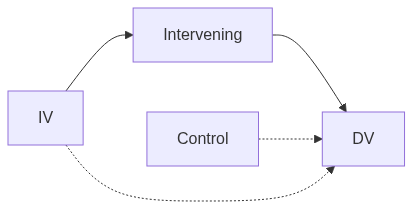
The independent variable is the presumed condition or cause that the researcher treats as input. The dependent variable is the outcome to be explained. An intervening or mediating variable sits on the path between them. A control or extraneous variable is held constant, statistically or by design, so that a spurious link is not mistaken for a cause. Paul Lazarsfeld’s elaboration model taught sociologists to introduce a third variable and see whether the original association survives.
Take literacy and fertility. Education of women may be independent; number of children dependent. Age at marriage and knowledge of contraception may intervene. Rural or urban residence, caste and household wealth are controls. If the education–fertility link vanishes after wealth is controlled, the first story was incomplete.
Types by measurement and nature
Variables are also typed by how they are scaled. S. S. Stevens’s levels remain the classroom kit: nominal (religion, gender as categories), ordinal (class self-placement, Likert agreement), interval and ratio (income, years of schooling, age). Qualitative or categorical variables sort cases; quantitative variables number them. Discrete counts (number of rooms) differ from continuous measures (income). Dummy variables turn a category into 0/1 for regression.
In Indian survey practice, NFHS and NSS/PLFS live on this vocabulary. A researcher who confuses a control with a dependent variable, or treats caste as a ratio scale, has not yet begun valid analysis. Variables are the grammar of hypothesis, sampling and table-making.
Flow diagram
Conclusion
A variable is a varying social property placed in a design as cause, effect, path or control, and scaled as category or number. The examiner wants types with a worked relation, not a dictionary list. Clear variables make reliability and hypothesis testing possible.
Quick related
Students also ask
-
Describe the differing principles of work organization in feudal and capitalist societies.
Next question on this syllabus topic (2024 · Q5(c)). View answer →
-
Is caste a quantitative variable?
Usually it is treated as a nominal or ordinal category. Treating it as a ratio score would be a measurement error.
-
What is an intervening variable?
A factor on the causal path, such as age at marriage between women’s education and fertility.
Same topic · past papers
UPSC has asked this before
These previous-year questions sit on the same topic. Open one to practise the earlier ask.
-
2017 · Q1(c) · Sociology GS 1 · 10 marks
Illustrate with example the significance of variable in sociology research -
2017 · Q1(d) · Sociology GS 1 · 10 marks
Critically analyse Talcott Parsons conception of pattern variable' -
2026 · Q8(c) · Sociology GS 1 · 10 marks
Discuss the significance and limitations of 'intersectionality' in social research -
2025 · Q3(c) · Sociology GS 1 · 10 marks
What is hypothesis? Critically evaluate the significance of hypothesis in social research -
2025 · Q7(a) · Sociology GS 1 · 20 marks
What is sampling in the context of social research? Discuss different forms of sampling with their relative advantages and disadvantages
More from this topic
Q5(c) · UPSC Mains 2024 · Sociology GS 1 · 10 marks · Solution
Describe the differing principles of work organization in feudal and capitalist societies.
Works and Economic Life
Feudal work is tied to land, lord and custom rather than to a free labour market. Surplus is taken through extra-economic power and personal dependence. Capitalist work sells labour power as a commodity under wage and clock. The factory and office separate production from the household. Marx’s modes of production name this contrast of principles. Unfree labour can survive inside capitalism without erasing the type.
Q4(c) · UPSC Mains 2022 · Sociology GS 1 · 15 marks · Solution
What is reliability ? Explain the different tests available to social science researcher to establish reliability.
Works and Economic Life
Reliability is consistency, not truth. Test-retest, parallel forms, split-half, Cronbach’s alpha, and inter-rater agreement are the main tests. Durkheim’s suicide files already needed stable coding. Census definition changes can mimic social change. A reliable scale can still miss Weber’s intended meaning.
Q4(b) · UPSC Mains 2021 · Sociology GS 1 · 20 marks · Solution
How has the idea of Work From Home forced us to redefine the formal and informal organisation of work ?
Works and Economic Life
Formal organisation is the official chart; informal organisation is unwritten practice. WFH moves Weber’s office into dashboards and Mayo’s group into the household. Unpaid care and gig ratings intensify informal extraction. Lockdown split salaried WFH from reverse-migrant informal labour. The split is relocated, not abolished.