
Revision summary
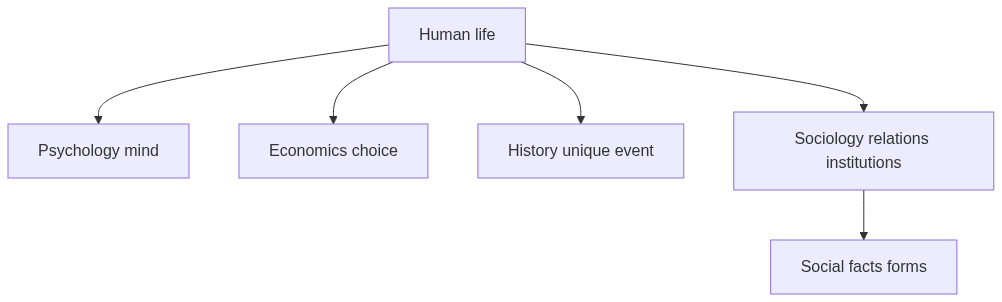
Scope means the distinctive object and questions of a discipline. Sociology’s object is social relationships, institutions and emergent social facts. Durkheim’s sui generis social facts and Simmel’s forms of interaction name that uniqueness. Contrast with psychology, economics, history and common sense clarifies the vantage. Topics such as family or class are shared; the relational cut is not. Indian events can be shared objects; sociology asks how groups and institutions make them.
Model answer
Copper italics in this answer — like this — are the key facts. Each one is unpacked in the Facts & figures rail.
Introduction
The scope of a discipline is the set of questions it can legitimately ask and the kind of object it treats as real. Sociology’s uniqueness is not that it alone studies human beings. Psychology, economics, political science and history do that too. Sociology is unique in taking social relationships, institutions and emergent social facts as its centre, rather than the isolated mind, the market choice, the office of the state, or the unique event.
Body
The social as a distinctive object
- Auguste Comte claimed a new science of society. Emile Durkheim made the claim precise: social facts are external, constraining and general, and they are not reducible to individual psychology. Suicide rates, a currency, a language, or a caste rule exist as a reality sui generis. Georg Simmel located the unique scope in the forms of interaction—conflict, exchange, sociability—that can be compared across contents. Anthony Giddens later said that sociology studies the constitution of society: how structure is produced in action and how action is made possible by structure.
This scope includes family, class, religion, law, education, work, gender and social change, but the uniqueness is the relational question: how are these patterned, reproduced and transformed together? C. Wright Mills’s sociological imagination is a method of using that scope, linking biography to history.
Uniqueness by contrast
Psychology asks about cognition and personality; sociology asks how those are socially distributed and labelled. Economics often models a rational chooser; economic sociology, after Weber and later Granovetter, puts choice back into networks and meanings. History narrates unique sequences; sociology compares types, though historical sociology shares the archive. Common sense naturalises the same world that sociology treats as constructed. The unique scope is therefore a vantage, not a fence around a few topics. In India, a riot, a marriage or a factory strike can be studied by many disciplines; sociology’s cut is group relations, institutions and the production of order and conflict.
Flow diagram
Conclusion
Sociology is unique because it studies society as a level of reality made of relations and institutions, not because it owns a list of chapters. Durkheim’s social facts and Simmel’s forms still name that scope. Other sciences overlap the terrain; they do not replace the relational question.
Quick related
Students also ask
-
Do you think that the formal workspaces are free of gender bias? Argue your case.
Next question on this syllabus topic (2025 · Q5(c)). View answer →
-
Is sociology unique because it is a residual science of leftovers?
No. That old jibe misses the positive object: relational structure and institutions as such.
-
Does uniqueness mean no interdisciplinary work?
No. Uniqueness is a centre of gravity. Historical sociology and economic sociology are still sociology when the question is relational.
Same topic · past papers
UPSC has asked this before
These previous-year questions sit on the same topic. Open one to practise the earlier ask.
-
2022 · Q1(a) · Sociology GS 1 · 10 marks
Delimit the scope of sociology in relation to other social sciences. -
2020 · Q5(a) · Sociology GS 1 · 10 marks
In the context of globalisation, has the scope of sociology been changing India ? Comment.
More from this topic
Q8(c) · UPSC Mains 2026 · Sociology GS 1 · 10 marks · Solution
Discuss the significance and limitations of 'intersectionality' in social research
Sociology
Intersectionality, coined by Kimberlé Crenshaw, examines how overlapping identities like race, class, and gender shape systemic oppression. Its significance in social research lies in capturing lived realities beyond single-axis frameworks and preventing reductive generalisations. However, limitations include methodological complexity, risks of infinite regress, and difficulties in operationalising fluid categories. Effective application requires balancing structural macro-analysis with micro-level lived experiences.
Q6(b) · UPSC Mains 2026 · Sociology GS 1 · 20 marks · Solution
Critically analyse the nature-nurture debate from different perspectives
Sociology
1. The nature-nurture debate explores whether biology or society primarily shapes human behavior
Q6(a) · UPSC Mains 2026 · Sociology GS 1 · 20 marks · Solution
Discuss the intellectual origins of sociology and its evolution as a distinct field of study
Sociology
Sociology arose in 19th-century Western Europe to make sense of massive upheavals caused by the Industrial and French Revolutions. Enlightenment thinkers laid the groundwork by championing reason, empirical observation, and human agency over traditional dogma. Auguste Comte gave the discipline its name, pushing for a positivist "physics of society" based on scientific laws. Émile Durkheim secured its academic legitimacy by defining "social facts" and using empirical methods to study human behavior. Max Weber introduced interpretive sociology, while Karl Marx focused on material conditions and class struggle. In the 20th century, Talcott Parsons advanced structural-functionalism to study systemic equilibrium. Later, conflict theories, the Frankfurt School, and postmodern critiques broadened the field to address power and marginalisation. Today, sociology continues to evolve by analyzing globalisation, digital shifts, and modern identity politics.