
Revision summary
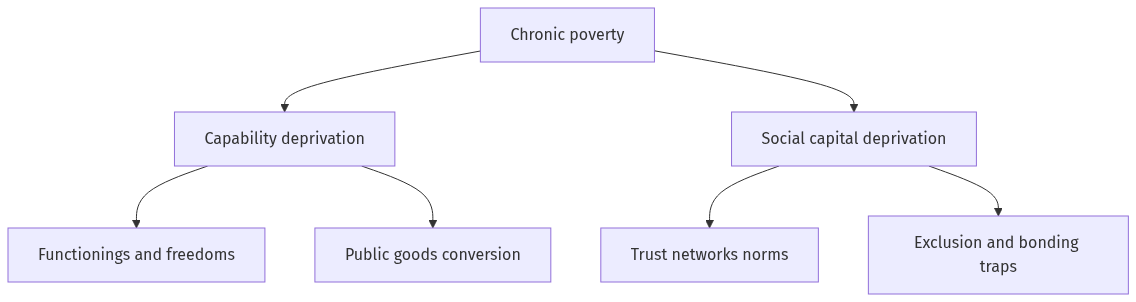
Sen’s approach defines poverty as capability deprivation, not income shortfall alone. Functionings are beings and doings; capabilities are the real set of lives one can choose. Social capital is networks, trust and norms in Coleman, Putnam and Bourdieu, unequally held. Chronic poverty lasts because freedoms stay contracted or because bridges to work and credit stay closed. Dense caste bonding can coexist with capability failure. Indian SHGs, migration networks and multidimensional poverty measures illustrate the comparison.
Model answer
Copper italics in this answer — like this — are the key facts. Each one is unpacked in the Facts & figures rail.
Introduction
Chronic poverty is poverty that lasts across years and often across generations, not a short shock after a drought. Two influential approaches try to say what is missing in such lives. Amartya Sen’s capability approach looks at the real freedoms people have to be and to do what they value. Social capital approaches look at the networks, trust and norms that help people get jobs, credit, care and political voice. They are not rivals in every respect, but they diagnose deprivation differently.
Body
Capability deprivation
Sen, later with Martha Nussbaum in a related philosophical register, shifted poverty studies from income baskets to functionings (being nourished, literate, mobile, respected) and capabilities (the set of lives one could actually choose). A person may have rupees and still be capability-poor if stigma, disability, unsafe streets or missing public health convert money poorly into living. The human development index and the Alkire–Foster multidimensional poverty index operationalise this spirit. Chronic poverty, on this view, is a durable contraction of the capability set: bonded labour, undernutrition of girls, exclusion from school, or living with a disability without assistive public goods. Income poverty lines miss those conversions. Gender and caste enter because conversion factors are social, not only metabolic.
Social capital deprivation
James Coleman treated social capital as obligations, information channels and norms that make action possible. Robert Putnam stressed trust, associations and civic engagement. Pierre Bourdieu treated social capital as actual or potential resources linked to a durable network, unequally distributed like other capitals. Deprivation here means thin or stigmatised networks: migrants without urban kin, Dalit households excluded from dominant-caste labour gangs, women whose mobility is policed so that SHG and market ties never form. Chronic poverty persists when people cannot convert effort into opportunity because the bridges are missing. India’s SHG-bank linkage and Kudumbashree try to manufacture social capital; the limits show when groups remain trapped in low-return activity.
Comparison for chronic poverty
- Capability deprivation is broader and more ethical: it names what a just society owes as freedoms, including health and education as public goods. Social capital deprivation is more relational and can be conservative if “community” is caste closure. A household may have dense bonding capital and still be capability-poor, as in a tightly knit but malnourished hamlet. Conversely, a person with a government job has capabilities partly because of institutionalised social capital. For chronic poverty in India, Sen explains why land, school and clinic matter as freedoms; social capital explains why two equally poor villages diverge when one has ties to a contractor, a party, or a women’s group. A full account uses both: missing freedoms and missing connections.
Flow diagram
Conclusion
Sen locates chronic poverty in lasting unfreedom to live a valued life. Social capital theory locates it in missing or exclusionary networks. They complement each other when networks are treated as one conversion factor among others, not as a substitute for rights, wages and public goods.
Quick related
Students also ask
-
Does the structural-functionalist perspective on social stratification promote a status quo? Give reasons for your answer.
Next question on this syllabus topic (2025 · Q5(b)). View answer →
-
Is social capital always good for the poor?
No. Bonding capital can exclude outsiders and trap people in low-return caste or kin circuits.
-
Does Sen ignore society?
No. Conversion of goods into capabilities is social, which is why caste, gender and public services matter in his framework.
Same topic · past papers
UPSC has asked this before
These previous-year questions sit on the same topic. Open one to practise the earlier ask.
-
2022 · Q7(b) · Sociology GS 1 · 15 marks
Discuss how "environmentalism" can be explained with new social movements approach. -
2021 · Q2(b) · Sociology GS 1 · 20 marks
How far are sociologists justified in using positivist approach to understand social reality ? Explain with suitable illustrations
More from this topic
Q7(b) · UPSC Mains 2026 · Sociology GS 1 · 20 marks · Solution
According to Weber how do class, status and power interact to produce and sustain social inequality?
Stratification and Mobility: Concepts
Max Weber departed from Marx's purely economic view by proposing a multidimensional model of stratification based on class, status, and power. Class operates in the economic order via market situations, producing property and non-property groupings. Status operates in the social order through shared lifestyles, honour, and social esteem, often creating communities. Power operates in the political order through parties and organizational capacity to influence collective outcomes. These three dimensions interact dynamically; economic wealth can convert into social prestige and political influence, reinforcing systemic inequality. While analytically distinct, they frequently overlap to sustain durable structures of stratification in modern societies.
Q5(e) · UPSC Mains 2026 · Sociology GS 1 · 10 marks · Solution
How do different theories explain social dimensions of social movements? Discuss.
Stratification and Mobility: Concepts
• Structural-functionalism views movements as responses to institutional strain and anomie, aiming to restore social equilibrium (e.g., Smelser's value-added theory). • Conflict and Marxist perspectives ground movements in material inequalities and class struggle, helping disadvantaged groups challenge existing power relations. • Resource Mobilization Theory shifts focus from grievances to practical assets like leadership, money, and communication networks. • Rational choice approaches view participation as a calculated decision based on selective incentives rather than just emotional outrage. • Cultural and identity-oriented theories (like New Social Movements) emphasize values, symbols, and lifestyle politics over purely economic demands. • Relational factors highlight how networks, alliances, and political opportunities shape movement emergence and success. • Ultimately, understanding social movements requires combining structural, cultural, and relational perspectives since no single theory explains everything.
Q5(b) · UPSC Mains 2025 · Sociology GS 1 · 10 marks · Solution
Does the structural-functionalist perspective on social stratification promote a status quo? Give reasons for your answer.
Stratification and Mobility: Concepts
Davis and Moore treat unequal rewards as devices to fill important positions. Parsons ties ranking to a shared value system and role allocation. That logic easily sanctifies the present hierarchy as necessary. Tumin asked who defines importance and why talent and reward match so neatly. Unpaid gendered labour and caste inheritance expose the payoff story. Merton’s dysfunctions qualify equilibrium but do not make functionalism a conflict theory.