
Revision summary
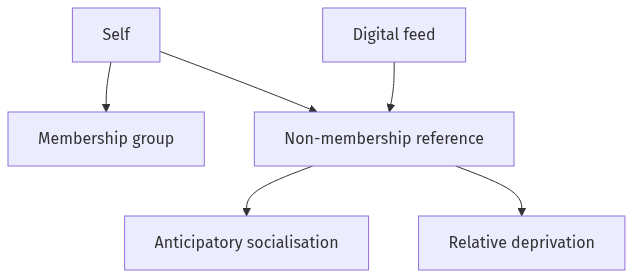
Merton distinguishes membership groups from non-membership reference groups used as standards. Anticipatory socialisation is rehearsal for a group one hopes to join. Relative deprivation is discontent from comparison, not from absolute want. Digital feeds supply global, curated others for identity performance. Indian caste and coaching publics online show membership and aspiration at once. The theory stays relevant because platforms multiply comparative audiences.
Model answer
Copper italics in this answer — like this — are the key facts. Each one is unpacked in the Facts & figures rail.
Introduction
- Robert K. Merton’s reference group theory asks a simple question: with whom do people compare themselves when they judge who they are and what they deserve? The group need not be one they belong to. In a digital world the comparative other is often a feed of strangers, influencers and curated peers. Identity making online is therefore a Mertonian process of selection, anticipation and relative deprivation, not only a story about gadgets.
Body
Merton’s kit
- A membership group is one the person actually belongs to: a college, a caste association, a workplace. A non-membership reference group is one used as a standard anyway: the civil-service batch one hopes to join, a global lifestyle class seen on Instagram. Anticipatory socialisation is the rehearsal of that group’s tastes and morals before entry, which Merton linked to mobility. Relative deprivation, developed with the American soldier studies and later with W. G. Runciman, is discontent produced by comparison, not by absolute lack. Positive reference groups attract; negative ones are the “not us” against which identity is drawn. George Herbert Mead’s significant others and Erving Goffman’s presentation of self sit beside Merton: identity is always audience-facing.
Digital identity making
Platforms multiply audiences and collapse them. A student in a small town can take a Korean pop fandom, a Delhi coaching-centre aesthetic, or a Silicon Valley founder as a non-membership reference group. Filters, follower counts and “stories” are props for anticipatory socialisation into a desired class or gender performance. Relative deprivation becomes chronic when the comparison set is global and edited. Caste and religious WhatsApp groups work as membership references that police honour, marriage and rumour. Hashtag publics can be negative reference groups for those who define themselves against “woke” or against “tradition”.
- Merton already warned that the wrong reference group can produce anomie: goals are copied without the legitimate means. Digital identity making shows that pattern at speed. The theory remains relevant because it names the comparative mechanism; the platforms only enlarge the menu of others.
Flow diagram
Conclusion
Merton’s reference groups, anticipatory socialisation and relative deprivation travel well into the digital world. Identity online is made by choosing audiences and measuring the self against them. The screen did not abolish the social psychology of comparison; it intensified it.
Quick related
Students also ask
-
Highlight the main features of historical materialism as propounded by Marx. How far is this theory relevant in understanding contemporary societies? Explain
Next question on this syllabus topic (2025 · Q2(b)). View answer →
-
Must a reference group be a real community?
No. Merton allowed non-membership and even imaginary or statistical others. A digital following can serve that role.
-
Is this only about youth and Instagram?
No. WhatsApp caste groups, professional LinkedIn selves and diaspora feeds are the same comparative mechanism.
Same topic · past papers
UPSC has asked this before
These previous-year questions sit on the same topic. Open one to practise the earlier ask.
-
2022 · Q6(b) · Sociology GS 1 · 15 marks
Analyse the nature of transition from ideology to identity politics in India.
More from this topic
Q7(c) · UPSC Mains 2026 · Sociology GS 1 · 10 marks · Solution
Compare the social organisation of work in industrial capitalism and platform capitalism
Sociological Thinkers: Karl Marx
• **Setting:** Industrial capitalism centres work in physical factories; platform capitalism disperses it via digital apps. • **Control:** Factories use direct managerial supervision and time-discipline; platforms use invisible algorithms and automated ratings. • **Contracts:** Industrial work relies on standard, secure employment with welfare benefits; platform work relies on gig contracts and independent contractors. • **Risk:** Factories shoulder capital costs; platform capitalism shifts risks and equipment costs onto individual workers. • **Solidarity:** Shared factory spaces foster collective class consciousness; digital isolation creates an atomised "precariat." • **Surplus Value:** Both systems extract surplus value, but platforms obscure exploitation behind the illusion of entrepreneurial freedom.
Q5(d) · UPSC Mains 2026 · Sociology GS 1 · 10 marks · Solution
How does Max Weber's 'theory of authority' shape bureaucracy? Analyse.
Sociological Thinkers: Karl Marx
Max Weber's sociological framework links different forms of legitimate domination directly to the rise of modern rational-legal bureaucracy. Traditional and charismatic authority provide historical context, but rational-legal authority creates the impersonal rules, hierarchy, and technical expertise defining bureaucratic structures. While ensuring efficiency, this iron cage of rationalisation also poses risks of alienation and goal displacement, which later thinkers critiqued.
Q3(c) · UPSC Mains 2026 · Sociology GS 1 · 10 marks · Solution
How does Emile Durkheim conceptualize religion as a 'social fact'? Explain
Sociological Thinkers: Karl Marx
Emile Durkheim treats religion as a quintessential social fact in 'The Elementary Forms of the Religious Life' (1912). Moving away from supernatural or animistic definitions, he argues that religion is fundamentally a collective product. Society objectifies its own moral authority and solidarity through sacred symbols and rituals. By separating the sacred from the profane, religious practices reinforce social integration and collective consciousness. Thus, religion is society worshipping itself, operating as an external and coercive constraint upon individual thought and action.